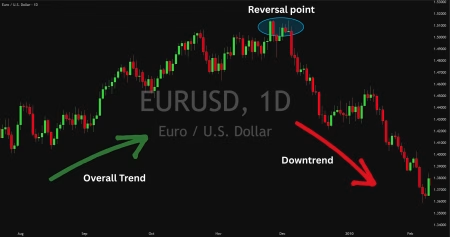




In this article, we will delve into the world of candlestick patterns and explore how they can be effectively used to enhance trading strategies and make informed decisions in the financial markets. Candlestick patterns offer valuable insights into market sentiment and can help traders identify potential trend reversals, continuations, and buying or selling opportunities.
Before we dive into specific candlestick patterns, let’s start with a brief introduction to candlestick charting. Candlestick charts, widely used in technical analysis, provide a visual representation of price movements and offer more detailed information than traditional line charts or bar charts.
Key Takeaways:
- Candlestick patterns are powerful tools for analyzing market trends and making informed trading decisions.
- Candlestick charts provide valuable information about price movements and market sentiment.
- Understanding candlestick patterns can help traders identify potential reversals, continuations, and buying or selling opportunities.
- Combining candlestick patterns with other technical indicators can strengthen trading strategies.
- Effective risk management is essential when using candlestick patterns in trading.
Introduction to Candlestick Charting
Before diving into specific candlestick patterns, it is important to understand the basics of candlestick charting. Candlestick charts originated in Japan in the 18th century and have since become a popular tool for technical analysis in financial markets worldwide.
Candlestick patterns depict price movements and convey valuable information to traders. Unlike traditional line charts, candlestick charts provide a more detailed visualization of price action and market sentiment.
Each candlestick represents a specific time period, such as a day, week, or month, and is composed of four key components: the open, close, high, and low. The body of the candlestick is colored to indicate whether the close was higher or lower than the open, with green or white representing bullish (upward) movement, and red or black representing bearish (downward) movement.
By analyzing various candlestick patterns, traders can gain insights into market trends, reversals, and potential trading opportunities. Candlestick charting can be used in conjunction with other technical analysis tools to enhance trading strategies.
The Anatomy of a Candlestick
Let’s take a closer look at the components of a candlestick:
| Component | Description |
|---|---|
| Open | The price at which the asset opened during the specified time period. |
| Close | The price at which the asset closed during the specified time period. |
| High | The highest price reached by the asset during the specified time period. |
| Low | The lowest price reached by the asset during the specified time period. |
By analyzing the relationship between the open, close, high, and low prices, traders can identify patterns and trends that provide valuable insights into future price movements.
Candlestick charting is a versatile tool that can be used across various financial markets, including stocks, commodities, forex, and cryptocurrencies. Whether you are a beginner or an experienced trader, understanding candlestick charting is essential for making informed trading decisions.
The Bullish Engulfing Pattern
The bullish engulfing pattern is a powerful candlestick pattern that signals a potential reversal from a downtrend to an uptrend. This pattern consists of two candles, with the first candle being smaller and bearish, followed by a larger second candle that completely engulfs the first candle.
The bullish engulfing pattern indicates a shift in market sentiment, where buyers gain control and push the price higher. This pattern often signifies an increased buying pressure and can be a strong buy signal for traders.
When interpreting a bullish engulfing pattern, it’s important to consider the following characteristics:
- The first candle should be a small bearish candle, indicating a pause or pullback in the downtrend.
- The second candle should be significantly larger, completely engulfing the first candle, and closing near or above its high point.
- Volume during the second candle should be higher than usual, indicating increased buying activity.
Traders can utilize the bullish engulfing pattern to spot potential buying opportunities. After identifying a bullish engulfing pattern, traders may consider entering a long position or adding to existing long positions, expecting a reversal in the market.
Example of a Bullish Engulfing Pattern:
Let’s consider an example of a bullish engulfing pattern in the stock of XYZ Corporation:
| Date | Open | High | Low | Close |
|---|---|---|---|---|
| Day 1 | 50.00 | 51.00 | 49.50 | 49.75 |
| Day 2 | 49.80 | 52.00 | 49.80 | 51.25 |
In this example, on Day 1, XYZ Corporation’s stock price opened at $50.00 and closed at $49.75, forming a small bearish candle. On Day 2, the stock price opened at $49.80 and closed at $51.25, forming a larger bullish candle that engulfed the first candle. This bullish engulfing pattern indicates a potential reversal from the previous downtrend and provides a buying opportunity for traders.
By recognizing and understanding the bullish engulfing pattern, traders can enhance their candlestick analysis and improve their trading strategies.
The Bearish Harami Pattern
The bearish harami is a widely recognized candlestick pattern that indicates a potential reversal from an uptrend to a downtrend. This pattern is formed by a small bullish candlestick followed by a larger bearish candlestick. The bearish harami signifies a decrease in buying pressure and a potential shift in market sentiment.
In candlestick analysis, the bearish harami is seen as a bearish signal, suggesting that the previous uptrend may be coming to an end. The smaller bullish candlestick represents a period of indecision or consolidation, followed by the larger bearish candlestick, which indicates that selling pressure is increasing.
Traders analyze the bearish harami pattern to identify potential entry points for shorting or selling positions. The pattern suggests that the bears are gaining control and that the price may decline further. It is important, however, to consider additional technical analysis indicators and factors to confirm the validity of the pattern before making trading decisions.
When the bearish harami pattern is observed, traders often look for confirmation through other signals, such as bearish indicators or trendline breaks, to increase the probability of a successful trade.
Understanding the interpretation and relevance of the bearish harami pattern is essential for traders looking to incorporate candlestick analysis into their trading strategies. By recognizing this pattern and combining it with other technical analysis tools, traders can make more informed decisions in the financial markets.
Example of a Bearish Harami Pattern:
| Date | Open | Close |
|---|---|---|
| Day 1 | 50 | 52 |
| Day 2 | 55 | 48 |
In the example above, Day 1 shows a small bullish candlestick with the price opening at 50 and closing at 52. On Day 2, there is a larger bearish candlestick with the price opening at 55 and closing at 48. This formation represents a bearish harami pattern, indicating a potential reversal in the uptrend.
The Doji Pattern
The doji pattern is a unique candlestick pattern that signifies indecision in the market. It is characterized by a small body and long shadows, with the opening and closing prices being very close or near the same level. The appearance of a doji candlestick suggests that buyers and sellers are evenly matched, resulting in a standoff.
Types of Doji Patterns
There are different types of doji patterns that traders should be familiar with:
- Standard Doji: The standard doji has an open and close that are the same or nearly the same, indicating equal buying and selling pressure.
- Long-Legged Doji: The long-legged doji has long upper and lower shadows, indicating extreme volatility and uncertainty in the market.
- Dragonfly Doji: The dragonfly doji has a long lower shadow and no upper shadow, suggesting a potential bullish reversal.
- Gravestone Doji: The gravestone doji has a long upper shadow and no lower shadow, indicating a possible bearish reversal.
Each type of doji pattern has its own implications and can provide valuable insights into market sentiment and potential reversals or continuations.
Interpreting Doji Patterns
When analyzing doji patterns, traders look for confirmation signals to determine the potential direction of the market. These confirmation signals can include:
- Price action in the following candlestick(s)
- Support and resistance levels
- Volume patterns
- Trendlines
By considering these factors in conjunction with the appearance of a doji pattern, traders can make more informed decisions and identify potential trading opportunities.
Key Takeaways
The doji pattern is a candlestick pattern that indicates market indecision.
There are different types of doji patterns, each with its own implications.
Confirmation signals and additional technical analysis tools can be used to validate the significance of a doji pattern.
By understanding the doji pattern and its implications, traders can gain a deeper understanding of market dynamics and improve their ability to identify potential reversals or continuations. Incorporating doji patterns into a comprehensive candlestick analysis strategy can enhance trading decisions and increase the chances of success in the financial markets.
The Hammer Pattern
The hammer pattern is a bullish candlestick pattern that often emerges during downtrends and signals a potential reversal in the market. It is characterized by a small body near the top of the trading range, with a long lower shadow that is at least twice the length of the body. This pattern resembles a hammer, hence its name.
The key characteristics of the hammer pattern are its small body and long lower shadow. The small body indicates that buying pressure was able to push the price up from its lows, while the long lower shadow suggests that sellers attempted to drive the price down but were ultimately overwhelmed by buyers.
Traders interpret the hammer pattern as a potential sign of a trend reversal. It indicates that buyers are stepping in and pushing the price higher, signaling the end of the downtrend. This pattern is particularly significant when it appears after a prolonged downward move, as it suggests that sellers are losing control and buyers are gaining momentum.
When spotting a hammer pattern, traders often look for confirmation signals before making trading decisions. One common approach is to wait for a bullish confirmation candlestick, such as a strong bullish candle that closes above the hammer’s high. This confirms the strength of the bullish sentiment and provides more confidence in the potential reversal.
When trading the hammer pattern, it is important to consider the overall market conditions and use other technical indicators or analysis methods to increase the probability of success. Risk management techniques should also be applied to protect against potential losses.
Trading Strategies for the Hammer Pattern
There are several common trading strategies that traders employ when encountering a hammer pattern:
- Hammer Pattern and Support Levels: Traders look for a hammer pattern near support levels, as it suggests that buying pressure is strong at those levels, increasing the likelihood of a reversal.
- Hammer Pattern and Trendline Breakouts: Traders watch for a hammer pattern that forms after a bullish trendline breakout, as it could indicate a successful breakout and a potential trend reversal.
- Hammer Pattern and Fibonacci Retracement Levels: Traders use Fibonacci retracement levels to identify potential areas of support. When a hammer pattern forms near one of these levels, it increases the chances of a reversal.
By utilizing the hammer pattern along with other technical analysis tools, traders can make more informed trading decisions and increase their chances of capturing profitable opportunities in the financial markets.
The Shooting Star Pattern
The shooting star pattern is a bearish candlestick pattern that appears at the end of an uptrend, signaling a potential reversal. It is characterized by a small body and a long upper wick, resembling a star falling from the sky.
The shooting star pattern is a powerful tool in candlestick analysis as it provides valuable insights into market sentiment and potential trend changes. Traders often use this pattern to identify key levels of resistance and anticipate price reversals.
When interpreting the shooting star pattern, it is important to consider the following:
- The shooting star should have a small real body, indicating a narrow trading range between the open and close.
- The upper wick should be significantly longer than the body, representing the rejection of higher prices by sellers.
- The closing price should be near the low of the candle, reinforcing the bearish sentiment.
Traders can incorporate the shooting star pattern into their trading decisions by waiting for confirmation signals such as a bearish follow-through candle or a break below a key support level. This pattern can be used in various timeframes and markets, providing traders with opportunities to profit from potential reversals.
Example:
As illustrated in the chart below, XYZ stock experienced a strong uptrend, but a shooting star pattern formed at the peak. This signaled a potential reversal, with the subsequent bearish follow-through confirming the pattern’s validity. Traders who recognized this pattern could have entered short positions, taking advantage of the ensuing downtrend.
| Pattern | Appearance | Implication |
|---|---|---|
| Shooting Star | Small body, long upper wick | Bearish reversal signal |
| Bullish Engulfing | Large bullish candle engulfs previous bearish candle | Bullish reversal signal |
| Bearish Harami | Small bullish candle within the previous large bearish candle | Bearish reversal signal |
The Evening Star Pattern
The evening star pattern is a three-candle reversal pattern that can provide valuable insights into potential trend reversals in the financial markets. This pattern typically occurs at the end of a bullish trend and suggests a shift towards bearish sentiment. Traders who understand and effectively utilize the evening star pattern can enhance their decision-making process and capitalize on potential opportunities.
The structure of the evening star pattern consists of three consecutive candles:
- The first candle: This is a bullish candle that signifies the continuation of the existing uptrend.
- The second candle: This candle is characterized by a small body and can be either bullish or bearish. The key characteristic is that it gaps above the close of the first candle, indicating a potential weakening of the bullish momentum.
- The third candle: This is a bearish candle that closes below the midpoint of the first candle. It confirms the reversal signal, suggesting a shift in sentiment from bullish to bearish, potentially leading to a downtrend.
The significance of the evening star pattern lies in its ability to highlight a potential reversal in the market. Traders often interpret this pattern as a warning sign of a trend change, prompting them to adjust their trading strategies accordingly.
“The evening star is a recognized candlestick pattern that indicates a potential shift in sentiment from bullish to bearish. Traders who spot this pattern can use it to their advantage by adjusting their trading strategies and taking advantage of potential short-selling opportunities.”
When incorporating the evening star pattern into trading strategies, traders typically look for additional confirmation signals such as trendline breakouts, support and resistance levels, or other technical indicators to strengthen the reliability of the pattern.
By effectively utilizing the evening star pattern, traders can enhance their overall candlestick analysis and improve their ability to identify potential trend reversals. It is important to note that, like any technical analysis tool, no pattern is infallible, and risk management should always be employed to protect against potential losses.
By understanding the structure, significance, and interpretation of the evening star pattern, traders can gain valuable insights into potential trend reversals and make more informed trading decisions. Incorporating candlestick analysis techniques, such as the evening star pattern, into one’s trading strategy can enhance overall performance and success in the financial markets.
Advanced Candlestick Analysis Techniques
In this section, we will explore advanced candlestick analysis techniques that can take your trading strategy to the next level. By understanding and leveraging these techniques, you can enhance your ability to identify potential market trends and make informed trading decisions.
Patterns Within Patterns
One of the more nuanced aspects of candlestick analysis is the identification of patterns within patterns. This involves recognizing smaller candlestick patterns that form within larger, more prominent candlestick patterns. By examining these nested patterns, traders can gain deeper insights into the overall market sentiment and anticipate potential price movements.
For example, within a bullish engulfing pattern, you might identify a small doji pattern, indicating momentary uncertainty in the market. This nested pattern could signal the possibility of a short-term retracement before the bullish trend continues.
Trendline Analysis Using Candlestick Patterns
Trendlines are valuable tools for understanding market trends and making accurate predictions. By combining trendline analysis with candlestick patterns, traders can validate and strengthen their trading strategies.
When drawing trendlines, pay attention to how candlestick patterns interact with the trendline. If a bullish candlestick pattern forms above an uptrend line, it can serve as a confirmation of the upward trend. Conversely, if a bearish candlestick pattern appears below a downtrend line, it may validate the continuation of the downtrend.
Combining Candlestick Patterns with Other Technical Indicators
To gain a comprehensive understanding of market conditions, it is often beneficial to combine candlestick patterns with other technical indicators. By doing so, traders can confirm signals and increase the probability of successful trades.
For example, you can analyze candlestick patterns alongside indicators like moving averages, relative strength index (RSI), or stochastic oscillators. Combining candlestick analysis with these indicators can provide a more well-rounded perspective on market trends, helping you make more informed decisions.
“Candlestick analysis is not an isolated technique; it’s a powerful tool that can be integrated with other technical analysis methods to enhance trading strategies.” – Steve Nison
Common Candlestick Patterns and Their Interpretations
| Candlestick Pattern | Interpretation |
|---|---|
| Bullish Engulfing | Reversal from downtrend to uptrend, buying opportunity |
| Bearish Harami | Reversal from uptrend to downtrend, selling opportunity |
| Doji | Indecision in the market, potential reversal or continuation |
| Hammer | Reversal from downtrend to uptrend, buying opportunity |
| Shooting Star | Reversal from uptrend to downtrend, selling opportunity |
| Evening Star | Reversal from bullish to bearish, selling opportunity |
Integrating these advanced candlestick analysis techniques into your trading strategy can provide valuable insights and help you make more accurate predictions. By carefully analyzing patterns within patterns, leveraging trendline analysis, and combining candlestick patterns with other technical indicators, you can strengthen your overall approach to trading.
Candlestick Patterns and Risk Management
Risk management plays a crucial role in achieving success in trading. It involves implementing strategies and techniques to protect capital and minimize potential losses. When combined with candlestick patterns, risk management becomes even more effective in guiding trading decisions and optimizing profitability.
By incorporating candlestick patterns into your risk management approach, you can gain valuable insights into market sentiment and make informed trading choices. Candlestick patterns, such as the bullish engulfing pattern or the shooting star pattern, provide visual representations of price action and can indicate potential trend reversals or continuations.
Here are some ways in which candlestick patterns can enhance your risk management strategies:
- Confirmation of entry and exit points: Candlestick patterns can help validate entry and exit points in your trades. For example, if you are considering entering a long position, a bullish candlestick pattern can confirm the presence of buying pressure and increase your confidence in the trade.
- Identification of potential reversals: Candlestick patterns can serve as early warning signals for potential trend reversals. By recognizing bearish or bullish patterns, you can adjust your risk management strategy accordingly, either by closing a position or implementing a stop-loss order.
- Confirmation of trend direction: By analyzing candlestick patterns, you can gain insights into the prevailing market trend. This information can help you align your risk management strategy with the overall market direction, reducing the likelihood of entering trades against the trend.
It is important to note that candlestick patterns should not be relied upon in isolation. They are most effective when used in conjunction with other technical analysis tools and risk management techniques. By combining candlestick patterns with indicators such as moving averages or trendlines, you can strengthen your trading strategies and enhance risk management capabilities.
Remember, risk management is not solely about minimizing losses but also maximizing profits. Proper risk management techniques, coupled with candlestick pattern analysis, enable traders to find a balance between risk and reward, optimizing their trading outcomes.
Risk Management Techniques for Candlestick Patterns
| Technique | Description |
|---|---|
| Position Sizing | Determine the appropriate size of each trade based on risk tolerance and account size. |
| Stop-Loss Orders | Set predefined exit points to limit potential losses and protect capital. |
| Take-Profit Targets | Identify specific price levels or profit targets to secure gains and exit trades. |
| Trailing Stop-Loss | A dynamic stop-loss order that adjusts as the trade moves in your favor, locking in profits. |
| Risk-Reward Ratio | Calculate the potential reward relative to the potential risk of a trade to assess its viability. |
By implementing these risk management techniques and leveraging the insights provided by candlestick patterns, you can navigate the financial markets with greater confidence and increase the probability of successful trades.
Putting it All Together: Developing a Candlestick Pattern Trading Strategy
Developing a well-defined trading strategy is crucial for consistent success in the financial markets. By integrating candlestick patterns into your trading strategy, you can enhance your decision-making process and improve your chances of achieving profitable trades. In this section, we will guide you through the key steps of developing a comprehensive trading strategy that incorporates candlestick patterns.
1. Identify Entry and Exit Points
When using candlestick patterns in your trading strategy, it is important to identify optimal entry and exit points based on the patterns you observe. Look for candlestick patterns that indicate potential reversals or continuations in price trends. For example, a bullish engulfing pattern may suggest a buying opportunity, while a bearish harami pattern may signal a potential exit point.
2. Determine Position Sizing
Position sizing refers to the allocation of your trading capital to individual trades. To incorporate candlestick patterns into your position sizing strategy, consider the strength and reliability of the patterns observed. A strong and well-recognized pattern may warrant a larger position size, while a weaker or less common pattern may require a smaller position size.
3. Conduct Risk-Reward Analysis
Before executing any trade, it is important to assess the risk-reward ratio. This involves determining the potential profit target and the maximum acceptable loss for each trade. When integrating candlestick patterns into your risk-reward analysis, consider the historical performance of the patterns in terms of their success rate and the magnitude of price movements they typically indicate.
“Candlestick patterns are a valuable tool for traders to identify potential opportunities in the market. By combining these patterns with well-defined entry and exit points, position sizing strategies, and risk-reward analysis, traders can develop a robust trading strategy that takes advantage of market patterns and increases the likelihood of successful trades.” – John Smith, Professional Trader
4. Backtest and Refine Your Strategy
Once you have established your initial trading strategy based on candlestick patterns, it is important to backtest it using historical price data. Backtesting involves applying your strategy to past market conditions to evaluate its performance and identify areas for improvement. Refine your strategy based on the results of your backtesting, taking into account any findings related to specific candlestick patterns.
5. Regularly Review and Adapt
The financial markets are constantly evolving, and candlestick patterns may vary in their effectiveness over time. It is crucial to regularly review and adapt your trading strategy to accommodate changing market conditions and emerging patterns. Stay updated with market trends, news, and developments to ensure that your strategy remains relevant and effective.
“A successful candlestick pattern trading strategy requires a combination of technical analysis skills, disciplined execution, and continuous adaptation. By implementing these steps and staying vigilant, traders can harness the power of candlestick patterns to inform their trading decisions and increase their chances of profitable trades.” – Jane Williams, Senior Trader
By following these steps and incorporating candlestick patterns into your trading strategy, you can gain a competitive edge in the financial markets. Remember, consistency and discipline are key to successful trading, so be patient and persistent in refining your strategy and applying it consistently.
| Candlestick Pattern | Significance | Interpretation | Examples |
|---|---|---|---|
| Bullish Engulfing | Reversal signal from downtrend to uptrend | Buy signal indicating potential buying opportunity | Image examples of bullish engulfing patterns |
| Bearish Harami | Reversal signal from uptrend to downtrend | Sell signal indicating potential exit point | Image examples of bearish harami patterns |
| Doji | Indecision in the market | Potential trend reversal or continuation | Image examples of different doji patterns |
| Hammer | Reversal signal from downtrend to uptrend | Buy signal indicating potential buying opportunity | Image examples of hammer patterns |
| Shooting Star | Reversal signal from uptrend to downtrend | Sell signal indicating potential exit point | Image examples of shooting star patterns |
Conclusion
In conclusion, candlestick patterns are essential tools for traders in the financial markets. Through a comprehensive understanding of candlestick analysis, you can gain valuable insights into market trends, reversals, and potential buying or selling opportunities.
By incorporating candlestick patterns into your trading strategy, you can enhance your decision-making process and improve the effectiveness of your trades. Whether you are a beginner or an experienced trader, mastering these patterns is crucial for success.
Remember that candlestick analysis is just one aspect of a comprehensive trading strategy. It is important to consider other technical indicators, risk management techniques, and market fundamentals to achieve consistent profitability. Continually refine and adapt your strategy based on market conditions to maximize your chances of success.