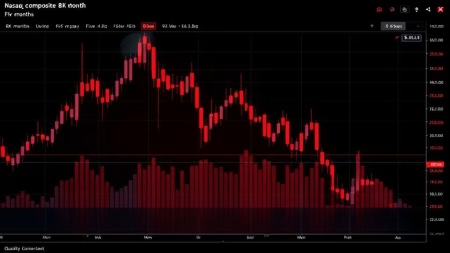


EUR/JPY Report 2025
The EUR/JPY report (currency pair), which represents the exchange rate between the euro and the Japanese yen, remains one of the more actively traded pairs in the forex market. This pair reflects the economic and monetary dynamics between the Eurozone and Japan, two of the largest global economies. As of recent trading sessions in May 2025, EUR/JPY has demonstrated relative strength, with the euro maintaining a bullish bias against the yen. Several macroeconomic and technical factors contribute to this trend, and understanding these drivers is essential for both short-term traders and long-term investors.
One of the key factors influencing the EUR/JPY pair is the divergence in monetary policy between the European Central Bank (ECB) and the Bank of Japan (BoJ). The ECB has gradually shifted from its ultra-loose monetary stance and is signaling a readiness to raise interest rates further to combat persistent inflationary pressures within the Eurozone. Consumer prices across member countries have remained stubbornly above the ECB’s target of 2%, leading to continued hawkish rhetoric from top officials. The ECB’s latest meeting minutes revealed concerns about second-round effects and a willingness to maintain tighter financial conditions until inflation is convincingly subdued.
Conversely, the Bank of Japan has remained relatively dovish. Despite recent discussions around yield curve control and potential normalization, the BoJ has been cautious in adjusting its policy tools. Inflation in Japan has picked up in recent months, largely due to higher import costs and energy prices, but it has not reached the levels observed in Europe or the United States. As a result, the BoJ continues to maintain negative interest rates and yield curve control to support the fragile recovery. This divergence in interest rates – with European rates rising and Japanese rates staying near zero or negative – continues to weigh on the yen and supports the upward trajectory of the EUR/JPY pair.
From a macroeconomic perspective, the Eurozone’s relative economic resilience also supports euro strength. Although growth has slowed due to higher borrowing costs and geopolitical uncertainties, including the ongoing effects of the Russia-Ukraine conflict, key economies like Germany and France have shown signs of stabilizing industrial output and consumer sentiment. Moreover, robust labor markets across much of the Eurozone provide additional support to domestic consumption, further strengthening the euro’s fundamentals.
In contrast, Japan’s economy faces unique challenges. While the country has emerged from the pandemic era with increased tourism and a weaker yen boosting exports, structural issues persist. An aging population, stagnant wage growth, and a reliance on imports for energy and food products limit domestic economic momentum. The yen, traditionally seen as a safe-haven currency, has lost some of its appeal amid global risk appetite and the yield advantage held by other major currencies. Investors seeking yield have continued to move funds out of the yen into higher-yielding currencies, such as the euro, further amplifying the EUR/JPY rally.
Technical analysis of the EUR/JPY pair suggests that bullish momentum remains intact. The pair has consistently traded above key moving averages such as the 50-day and 200-day simple moving averages, signaling a strong uptrend. Resistance levels are being tested near multi-year highs, and unless significant macroeconomic surprises emerge, the pair appears poised to retest or even break above previous resistance zones. Momentum indicators such as the Relative Strength Index (RSI) and Moving Average Convergence Divergence (MACD) show sustained buying pressure, although some short-term overbought conditions may prompt temporary pullbacks.
Geopolitical risks also play a role in shaping EUR/JPY movements. The ongoing conflict in Eastern Europe, tensions in the Middle East, and trade disputes between major global economies can all shift investor sentiment rapidly. However, unless these events create a broad risk-off environment that favors safe-haven assets like the yen, the broader bias remains in favor of euro strength. Any escalation in geopolitical tensions would likely lead to temporary yen appreciation due to its historical role as a risk-averse asset, but such gains may be limited unless accompanied by a shift in BoJ policy.
Looking ahead, traders and investors will closely monitor upcoming economic releases and central bank communications. Key data to watch include Eurozone inflation reports, GDP growth figures, and employment data, as well as Japan’s inflation, trade balance, and BoJ meeting summaries. Market participants will be particularly sensitive to any signals from the BoJ about potential changes in yield curve control or rate policy. Any indication that the BoJ may move toward normalization could result in yen strength and a correction in EUR/JPY.
In conclusion, the EUR/JPY pair reflects a complex interplay of monetary policy divergence, economic fundamentals, and geopolitical considerations. The euro’s strength is underpinned by the ECB’s tightening stance and relative economic stability, while the yen’s weakness stems from continued policy accommodation by the BoJ and structural economic challenges in Japan. Technical and fundamental indicators both support a bullish outlook for EUR/JPY in the near term, although volatility driven by central bank decisions or geopolitical surprises remains a possibility. As such, traders are advised to stay alert to policy shifts and economic data releases that could influence this high-profile currency pair.
For more updates, visit https://tradingmarketsignals.com/