

China manufacturing PMI analysis January 2026 shows a second consecutive month of expansion at 50.3, up from December’s 50.1, signaling fragile but positive momentum in the world’s second-largest economy.
China Manufacturing PMI Analysis January 2026 – Market Overview
The RatingDog China General Manufacturing PMI edged up to 50.3 in January 2026, marking a 0.2-point improvement from December and staying above the critical expansion threshold. This reading represents the highest level since September 2025, when the index last touched 50.6. Compared to January 2025’s contractionary 49.2, the current figures suggest gradual stabilization.
Output growth accelerated to 51.1 (seasonally adjusted) from 50.8 last month, while new orders climbed to 50.7 versus 50.4 in December. The most dramatic improvement came in export orders, which jumped 1.3 points to 51.4 after dipping to 49.8 in Q4 2025. Southeast Asian demand accounted for 63% of the export rebound, according to survey respondents.
Traders may also want to review Gold Price Analysis Today: $5,000 Critical Bearish Plunge Warning.
However, the recovery remains uneven – input prices surged 2.8% month-over-month, the fastest pace since September 2025, while output prices rose for the first time in 14 months. Business confidence deteriorated to 58.2, the lowest since April 2025, as 72% of firms cited margin pressures from rising metal and energy costs.
Fundamental Analysis and Key Drivers
The January 2026 PMI improvement reflects three key dynamics: regional export demand, inventory restocking, and selective policy support. Southeast Asian orders grew at a 6.2% annualized pace, offsetting stagnant EU and North American demand, Bloomberg reports. The ASEAN-China Free Trade Area upgrades implemented in Q3 2025 now cover 92% of tariff lines. As Reuters reports.
Domestically, the People’s Bank of China maintained its benchmark Loan Prime Rate at 3.45% on January 22, but injected ¥800 billion via targeted MLF operations for manufacturing SMEs. This follows December 2025’s ¥1 trillion special sovereign bond issuance for industrial upgrading. Reuters analysis suggests these measures boosted working capital for 41% of surveyed firms.
For more insights, see our coverage on USD Forecast January 2026: Critical Bearish Plunge Warning.
Commodity markets pose the largest risk – Shanghai rebar futures hit ¥4,120/ton on January 28, up 18% from Q4 2025 lows. Aluminum premiums reached $380/ton due to Guinea bauxite disruptions. These inputs account for 22-35% of production costs across machinery, electronics, and construction materials sectors.
Technical Analysis and Macro Implications
The PMI’s 50.3 print clears immediate resistance at 50.2 (December high), with next upside targets at 50.8 (September 2025 peak) and 51.4 (June 2025 swing high). Support holds at 49.9 (current 50-day moving average) and 49.6 (November-December 2025 double bottom).
RSI momentum reads 56.4 – neither overbought nor oversold – while the MACD histogram shows +0.3 positive divergence. The 3-month PMI moving average (49.9) just crossed above the 6-month MA (49.7), confirming a bullish trend change.
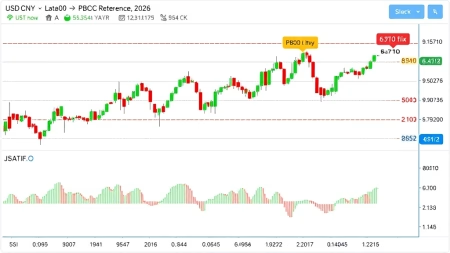
Currency markets reacted cautiously – USD/CNH held near 7.18 as traders weighed export growth against capital outflow risks. The CSI 300 Industrials Index gained 1.2% post-release, led by solar equipment (+3.4%) and EV battery makers (+2.8%).
Trading Outlook and Risk Factors
Bullish Scenario: A sustained break above 50.8 would signal accelerating growth, potentially lifting Q1 GDP forecasts to 5.1% YoY. This requires: 1) ASEAN demand stability, 2) Commodity price stabilization below ¥4,000/ton for steel, and 3) Additional PBOC liquidity measures by March.
Bearish Case: Failure to hold 50.0 in February would indicate stalled recovery, risking pullback to 49.2 support. Key triggers: 1) US/Europe recession cutting export orders, 2) Property sector relapse dragging domestic demand, or 3) Supply chain disruptions from Taiwan Strait tensions.
Critical dates ahead: February 10 Lunar New Year demand data, February 28 Official NBS PMI release, and March 5 NPC policy announcements. Traders should monitor Shanghai copper inventories (currently at 42,000 tons) as a leading indicator.