


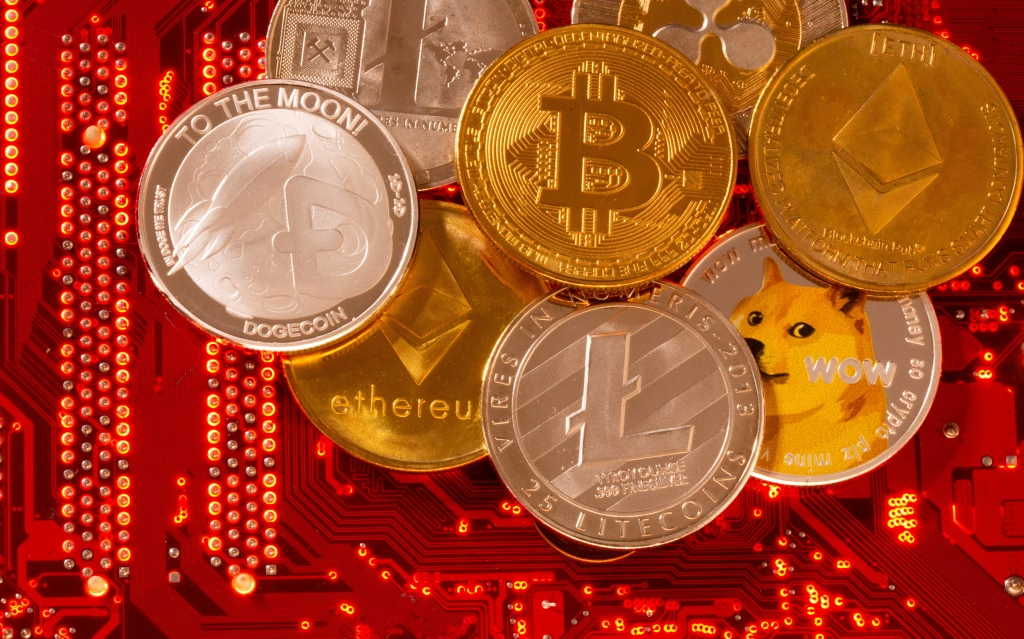
In a global financial landscape increasingly shaped by rapid technological innovation, rising debt markets, and evolving geopolitical tensions, the G20 has issued a significant warning. During its latest meetings, the G20 highlighted growing vulnerabilities linked to the booming private credit market and the accelerating expansion of stablecoins, urging nations to adopt more coordinated oversight.
This official caution—“G20 warns on private credit, stablecoins risks”—has already resonated across financial markets, raising questions among investors, financial institutions, and regulators worldwide.
This comprehensive analysis explores why the G20 is raising these concerns, how private credit and stablecoins have evolved, what risks the global economy faces in 2025, and what investors should do to navigate the uncertainty.
For more market insights and expert trading analysis, visit TradingMarketSignals.com.
1. Introduction: The Global Shift That Sparked the Warning
The global financial environment in 2025 is vastly different from the pre-pandemic world. Over the past five years, markets have seen:
- Explosive growth in private credit, now exceeding $2.1 trillion globally
- Rapid adoption of stablecoins, used not only in crypto trading but in commercial payments
- Rising interest rates, pressuring borrowers and exposing structural weaknesses
- Increasing regulatory gaps as innovation has outpaced traditional frameworks
This combination of high leverage, unregulated growth, and complex financial engineering has pushed the G20 to issue its strongest warning in a decade.
The message is clear:
Global financial stability is at risk unless the world tightens oversight on private credit markets and stablecoins.
2. What Is Private Credit and Why Is It Booming?
Private credit refers to loans made by non-bank institutions—such as private equity firms, hedge funds, and asset managers—to companies that cannot or prefer not to borrow from traditional banks.
Key drivers behind the private credit surge:
- Banks pulled back after stricter Basel III regulations
- Higher returns attracted institutional investors
- Businesses prefer flexibility compared to bank loans
- Rising interest rates enhanced profitability for lenders
The market has grown nearly fivefold in the past decade. Once a niche lending sector, private credit is now a primary funding source for mid-sized businesses, leveraged buyouts, and real-estate developers.
However, the G20 warns this unregulated growth could lead to hidden leverage, opaque risks, and systemic vulnerabilities.
3. G20’s Concerns About Private Credit: A Breakdown
The core warning from G20 leaders revolves around three major risks:
3.1 Lack of Transparency
Private credit deals are negotiated privately and lack the disclosures required of public markets.
This creates data blind spots for regulators and investors.
3.2 Hidden Leverage
Many borrowers in private credit are also highly leveraged through other instruments, raising the possibility of widespread defaults if economic conditions deteriorate.
3.3 Liquidity Mismatches
A major structural weakness:
- Investor money is often locked in long-term, illiquid loans
- Yet many funds offer short-term redemption options
The risk is similar to what triggered the 2008 financial crisis when liquidity dried up unexpectedly.
3.4 Concentration Risks
A few large asset managers dominate the market.
If one major player collapses, the shock could ripple across the entire global economy.
4. The Rise of Stablecoins and Why They Are a Concern
Stablecoins—crypto tokens pegged to stable assets such as the U.S. dollar—have soared in popularity.
Today, they are used not only for trading but for cross-border remittances, e-commerce, and increasingly in corporate finance.
Major stablecoins include:
- USDT (Tether)
- USDC (Circle)
- DAI
- PYUSD (PayPal USD)
Their combined market cap has returned to over $150 billion, a number rising faster each month.
Why the G20 sees stablecoins as a threat:
- Redemption runs could destabilize financial markets
- Reserve assets may not be fully transparent
- Cross-border transactions bypass central banks
- Systemic risk if stablecoins become widely adopted for payments
- Potential for money laundering, tax evasion, and illicit finance
The Financial Stability Board (FSB) and Bank for International Settlements (BIS) have also raised concerns, urging stronger global regulations.
You can explore more about global financial stability insights at the IMF:
https://www.imf.org/
5. Why the G20 Warning Matters Now
Several global developments make this warning timely and serious:
5.1 Elevated Global Debt
According to the IMF, global debt has reached over $315 trillion, setting a new record.
Much of this debt sits in the private sector and is tied to floating-rate borrowing—increasing default risk.
5.2 Tight Monetary Policies
Central banks like the Federal Reserve and European Central Bank (ECB) continue to maintain higher interest rates to combat inflation.
High rates tend to expose weak borrowers.
5.3 Geopolitical Instability
Conflicts such as Russia-Ukraine and tensions in Asia contribute to financial volatility.
5.4 Weakening Economic Growth
The world economy is slowing, making debt repayment harder for highly leveraged companies.
These combined factors mean that the rapid, unregulated growth of private credit and stablecoins could trigger cascading failures.
6. What the G20 Is Proposing: Regulatory Roadmap
The G20 is pushing for a coordinated global framework to avoid regulatory arbitrage.
Key proposals include:
6.1 Standardized Reporting for Private Credit Markets
To reduce opacity and enhance investor protection.
6.2 Liquidity Risk Stress Testing
Modeled after banking regulations.
6.3 Enhanced Capital Requirements
Especially for funds dealing with high-risk borrowers.
6.4 Cross-Border Rules for Stablecoin Reserves
Ensuring:
- 1:1 backing
- independent audits
- robust redemption mechanisms
6.5 Active Monitoring by the FSB and BIS
Learn more via the FSB: https://www.fsb.org/
And BIS: https://www.bis.org/
7. The Global Market Impact: What Investors Are Seeing
Investors have reacted with caution after the statement “G20 warns on private credit, stablecoins risks.”
Immediate market effects:
- Bond yields dipped slightly as investors shifted toward safe-haven assets
- Crypto markets saw modest volatility
- Financial stocks experienced pressure due to regulatory concerns
- Private equity sentiment turned more conservative
Long-term, the introduction of tighter regulations could reshape entire sectors.
8. Private Credit Outlook for 2025–2030
Despite regulatory risks, private credit is expected to continue growing—but with more oversight.
Growth factors:
- Aging global population investing heavily in yield-generating assets
- Continued retreat of banks from direct lending
- Strong demand for private equity financing
Risks:
- Rising default rates
- Economic slowdown
- Liquidity pressures during market stress
Overall outlook: Cautiously optimistic but structurally fragile.
9. Stablecoins: The Next Decade Ahead
Stablecoins could become the backbone of global payments, but only if properly regulated.
Bullish drivers:
- Faster, cheaper settlement than banks
- Global e-commerce growth
- Enhanced blockchain adoption
- Institutional interest
Bearish risks:
- Lack of unified regulation
- Reserve transparency issues
- Cybersecurity vulnerabilities
- Central bank digital currencies (CBDCs) competing directly with stablecoins
10. G20 Warning and the Crypto Regulation Wave
The G20’s statement accelerates the momentum already seen among major regulators:
— United States:
The Federal Reserve and Treasury are pushing for full stablecoin reserve disclosure.
https://www.federalreserve.gov/
— Europe:
The ECB’s MiCA regulatory framework is set to reshape crypto markets.
https://www.ecb.europa.eu/
— Asia:
Japan is leading with strict stablecoin rules requiring 100% cash reserves.
Regulation is no longer a matter of “if” but “when.”
11. What Investors Should Do Now
With the G20 warning in place, investors must stay vigilant.
11.1 For stock market investors:
- Reduce exposure to overly leveraged companies
- Favor high-liquidity, stable dividend stocks
- Monitor financial sector regulatory news
11.2 For crypto investors:
- Stick to well-regulated stablecoins
- Avoid platforms with opaque reserves
- Diversify across BTC, ETH, and regulated tokens
11.3 For institutional investors in private credit:
- Perform deeper due diligence
- Prepare for liquidity shocks
- Pressure managers for greater transparency
12. Why This Warning Matters for Financial Stability
The G20 message is not simply a technical update—it’s a global alert.
Private credit and stablecoins are transforming finance at unprecedented speed.
But like all major innovations, they can cause catastrophic damage if left unchecked.
History has shown this pattern repeatedly:
- 2008 mortgage crisis (opaque derivatives)
- 2020 COVID-19 market shock
- 2022 crypto collapses
By acting early, policymakers aim to prevent another global meltdown.
13. Conclusion: A Defining Moment for Global Finance
The warning—“G20 warns on private credit, stablecoins risks”—marks a turning point for the future of global finance.
It signals the beginning of a new era where traditional finance and digital finance intersect, creating opportunities but also systemic vulnerabilities.
For investors, this is a moment to:
- Stay informed
- Diversify
- Watch regulatory developments closely
- Monitor liquidity and leverage risks
As markets evolve, platforms like TradingMarketSignals.com provide essential insights, forecasts, and strategies to stay ahead of emerging risks.