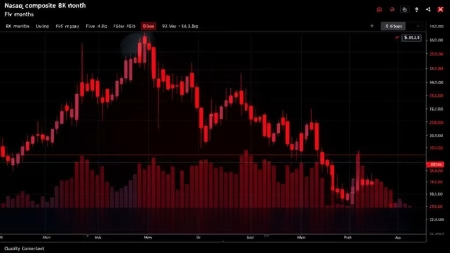


The Nikkei 225 index fell 1.21% on Friday, closing at 56,941.97 and marking one of its worst sessions in February 2026. The sell-off was driven by a combination of rising Japanese government bond yields, a strengthening yen, and renewed concerns about the Bank of Japan’s monetary policy trajectory. For traders and investors with exposure to Japanese equities, the move raises an important question: is this a temporary pullback in a broader uptrend, or the beginning of something more significant?
In this analysis, we break down what triggered the decline, how it compares to other global markets, what the Bank of Japan is signaling, and where the Nikkei might be headed next.
What Happened: The Numbers Behind the Drop
The Nikkei 225 opened lower and never recovered, sliding steadily throughout the Asian trading session before closing at 56,941.97 — down 696 points or 1.21% on the day. Trading volume was elevated at roughly 20% above the 20-day average, suggesting this wasn’t just a low-liquidity drift but an active repositioning by institutional investors.
The broader TOPIX index also declined, falling 0.95% to close near its lowest level in two weeks. Within the Nikkei, technology and automotive stocks were the hardest hit. SoftBank Group dropped 2.8%, Toyota Motor fell 1.9%, and Tokyo Electron — Japan’s largest chipmaker — declined 3.1% as semiconductor stocks faced global selling pressure.
The damage wasn’t limited to large caps. The Mothers Index, which tracks smaller growth companies on the Tokyo Stock Exchange, fell 1.7%, underscoring the breadth of the selling. When both large and small caps decline in unison, it typically signals a macro-driven move rather than sector-specific news.
Why Japanese Markets Are Under Pressure
The Yen Factor: Currency Strength Hurting Exporters
The Japanese yen has been strengthening against the US dollar, with USD/JPY dropping below 154. For a market that derives a significant portion of its corporate earnings from exports, a stronger yen is a direct headwind. Every 1-yen appreciation against the dollar reduces Toyota’s annual operating profit by approximately 450 billion yen, according to the company’s own estimates.
The yen’s rally has been fueled by growing expectations that the Bank of Japan will continue raising interest rates in 2026, while the Federal Reserve is expected to cut. This divergence in monetary policy has narrowed the interest rate differential between the two countries, making the yen carry trade less attractive and encouraging repatriation of Japanese capital.
For traders who remember the massive Nikkei rally of 2023-2025 — when the index surged from 26,000 to above 60,000 — it’s worth noting that much of that rally was powered by yen weakness. If the yen continues to strengthen, the tailwind that drove one of the most impressive equity rallies in recent history could become a headwind.
Rising Bond Yields: The BOJ’s Tightening Path
The 10-year Japanese government bond (JGB) yield has climbed to 2.214%, a level that would have been unthinkable just two years ago when the Bank of Japan was still maintaining its yield curve control policy. The steady rise in yields reflects the market’s expectation that the BOJ will continue normalizing monetary policy throughout 2026.
Higher bond yields compete with equities for investor capital. When Japanese government bonds offer meaningful yields for the first time in decades, some institutional investors — particularly domestic pension funds and insurance companies — are rotating out of stocks and into fixed income. This rotation has been a persistent source of selling pressure on Japanese equities since the BOJ began its tightening cycle.
The impact is particularly acute for growth stocks and companies with high debt levels, which are more sensitive to rising interest rates. This explains why the technology-heavy portions of the Nikkei have underperformed value-oriented sectors like banking and insurance.
Global Context: Japan Underperforms While the West Holds Steady
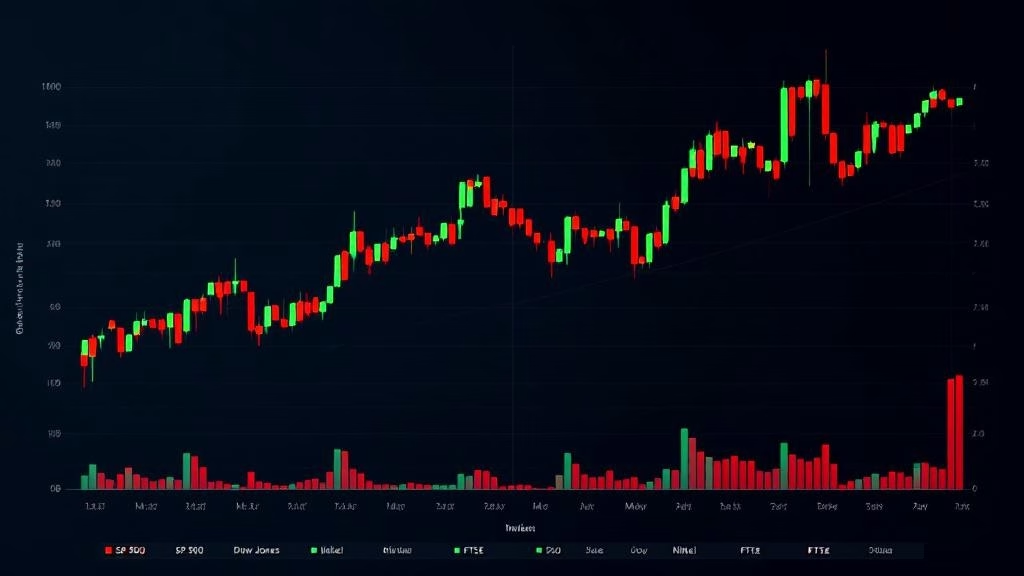
What makes the Nikkei’s decline notable is its divergence from Western markets. On the same day that Japanese stocks fell 1.2%, the S&P 500 was essentially flat at 6,836, the Dow Jones edged up 0.10% to 49,500, and Europe’s FTSE 100 actually gained 0.42%.
This divergence suggests that the selling is driven by Japan-specific factors rather than a broad global risk-off event. When all markets fall together, it’s typically about global macro fears. When one market falls while others hold steady, it usually points to local catalysts — in this case, the BOJ policy trajectory and yen dynamics.
However, it’s worth noting that the Euro STOXX 50 also declined 0.43%, suggesting that some degree of nervousness exists outside of Japan as well. European markets have their own concerns about economic growth and ECB policy, which may be amplifying the risk-off tone in Asian hours.

What the Bank of Japan Is Really Signaling
Understanding the BOJ’s intentions is essential for anyone trading Japanese markets in 2026. After decades of ultra-loose monetary policy — including negative interest rates and yield curve control — the central bank has executed a historic policy reversal.
Governor Kazuo Ueda has signaled that additional rate hikes are likely if economic data continues to support them. The key metrics the BOJ is watching include:
- Wage growth: Japan’s spring wage negotiations (shunto) are expected to deliver another round of significant pay increases, potentially exceeding 5% for the second consecutive year. Strong wage growth gives the BOJ confidence that inflation is becoming self-sustaining rather than imported.
- Core CPI: Japanese inflation has remained above the BOJ’s 2% target for over three years now, a dramatic shift for a country that battled deflation for decades. The persistence of inflation makes further rate hikes increasingly likely.
- Services inflation: This is the metric the BOJ watches most closely as an indicator of domestic demand-driven price pressures. Services inflation has been trending higher, reinforcing the case for continued tightening.
Market pricing currently implies two additional 25-basis-point rate hikes in 2026, which would bring the BOJ’s policy rate to approximately 1.0%. While this remains low by global standards, the direction of travel matters more than the absolute level for asset prices.
Technical Analysis: Where Is the Nikkei Headed?
From a technical perspective, Friday’s decline pushed the Nikkei below its 50-day moving average for the first time since early January, a mildly bearish signal that could attract additional selling from trend-following algorithms.
Key levels to watch:
- Support at 55,500-56,000: This zone corresponds to the 100-day moving average and a horizontal support level from December 2025. A break below here would signal a more significant correction and could open the door to 52,000-53,000.
- Resistance at 58,500-59,000: The recent highs and the 50-day moving average now act as overhead resistance. The index needs to reclaim this zone to restore the bullish trend.
- Major support at 52,000: The 200-day moving average sits near this level. A test of this zone would represent approximately an 8% correction from recent highs — painful but within the range of a normal pullback in a secular bull market.
Volume patterns are concerning in the short term. Selling volume has exceeded buying volume for three consecutive sessions, and the McClellan Oscillator — a measure of market breadth — has turned negative. These are signs that the path of least resistance may be lower in the near term.
However, the monthly chart still shows a well-defined uptrend channel that has been in place since 2023. As long as the 200-day moving average holds, the longer-term bullish case for Japanese equities remains intact.
Investment Implications: How to Position
The Nikkei’s decline creates both risks and opportunities depending on your time horizon and investment thesis.
For Short-Term Traders
The near-term bias is cautious. With the index below its 50-day moving average and selling volume increasing, traders should be wary of catching a falling knife. Wait for either a clear bounce off the 55,500-56,000 support zone or a reclaim of the 50-day moving average before adding long exposure.
For those who are short or looking to hedge, the 55,500 level is the key line in the sand. A break below opens significant downside potential. Consider using Nikkei 225 futures or the iShares MSCI Japan ETF (EWJ) for tactical positioning.
For Long-Term Investors
Japan’s structural story remains compelling despite the short-term turbulence. Corporate governance reforms continue to drive improvements in profitability and shareholder returns. Japanese companies are buying back stock at record levels, and dividend payout ratios are trending higher across the market.
For patient investors, a 5-10% pullback in the Nikkei would represent an attractive entry point. The key is to focus on companies that benefit from, rather than suffer from, a stronger yen and higher rates. Japanese banks, for example, have been significant outperformers as higher rates boost their net interest margins.
Hedging Currency Risk
For non-Japanese investors, currency hedging is an essential consideration. The yen’s strength means that even if the Nikkei stabilizes, unhedged foreign investors face an additional headwind from the currency. Consider currency-hedged Japan ETFs like the WisdomTree Japan Hedged Equity Fund (DXJ) if you want pure equity exposure without yen risk.
The Bigger Picture: Is the Japan Rally Over?
The most important question facing Japan investors is whether the remarkable rally that took the Nikkei from 26,000 to above 60,000 is fundamentally over. The answer depends largely on which forces you believe are more powerful.
The bull case: Japan’s corporate governance revolution is real and ongoing. Companies are becoming more shareholder-friendly, margins are expanding, and the end of deflation means nominal growth is finally translating into earnings growth. Even with a stronger yen and higher rates, Japanese equities remain attractively valued compared to US stocks on a P/E and price-to-book basis.
The bear case: The easy money tailwind from BOJ policy is reversing. Yen weakness was a critical driver of the rally, and that trend is now turning. Rising bond yields provide domestic investors with an alternative to equities for the first time in years. And global economic uncertainty could disproportionately hurt Japan’s export-dependent economy.
The truth likely lies somewhere in between. The secular bull case for Japan remains valid, but the pace of gains is likely to moderate significantly as the BOJ normalizes policy. Expect more volatility, more pullbacks, and a market that rewards stock selection over broad index exposure.
Final Thoughts
Friday’s 1.2% drop in the Nikkei 225 is a reminder that even the strongest bull markets don’t move in a straight line. The combination of rising yields, a stronger yen, and BOJ tightening expectations creates genuine headwinds that could persist for several more months.
For traders, the immediate focus should be on the 55,500-56,000 support zone. How the market behaves at this level will tell us a lot about whether this is a healthy correction within an ongoing uptrend or the beginning of a more meaningful reversal.
For longer-term investors, Japan’s transformation story hasn’t changed. But the market is reminding us that buying at the right price matters — and a pullback to the 200-day moving average might offer a more favorable risk-reward entry point than chasing the index at all-time highs.
Either way, Japan remains one of the most interesting equity markets in the world right now. The volatility may be uncomfortable, but it’s creating opportunities for those with the patience and discipline to exploit them.