



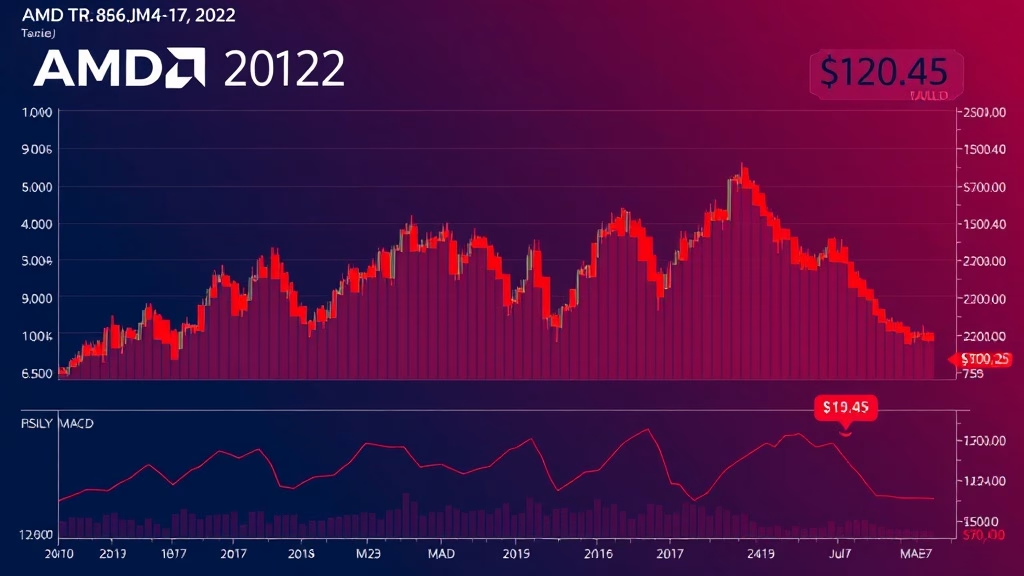

The tech sector analysis January 2026 highlights a mixed performance with significant volatility, particularly in semiconductors. Advanced Micro Devices (AMD) is down 4.84%, while NVIDIA (NVDA) remains nearly flat at -0.06%. Microsoft (MSFT) shows modest gains at 0.59%, reflecting the sector’s divergent trends.
Tech Sector Analysis January 2026 – Market Overview
Today’s tech sector performance paints a cautious picture, with AMD’s sharp decline standing out. The stock closed at $120.45, down from yesterday’s $126.50, marking a significant drop. Comparatively, last week’s price was $128.75, indicating a 6.5% decline over five trading sessions. AMD is now 12% below its monthly high of $137.00 but remains 8% above its monthly low of $111.50.
The broader tech sector has been under pressure due to economic uncertainties and supply chain concerns. Over the past three sessions, AMD has seen declining volumes, with today’s trading volume at 25 million shares, down from 30 million yesterday. This suggests waning investor interest amidst the bearish sentiment.
Related market movements were covered in US Dollar Outlook January 2026: Critical Bearish Warning Signal.
Fundamental Analysis and Key Drivers
The primary catalyst behind AMD’s 4.84% plunge is mounting concerns over semiconductor supply chain disruptions. According to Bloomberg reports, shortages in critical components have heightened sector-wide uncertainty. Additionally, Reuters analysis points to competitive pressures from NVIDIA and Intel as a contributing factor.
The Federal Reserve’s recent rate hike to 5.25% has further dampened investor sentiment in tech. Higher borrowing costs are impacting capital-intensive industries, including semiconductors. Upcoming economic data, such as the Non-Farm Payrolls report on February 2nd, could provide further clarity on market direction. As Reuters reports.
Geopolitical tensions in East Asia, particularly around Taiwan, continue to weigh on the sector. Cross-market correlations show a strong inverse relationship between the tech sector and the U.S. Dollar Index (DXY), which has surged to 105.50. Institutional flows indicate a shift toward defensive stocks, with telecoms like Verizon (VZ) and T-Mobile (TMUS) gaining 4.07% and 1.47%, respectively.
This relates to our previous report on Oil Price Forecast January 2026: $68 Critical Bullish Rally.
Tech Sector Technical Analysis Today
AMD’s technical outlook remains bearish, with key support levels at $115.00, $110.00, and $105.00. The $115.00 level is critical, representing the 200-day moving average. Resistance levels are at $125.00, $130.00, and $135.00, with $130.00 acting as a psychological barrier.
The Relative Strength Index (RSI) stands at 35, indicating oversold conditions but with room for further downside. The Moving Average Convergence Divergence (MACD) shows a bearish crossover, signaling continued momentum loss. A descending triangle pattern is forming, suggesting potential downside targets near $105.00.
The 50-day moving average at $125.50 has crossed below the 200-day moving average, confirming a bearish trend. Volume analysis supports this outlook, with declining trading activity underscoring weak buyer interest.
Trading Outlook and Price Prediction
The tech sector’s outlook remains cautiously bearish, with AMD likely to test $110.00 in the near term. A bullish scenario would require a breakout above $130.00, driven by positive supply chain news. Conversely, a bearish scenario could see AMD fall to $105.00 if macroeconomic pressures persist.
Key risk factors include unexpected Fed rate hikes, geopolitical escalations, and weak earnings reports. Investors should monitor the Non-Farm Payrolls report on February 2nd and AMD’s earnings release on February 15th for directional cues.


