



The number that defines asset management in 2026 is not a market index or an interest rate. It is negative $600 billion — the cumulative net redemptions from traditional active mutual funds over the trailing twelve months, even as total industry assets climb to fresh records. The money is not leaving the market. It is walking, quietly and relentlessly, from one vehicle to another.
This is the Great Migration: the structural shift of American savings out of the 40 Act mutual fund wrapper and into exchange-traded funds, both passive and active. Q1 2026 earnings season made the scale impossible to ignore. BlackRock posted record inflows. Fidelity took redemptions. And Vanguard, the firm that arguably started the passive revolution, is now racing to reinvent itself again.
For wealth managers, plan sponsors, and individual investors alike, the question is no longer whether this migration is happening. It is how to position for the next phase.
A $600 Billion Wake-Up Call
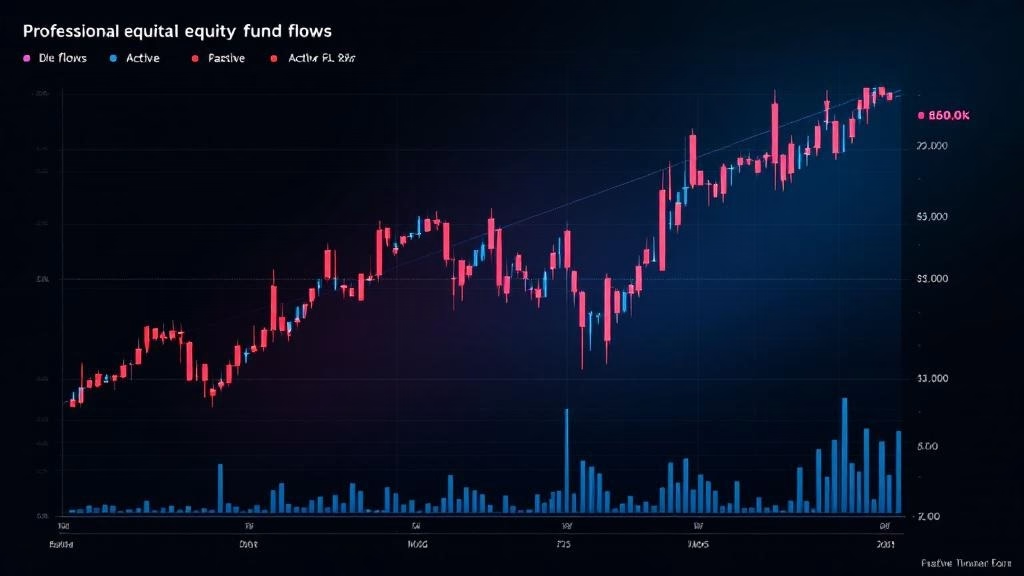
According to Investment Company Institute data, active mutual funds and ETFs combined collected roughly $1.14 trillion in estimated net inflows over the twelve months ended March 31, 2026 — narrowly outpacing passive products at $1.08 trillion. That headline obscures a sharper truth inside the numbers: nearly all of the active money is now flowing into active ETFs, not active mutual funds. When the legacy mutual fund wrapper is isolated, the twelve-month tally shows roughly $600 billion of net redemptions.
February 2026 alone captured the pattern in miniature. Long-term index funds pulled in $109 billion, while active long-term funds attracted $34.6 billion — a three-to-one passive advantage in a single month. The gap is not cyclical. It is structural, and it is accelerating.
Three forces explain the shift:
- Tax efficiency. The in-kind creation and redemption mechanism of an ETF effectively externalizes capital gains. A comparable mutual fund must distribute realized gains to shareholders every year, creating a tax drag that compounds brutally over a decade.
- Fee compression. Average expense ratios on active mutual funds still sit near 60 basis points. Active ETFs routinely launch at 25–45 bps, and passive ETFs continue to grind toward zero.
- Advisor platform economics. RIAs and independent broker-dealers now overwhelmingly default to ETFs inside model portfolios, direct indexing sleeves, and tax-managed separately managed accounts.
BlackRock’s Record: $13.9 Trillion and Counting

The clearest beneficiary of the migration is BlackRock. On April 14, 2026, the firm reported $13.9 trillion in assets under management — an all-time high. Q1 2026 produced roughly $130 billion of total net inflows, with the iShares ETF platform alone pulling in $132 billion.
The standout story is not the flagship S&P 500 tracker. It is active ETFs. BlackRock’s active ETF platform has quadrupled in two years and now exceeds $110 billion in AUM. This is the wrapper that translates a portfolio manager’s security selection into a tax-efficient, intraday-traded, low-friction vehicle — and it is eating the core of what active mutual funds used to sell.
Add BlackRock’s build-out in private markets through its GIP and HPS acquisitions, and the firm now offers retirement platforms, institutional allocators, and wirehouses a single-vendor answer spanning public index, active, and alternatives. That bundling is exactly what the “vanishing middle” of asset managers cannot match.
Fidelity’s Squeeze and the Active-Manager Problem
Fidelity Investments tells the other side of the story. The firm posted approximately $5.6 billion of overall net outflows over the measured period, driven by roughly $11.3 billion of redemptions from active funds, partially offset by $5.7 billion of inflows into its passive lineup.
Fidelity is not a failing franchise. It remains one of the largest retirement recordkeepers in the country and a retail brokerage powerhouse. But the numbers reveal the problem facing every active-first shop: the asset base that paid for decades of star-manager compensation is being re-underwritten, one rollover and one 401(k) menu refresh at a time.
The managers who survive this transition share three traits: – A credible ETF conversion strategy or a standalone active ETF lineup – Scale in sub-advisory and model-portfolio distribution – A differentiated capability — private credit, small-cap, emerging markets alpha — that cannot easily be replicated by a passive index
Managers who check none of these boxes are quietly being consolidated or wound down.
Vanguard’s New Era
Vanguard, the firm that built the passive industry, now manages approximately $12 trillion. Yet its challenge is the opposite of Fidelity’s: not how to defend active, but how to compete in a world where passive indexing is table stakes.
Morningstar coverage of the firm’s 50-year milestone underscored two gaps. First, Vanguard lacks a scaled “whole portfolio” technology suite comparable to BlackRock’s Aladdin — a material disadvantage in institutional solutions sales. Second, Vanguard entered private markets late, and the catch-up cost in a world where 401(k) plans may soon accept alternatives is non-trivial.
The firm’s response under new leadership includes fee cuts across its ETF lineup, an accelerated push into active ETFs, a wealth advisory buildout, and early-stage private markets partnerships. Whether that is enough to defend the throne over the next decade is the open question of the industry.
What This Means for Plan Sponsors and Advisors
For 401(k) plan sponsors, the Great Migration raises uncomfortable menu-review questions. A plan line-up dominated by legacy active mutual funds is increasingly hard to defend under ERISA fiduciary review when cheaper, more tax-efficient, and equally diversified ETF alternatives exist — and when the Department of Labor itself is now explicitly contemplating alternative assets inside defined contribution menus. (We cover that rule-making here.)
For RIAs and independent advisors, three practical implications stand out:
- Model portfolios need an ETF-first refresh. Mutual fund share classes with 12b-1 fees or revenue-sharing arrangements are disappearing from institutional platforms, and custodians are raising friction on legacy wrappers.
- Tax-loss harvesting and direct indexing are now product categories, not features. Advisors who fail to offer them will lose clients who can find them elsewhere.
- Due diligence on active managers must now include their ETF roadmap. A portfolio manager with a strong ten-year record but no plan to deliver it in an ETF wrapper is a depreciating asset.
For individual investors, the guidance is simpler. Check the tax bill on every actively managed fund held outside a retirement account. If year-end distributions are eroding after-tax return, an ETF with a comparable strategy almost certainly exists — and the tax savings compound.
The Next Phase: Active ETFs, Alternatives, and the 401(k)
The next twelve months will be defined by three storylines:
- Active ETF launches accelerate. Expect every major active house to convert at least one flagship strategy, following the Dimensional and JPMorgan blueprints.
- Private markets come to defined contribution. The Department of Labor’s April 2026 proposed rule on alternative assets in 401(k) plans, if finalized, reopens a revenue line that large active managers badly need.
- Consolidation bites the middle. Asset managers between $50 billion and $500 billion in AUM — too small for platform economics, too large to pivot as a boutique — will face sale, merger, or slow-motion decline.
BlackRock, Vanguard, State Street, and a handful of specialist alternatives firms are positioning for the consolidated industry that emerges on the other side. For everyone else — including the advisors and plan fiduciaries who allocate to these products — the migration is not something to watch. It is something to act on.
Bottom Line
The $600 billion leaving active mutual funds is not a crisis of confidence in active management. It is a crisis of confidence in the mutual fund wrapper. Money is still hunting for alpha, still paying for skill, still allocating to private markets. It is simply refusing to do so inside a 1940-vintage structure that distributes capital gains, trades once a day, and costs more than it needs to.
The firms building for what comes next — active ETFs, model portfolios, private markets inside defined contribution — are the ones writing the next chapter of asset management. The rest are writing quarterly outflow reports.
Sources: Investment Company Institute fund flow data; BlackRock Q1 2026 earnings coverage; Citywire fund flows analysis; Morningstar on Vanguard’s next era.
About Me

Founder and Chief Research Analyst at Trading Market Signals. Abdelali El Khadmaoui specializes in AI Wealth Intelligence, Wealth Management, Registered Investment Advisors (RIAs), Family Offices, Retirement Planning and Private Credit. He publishes in-depth research and data-driven analysis for financial professionals.