



For four decades, the typical 401(k) menu looked remarkably similar from one plan to the next: a stable value fund, a few index funds, a target-date series, a handful of active equity and bond sleeves, and — if the sponsor was adventurous — a brokerage window. Private equity, private credit, real estate, infrastructure, and digital assets sat firmly outside the fence. That fence is now being lowered.
On March 30, 2026, the U.S. Department of Labor released a proposed rule that would establish a process-based fiduciary safe harbor for the inclusion of alternative investments inside participant-directed 401(k) plans. The comment period runs through June 1, 2026, and plan sponsors, fund managers, and advisors are already rewriting their 2027 investment committee agendas.
This is one of the most consequential retirement policy changes in a generation. It is also one of the most misunderstood. Here is what it actually does, what it does not do, and how financial planners and participants should think about it.
What the Rule Proposes
The proposed regulation — formally titled a rule on fiduciary duties in selecting designated investment alternatives — follows President Trump’s executive order, “Democratizing Access to Alternative Assets for 401(k) Investors.” It does not mandate that plans add alternatives. Instead, it constructs a safe harbor: a documented process that, if followed, creates a legal presumption that the fiduciary satisfied ERISA’s duty of prudence when selecting an investment option.
The rule identifies six factors a plan fiduciary must “objectively, thoroughly, and analytically” evaluate:
- Performance — both absolute return and risk-adjusted measures over appropriate periods
- Fees — including management, performance, and any embedded costs
- Liquidity — the ability of the fund structure to accommodate participant-directed withdrawals and rebalancing
- Valuation — the frequency, methodology, and independence of NAV determination
- Performance benchmarks — and whether appropriate benchmarks even exist for the strategy
- Complexity — including participant comprehension and fiduciary oversight burden
Sidley Austin’s analysis underscores that the framework applies to any designated investment alternative, not only alternatives — but the practical effect is to de-risk the inclusion of private equity, private credit, real estate, infrastructure, and digital asset products that most fiduciaries previously avoided for litigation reasons.
The Litigation Backdrop

To understand why the rule matters, look at what it is designed to neutralize. Over the past decade, ERISA class-action litigation has produced hundreds of cases targeting plan investment menus — and a cottage industry of plaintiffs’ firms scrutinizing every fee, every share class, every fund selection decision. Fiduciaries responded rationally: they added index funds, removed anything unusual, and narrowed menus to the defensible middle.
The safe harbor shifts that calculus. A plan sponsor who follows the six-factor process and documents it carefully can include a private equity sleeve in a target-date fund without facing a near-automatic lawsuit. That is not the same as eliminating litigation risk, but it dramatically reduces it.
CNBC coverage noted that the rule arrived alongside a separate regulatory story: the prior DOL fiduciary rule — the one that would have expanded fiduciary obligations to more retirement advice — was vacated by Texas courts in March 2026 after the administration declined to defend it. The two developments are not a coincidence. The 2026 agenda is explicitly about opening access and reducing fiduciary friction.
What This Means in Practice
Alternative investments in 401(k) plans will not arrive overnight. Implementation will unfold in stages.
Phase 1 (2026–2027): Target-date funds adopt small sleeves. The most likely first mover is the target-date fund. Plan participants in a single diversified vehicle will be allocated, say, 5–10% to private equity or private credit, with the allocation managed entirely by the fund provider. Participants will not see the allocation on their statement as a separate line item. This is the blueprint already piloted in a handful of large mega-plans.
Phase 2 (2027–2028): Menu-level alternatives emerge. Larger plans — particularly Fortune 500 sponsors — will add standalone alternatives options to their menus, typically via interval-fund structures or tender-offer funds that handle the liquidity mismatch between the underlying assets and participant-directed flows.
Phase 3 (2028+): The small-plan question. Whether alternatives migrate into small and mid-size 401(k) plans depends on three factors: product availability, pricing compression, and recordkeeper integration. This is likely the slowest leg.
SECURE 2.0 Is Still Reshaping Plan Design
The alternatives rule does not arrive in a vacuum. SECURE 2.0 provisions continue to roll in, and 2026 brought several that matter:
- Super catch-up contributions for ages 60–63. Workers in this band can contribute up to $11,250 in catch-up contributions, materially above the standard $8,000 catch-up limit. This is a meaningful acceleration for late-career savers.
- Mandatory auto-enrollment. Newly established 401(k) and 403(b) plans must auto-enroll new participants at a starting rate between 3% and 10%, with automatic annual escalation to at least 10% (capped at 15%).
- Plan document deadlines. Employers have until the end of 2026 to adopt required SECURE 2.0 amendments, a deadline many plans are still chasing.
- Expanded hardship withdrawal rules for participants facing domestic abuse, natural disasters, and certain emergency expenses.
Together, the SECURE 2.0 layer and the alternatives rule produce a retirement system doing two things at once: widening access to previously institutional-only asset classes while structurally pushing more Americans into automatic savings.
The Case For — and Against
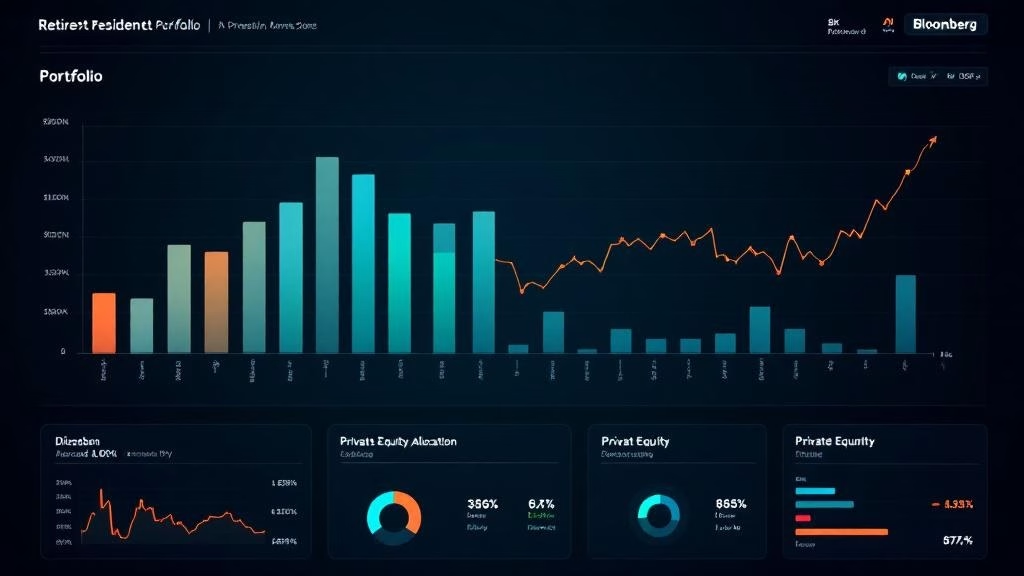
The case for alternatives in 401(k) plans rests on a real diagnosis. Public equity markets have shrunk materially. The number of publicly listed U.S. companies has fallen by roughly half since the late 1990s, and the typical high-growth company now stays private far longer. For a participant with a 30-year time horizon, exclusion from private markets is not a neutral choice; it is a structural underweight relative to the economy’s actual risk-and-return opportunities.
The case against centers on three legitimate concerns:
- Fees. Even at institutional scale, private equity typically charges 2% management fees and 20% performance fees. Inside a 401(k) target-date fund, those costs are layered on top of the fund’s own expense ratio.
- Liquidity illusions. Private assets are valued quarterly on the basis of models, not market trades. A 401(k) wrapper that permits daily participant activity creates the potential for gated withdrawals in a stressed market — exactly the scenario that embarrasses fiduciaries.
- Participant comprehension. Disclosure rules under ERISA assume that participants can make informed decisions. Private equity fund structures are complex even for professional allocators.
The honest answer is that the rule will produce good outcomes for some participants and poor outcomes for others, and it will take a decade of data to sort out which plan designs belong in which camp.
Guidance for Plan Sponsors, Advisors, and Participants
For plan sponsors: treat the comment period as an information-gathering exercise, not a mandate to act. If the rule finalizes in late 2026, expect recordkeeper and investment consultant proposals to arrive quickly in 2027. Use the interim to build the six-factor documentation framework, because the safe harbor only protects the sponsors who actually follow the process.
For financial advisors: participants will ask about this. Be prepared to explain the distinction between holding private equity through a target-date fund and allocating a standalone menu option. And be prepared for the reality that the RIA industry itself is being reshaped by the same private capital dynamics driving alternatives into 401(k) plans.
For participants: the core advice remains unchanged. Max the match. Capture the super catch-up if you are 60–63. Diversify. When alternatives appear in your plan menu, read the fee disclosure — twice — before allocating. And remember that a target-date fund with a modest alternatives sleeve is a very different proposition from a standalone private equity option that demands independent analysis.
The Broader Context
The DOL rule is one piece of a larger reordering. The Great Migration from active mutual funds to ETFs is changing the plumbing of retirement menus. Private capital is reshaping the wealth management industry that advises many of those participants. And demographic pressure on Social Security is pushing more of the retirement-security burden onto defined contribution plans every year.
For the first time in a generation, the 401(k) is being treated as a capital allocation vehicle capable of holding the full range of institutional-quality investments — not just a menu of publicly traded mutual funds. Whether the policy produces better retirement outcomes depends entirely on whether the six-factor discipline is taken seriously. The safe harbor is a floor, not a ceiling.
Bottom Line
The March 30, 2026 proposal is a genuine inflection point. It does not open the floodgates, and it does not force a single plan to add alternatives. What it does is legitimize a conversation that most plan sponsors were afraid to have.
The plans that take the comment period seriously, build the documentation discipline the rule requires, and choose products with a critical eye will produce the retirement outcomes the policy is aiming for. The plans that treat it as a license to bolt on whatever their recordkeeper is selling will produce the litigation case studies that define the next wave of ERISA reform.
The rule is a tool. The outcomes will depend on who is holding it.
Sources: DOL press release, March 30, 2026; Sidley Austin legal analysis; Gibson Dunn client alert; CNBC coverage; Fidelity SECURE 2.0 guide. The 2026 safe harbor sharpened this further: see how the new liquidity and valuation factors collide with private credit redemption gates.
About Me

Founder and Chief Research Analyst at Trading Market Signals. Abdelali El Khadmaoui specializes in AI Wealth Intelligence, Wealth Management, Registered Investment Advisors (RIAs), Family Offices, Retirement Planning and Private Credit. He publishes in-depth research and data-driven analysis for financial professionals.