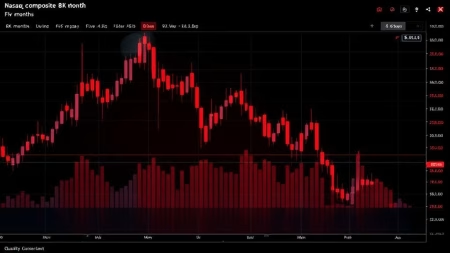


The oil price surge stocks selloff intensified on Monday, March 9, as global equity markets buckled under the weight of crude oil prices topping $110 per barrel. Brent crude jumped nearly 10% to $101.81 while West Texas Intermediate surged 11.73% to $101.56 in Friday’s session, and futures markets pointed to further gains above $110 as the Iran conflict showed no signs of abating. The S&P 500 fell 1.54% to 6,637 points, extending a brutal week that has pushed the index into negative territory for 2026.

Oil Price Surge Stocks Impact: Why Markets Are Plunging
The U.S.-Israeli war with Iran has created a perfect storm for equity markets. According to Reuters, even a quick resolution to the conflict could leave consumers and businesses facing weeks or months of higher fuel prices as damaged facilities, disrupted logistics, and elevated shipping risks ripple through the global energy supply chain.
Australia’s All Ordinaries shed 2.9%, wiping approximately $90 billion in market value, as Asian markets opened to the reality of $110 oil. The carnage wasn’t limited to one region — European futures signaled steep losses, and U.S. stock futures sank in overnight trading. Investors who had been watching Asian markets crashing on Iran war fears now face an even more challenging environment as the conflict escalates.
The speed of the oil price move has been staggering. Brent crude has risen more than 25% since the start of hostilities, making this one of the sharpest energy-driven market dislocations since Russia’s invasion of Ukraine in 2022. Energy stocks have been among the few bright spots, with energy stocks benefiting from crude oil gains while the broader market deteriorates.
Strait of Hormuz: The $110 Oil Catalyst
The Strait of Hormuz, through which roughly 20% of the world’s oil passes daily, has become the focal point of market anxiety. Disruptions to shipping through this critical chokepoint have sent oil prices into a parabolic move that shows little sign of slowing.

OPEC+ responded by agreeing to increase output more than expected, but analysts remain skeptical that additional supply can offset the magnitude of disruption. The cartel’s spare capacity is limited, and the logistical challenges of rerouting tankers around conflict zones add cost and delay that translate directly into higher prices at the pump.
The Guardian reported that gas prices surged immediately as the conflict disrupted major production and supply routes. U.S. crude was on track for an 11% jump when trading resumed, signaling that the worst may not be over for consumers and businesses dependent on affordable energy.
Which Sectors Are Hit Hardest by the Oil Price Surge?
The impact varies dramatically across sectors. Airlines, shipping companies, and transportation firms face immediate margin compression as fuel costs skyrocket. Consumer discretionary stocks are under pressure as higher gas prices threaten to eat into household spending. Technology stocks, particularly those with high energy-intensive data center operations, face rising operational costs.
Conversely, energy producers, defense contractors, and companies with strong pricing power are finding relative strength. The divergence between winners and losers has widened dramatically over the past week, creating both risk and opportunity for active investors.
The Fed’s Stagflation Nightmare
Perhaps the most troubling development for equity markets is the growing specter of stagflation — a toxic combination of rising inflation and slowing economic growth. The latest U.S. jobs report showed unemployment rising to 4.4%, with the economy shedding 92,000 jobs. Combined with the inflationary pressure from surging energy costs, the Federal Reserve finds itself, as Morgan Stanley’s Ellen Zentner put it, “between a rock and a hard place.”

The weak jobs data already weighing on equities, and now energy-driven inflation is removing the Fed’s ability to cut rates in response. This policy paralysis is particularly damaging for rate-sensitive sectors like real estate, utilities, and growth stocks that had been pricing in rate cuts throughout the first quarter.
The New York Times reported that the conflict creates a tug of war over the path forward: the Iran conflict argues for holding rates steady, while the weakening labor market makes a strong case for cuts. The outcome will significantly affect stock prices, the dollar, and broader financial conditions.
Key Data Points This Week
According to S&P Global’s weekly preview, markets face several important data releases that could amplify volatility:
- U.S. CPI (Wednesday): The consumer price index will be closely watched for signs that oil’s surge is already feeding into broader inflation. Any upside surprise could trigger another leg lower in equities.
- UK GDP (Wednesday): Britain’s economic output data will reveal how the global slowdown is affecting Europe’s second-largest economy.
- China CPI (Sunday): China’s inflation numbers will provide insight into demand conditions in the world’s largest oil importer.
- Eurozone Industrial Production (Thursday): A key gauge of manufacturing activity as energy costs surge across the continent.
NVIDIA GTC 2026: A Potential Bright Spot
Not all the news is bearish. NVIDIA’s GPU Technology Conference (GTC), scheduled for March 16-19 in San Jose, has historically served as a catalyst for AI and semiconductor stocks. With the AI infrastructure buildout showing no signs of slowing, the conference could provide a much-needed counterbalance to the geopolitical anxiety dominating markets.
However, even tech stocks aren’t immune to the broader selloff. The Nasdaq has fallen more than 5% from its recent highs, and the question for investors is whether AI enthusiasm can overcome macroeconomic headwinds. Given that data centers consume enormous amounts of energy, rising power costs could actually dampen the near-term earnings outlook for hyperscalers.
What Should Investors Do Now?
The combination of geopolitical risk, energy-driven inflation, a weakening labor market, and Fed policy uncertainty creates an environment that demands caution. Here are key considerations for navigating the oil price surge stocks selloff:
- Reduce exposure to energy-intensive sectors — Airlines, shipping, and logistics companies face direct margin pressure that could persist for weeks or months.
- Consider energy hedges — Energy stocks and commodity ETFs can offset portfolio losses from the broader market decline.
- Watch the CPI print closely — Wednesday’s inflation data will likely determine whether the Fed can cut rates this quarter or is forced to stay on hold.
- Don’t panic sell — Geopolitical shocks historically create short-term dislocations that recover once uncertainty clears. The key is sizing positions appropriately for the elevated volatility.
- Focus on quality — Companies with strong balance sheets, pricing power, and limited commodity exposure tend to outperform during stagflationary environments.
Historical Parallels: How Oil Shocks Have Moved Markets
The current oil price surge stocks selloff has striking parallels to previous energy-driven market dislocations. During the 1973 Arab oil embargo, the S&P 500 fell nearly 50% over the following year as stagflation gripped the U.S. economy. The 1990 Gulf War spike saw oil double in three months, though markets recovered relatively quickly once the conflict resolved. More recently, Russia’s 2022 invasion of Ukraine sent Brent crude above $130, triggering a bear market in equities that lasted until late that year.
What makes the current situation particularly concerning is the combination of already elevated inflation expectations and a weakening labor market. Unlike 2022, when the economy was still adding hundreds of thousands of jobs per month, today’s backdrop of rising unemployment at 4.4% leaves far less cushion for consumers to absorb higher energy costs. The stagflation parallel to the 1970s, while not exact, is closer than many investors would like to acknowledge.
Energy Sector Winners and Losers
Within the energy complex itself, the picture is nuanced. Upstream producers with significant Middle East exposure face production disruptions, while those with operations concentrated in the Permian Basin, Canadian oil sands, and other regions outside the conflict zone stand to benefit enormously from higher prices without the operational risk.
Refiners face a mixed outlook — higher crude input costs are partially offset by wider crack spreads as gasoline and diesel prices surge. Pipeline operators and midstream companies benefit from higher throughput volumes as the U.S. ramps production to fill the global supply gap. Meanwhile, renewable energy stocks have seen renewed interest as the conflict underscores the strategic vulnerability of fossil fuel dependence.
Global Market Reactions: A Coordinated Selloff
The selloff has been remarkably synchronized across global markets. Japan’s Nikkei 225 dropped over 3% in Monday’s session, while Hong Kong’s Hang Seng fell 2.8%. European markets are expected to open sharply lower, with DAX futures pointing to a 2.5% decline and FTSE 100 futures down 2.1%. The coordinated nature of the selloff suggests that institutional investors are broadly de-risking rather than rotating between regions.
Bond markets tell an equally compelling story. The U.S. 10-year Treasury yield has risen despite the equity selloff — an unusual divergence that reflects inflation fears overriding the typical flight-to-safety dynamic. This is particularly worrisome because it means the traditional portfolio hedge of government bonds is failing to provide protection, leaving investors with few places to hide.
Currency markets have also reacted dramatically. The U.S. dollar has strengthened against most major currencies as global capital seeks the relative safety of dollar-denominated assets. However, currencies of oil-exporting nations like the Canadian dollar and Norwegian krone have outperformed, reflecting the windfall that higher oil prices bring to their economies.
Commodity Spillover Effects
The oil shock is creating ripple effects across the entire commodity complex. Natural gas prices in Europe have spiked on concerns about broader Middle East energy supply disruptions. Agricultural commodities are rising as higher fuel costs increase transportation and fertilizer expenses. Even metals markets are being affected, with aluminum and steel prices climbing on expectations of higher production costs.
These commodity price increases will take weeks to fully flow through to consumer prices, meaning the inflationary impact of the current crisis will likely intensify rather than diminish in the near term. For the Federal Reserve, this creates an extended timeline of policy uncertainty that could keep markets on edge well beyond the resolution of the immediate conflict.
The Week Ahead: Volatility Is Here to Stay
With oil above $110, the S&P 500 in negative territory for the year, and the Fed trapped between conflicting mandates, markets are likely to remain volatile throughout the week. The CPI release on Wednesday stands as the single most important data point — a hot print could push the S&P 500 toward correction territory, while a benign reading might offer temporary relief.
For now, the oil price surge stocks selloff is a reminder that geopolitical risk remains the most unpredictable force in financial markets. Investors should position defensively, stay informed, and be prepared for rapid shifts in sentiment as the Iran conflict evolves.