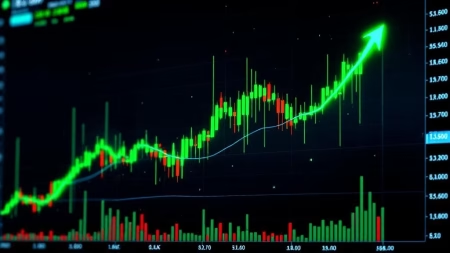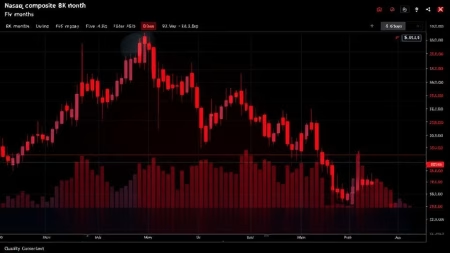

The Russell 2000 rally is capturing Wall Street’s attention as small-cap stocks surge ahead of their large-cap counterparts. While the Nasdaq Composite slipped 0.22% to close at 22,546.67 last Friday, the Russell 2000 jumped 1.18% to reach 2,646.70 – marking one of the widest single-day performance gaps between small caps and mega-cap tech stocks this year. For investors wondering whether this rotation has legs, the data points to a compelling case for small-cap outperformance in the weeks ahead.
The divergence between small-cap and large-cap performance is not a random occurrence. It reflects a deeper shift in market dynamics driven by macroeconomic fundamentals, Federal Reserve policy expectations, and a broadening earnings recovery that extends well beyond the “Magnificent Seven” tech giants.
Russell 2000 Rally Gains Momentum: What the Numbers Show
The Russell 2000 index, which tracks approximately 2,000 small-cap U.S. companies, has been steadily climbing since late January 2026. The index’s 1.18% gain on February 14 outpaced the Dow Jones Industrial Average (+0.10%), the S&P 500 (+0.05%), and the Nasdaq (-0.22%) by a significant margin.

This performance gap is particularly notable because it comes during a period when mega-cap technology stocks – which dominate the Nasdaq and S&P 500 – have shown signs of fatigue. NVIDIA (NVDA), the poster child of the AI boom, dropped 2.24% to $182.78 ahead of its February 25 earnings report, reflecting profit-taking after an extraordinary run.
Meanwhile, the broader market breadth has improved substantially. The percentage of Russell 2000 constituents trading above their 50-day moving average has climbed to approximately 62%, up from just 45% in mid-January. This breadth expansion suggests the rally is not confined to a handful of names but reflects genuine broad-based buying interest.
Why Small Cap Stocks Are Outperforming Big Tech
Several structural factors are converging to favor small-cap stocks over their large-cap peers:
1. Valuation Discount at Historical Extremes
The Russell 2000’s forward price-to-earnings ratio sits near 14.8x, compared to roughly 22.5x for the S&P 500 and over 30x for the Nasdaq 100. This valuation gap is one of the widest in more than two decades. Historically, when the small-cap valuation discount exceeds 30% relative to large caps, the subsequent 12-month returns for small caps tend to significantly outperform.
Value-oriented investors and institutional fund managers are increasingly rotating capital into this undervalued segment of the market. According to recent fund flow data, small-cap ETFs attracted over $3.2 billion in net inflows during the first two weeks of February alone.
2. Falling Bond Yields Support Smaller Companies
The U.S. 10-year Treasury yield has declined to 4.025%, down from 4.15% just two weeks ago. Lower yields reduce borrowing costs for smaller companies that tend to carry more floating-rate debt than their large-cap counterparts. Approximately 38% of Russell 2000 debt is variable-rate, compared to just 12% for S&P 500 companies.

This sensitivity to interest rates means that every 25 basis point decline in yields translates to roughly $4.5 billion in annual interest expense savings for Russell 2000 companies collectively. With the Federal Reserve widely expected to cut rates at least once more in 2026, the tailwind for small caps could strengthen further.
3. Domestic Revenue Exposure Shields Against Trade Uncertainty
Russell 2000 companies derive approximately 80% of their revenue from domestic U.S. markets, compared to roughly 40% for S&P 500 companies. In an environment where global trade tensions and tariff uncertainties remain elevated, this domestic focus provides a natural hedge against geopolitical risk.
The recent discussions around new trade policies have created headwinds for multinational corporations with significant overseas exposure. Companies like Apple, which generates over 60% of revenue internationally, face margin pressure from currency fluctuations and potential tariff impacts. Small-cap companies focused on domestic construction, regional banking, healthcare services, and consumer staples are largely insulated from these risks.
4. Earnings Recovery Broadening Beyond Tech
Q4 2025 earnings season has revealed a crucial trend: profit growth is no longer concentrated in the technology sector. According to FactSet data, Russell 2000 earnings growth is tracking at approximately 18% year-over-year for Q4, outpacing the S&P 500’s 12% growth rate for the first time in six quarters.
Key sectors driving this small-cap earnings revival include:
- Regional Banks: Net interest margins expanding as the yield curve normalizes
- Industrials: Infrastructure spending and reshoring trends boosting order books
- Healthcare: Small biotech and medical device companies seeing accelerated FDA approvals
- Energy Services: Domestic drilling activity remains robust despite Brent crude at $68.07
Federal Reserve Policy: The Key Catalyst for Small Caps

The Federal Reserve’s monetary policy trajectory is arguably the single most important variable for the Russell 2000’s continued outperformance. Fed funds futures currently price in a 68% probability of at least one additional 25 basis point rate cut by June 2026, which would bring the target range to 4.00%-4.25%.
Chair Jerome Powell’s recent testimony before Congress emphasized a “data-dependent” approach, but the tone was notably dovish regarding the labor market. With the unemployment rate holding steady at 4.0% and wage growth moderating to 3.8% year-over-year, the Fed appears comfortable that inflation is on a sustainable path toward its 2% target – currently at 2.6% on the core PCE measure.
For small-cap investors, this policy backdrop is exceptionally favorable. Historical analysis by market strategists shows that the Russell 2000 has outperformed the S&P 500 by an average of 8.3 percentage points in the 12 months following the start of a Fed easing cycle.
5 Sectors Leading the Russell 2000 Rally
Not all small-cap sectors are participating equally in the current rally. Here are the five leading groups:
Regional Banking (+4.2% MTD)
Regional banks are the standout performers within the Russell 2000 this month. The SPDR S&P Regional Banking ETF (KRE) has rallied sharply as the yield curve steepens, boosting net interest income expectations. Banks like First Horizon, Webster Financial, and Glacier Bancorp have each gained over 5% in February.
Industrial Manufacturing (+3.8% MTD)
Small-cap industrials are benefiting from the reshoring trend and continued government infrastructure spending under the Infrastructure Investment and Jobs Act. Companies involved in specialty manufacturing, construction materials, and logistics are seeing order backlogs extend to multi-year highs.
Healthcare Services (+3.1% MTD)
Small-cap healthcare, particularly outpatient services, specialty pharmacies, and medical device manufacturers, continues to benefit from an aging U.S. population and increased healthcare utilization post-pandemic.
Energy Services (+2.9% MTD)
Despite Brent crude trading around $68, domestic energy service companies remain well-positioned. U.S. shale producers have maintained discipline on capital expenditure, keeping utilization rates high for service companies. This sector also benefits from the LNG export boom.
Technology – Software (+2.5% MTD)
While mega-cap tech stumbles, small-cap software companies focused on cybersecurity, vertical SaaS, and AI-enabled enterprise tools are attracting fresh capital. These companies often offer higher growth rates than their large-cap peers at substantially lower valuations.
Risks to Watch: What Could Derail the Small Cap Rally
Despite the favorable setup, investors should be aware of several risks that could interrupt the Russell 2000’s momentum:
Credit Conditions: Small-cap companies are more vulnerable to tightening credit conditions. While bank lending standards have eased somewhat, the commercial real estate sector remains a source of potential stress for regional lenders.
Recession Risk: Although a soft landing appears to be the base case, any deterioration in employment data could disproportionately impact small-cap stocks, which tend to be more cyclically sensitive than large caps.
Crowded Rotation Trade: If too many institutional investors pile into the small-cap rotation simultaneously, it could create short-term volatility and potential sharp reversals on any negative catalyst.
Earnings Disappointments: While the aggregate earnings picture looks strong, individual small-cap stocks carry higher idiosyncratic risk. A cluster of earnings misses in key sectors could dampen enthusiasm quickly.
How to Position for Continued Small Cap Outperformance
For investors looking to capitalize on the Russell 2000 rally, several approaches merit consideration:
Broad ETF Exposure: The iShares Russell 2000 ETF (IWM) and Vanguard Small-Cap ETF (VB) offer diversified exposure to the entire small-cap universe. IWM currently trades with an expense ratio of just 0.19%.
Quality Screen: Not all small caps are created equal. Screening for companies with positive earnings, manageable debt-to-equity ratios below 1.5x, and revenue growth above 10% can help filter out the higher-risk names.
Sector Tilt: Overweighting regional banks, industrials, and healthcare services within a small-cap allocation aligns with the current fundamental drivers of the rotation.
Dollar-Cost Averaging: Given the inherent volatility of small-cap stocks, building positions gradually over the coming weeks rather than making a single large allocation can reduce timing risk.
The Bottom Line: Is the Russell 2000 Rally Sustainable?
The weight of evidence suggests the current small-cap rotation has fundamental support and is not merely a short-term tactical trade. Extreme valuation discounts, falling interest rates, improving earnings breadth, and domestic revenue insulation create a multi-factor tailwind that could persist well into the second half of 2026.
That said, the path will not be linear. Small-cap stocks are inherently more volatile, and periodic pullbacks of 3-5% should be expected and used as opportunities to add exposure. The key metrics to watch in the coming weeks include the 10-year Treasury yield trajectory, Fed commentary, and the breadth of Russell 2000 earnings beats during the remainder of Q4 reporting season.
For patient investors with a 6-12 month horizon, the Russell 2000 rally appears to be in its early innings rather than its final act. The rotation from mega-cap concentration to broad market participation is a healthy development that historically precedes sustained bull market phases.