



PancakeSwap’s price has rebounded, rising for three consecutive days, and reaching its highest level since Jan. 25.
PancakeSwap  cake-15.19% PancakeSwap token rose to a high of $2.1600, up by over 75% from its lowest level this month, bringing its market cap to $556 million.
The CAKE token rallied as investors anticipated more volume after the DEX network expanded its advanced trading tools on Arbitrum, Linea, and Base protocols. These tools, like dLIMIT, which have existed on the BSC Chain, will help with order execution.
PancakeSwap has also maintained its market share in the decentralized exchange industry. DeFi Llama data shows that it handled the most volume in the last 24 hours, flipping top DEX networks like Raydium and Uniswap.
Its volume was $2.95 billion, while the other two had $2.09 billion and $1.73 billion, respectively.

PancakeSwap daily volume fipped Uniswap and Raydium | Source: DeFi Llama
PancakeSwap has handled DEX volume worth $90 billion in the last 30 days, making it a major place in decentralized finance. Most of its volume happens in the BSC Chain, followed by Base and Arbitrum.
PancakeSwap significantly differs from other DEX networks like Uniswap and Raydium in offering more services. In addition to its swap services, it offers yield farming solutions that have over $1.67 billion in assets. It also offers a prediction market where traders bet on the direction of crypto assets.
PancakeSwap price forecast
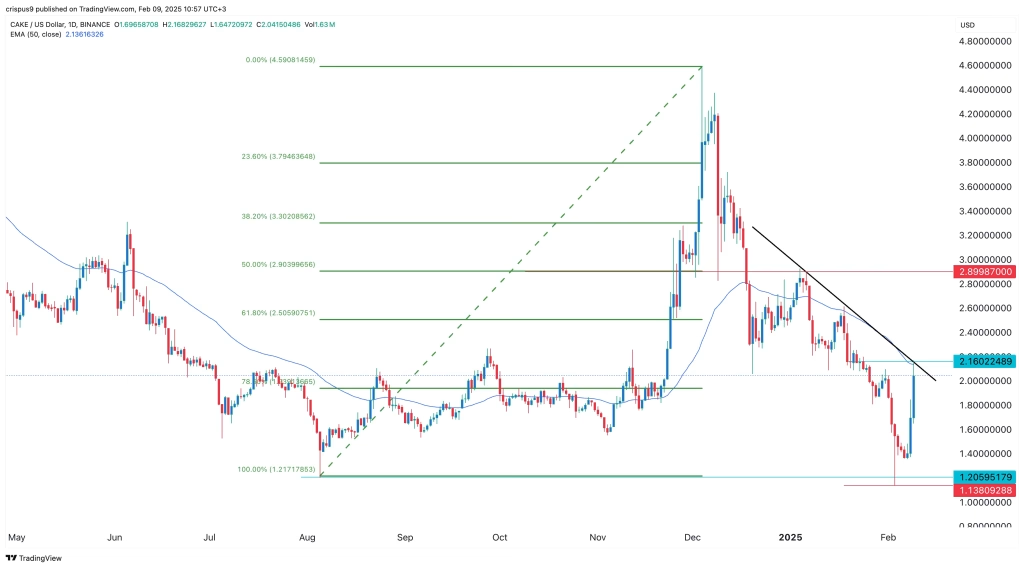
CAKE price chart | Source: crypto.news
The daily chart shows that the CAKE price bottomed at $1.1380 last week as most cryptocurrencies crashed. It formed a hammer candlestick pattern, comprising a small body and a long lower shadow.
A hammer is a popular bullish reversal pattern, which explains why it has rebounded recently.
PancakeSwap, which was launched in September 2020 by anonymous developers, has moved above the 78.6% Fibonacci Retracement level. This retracement is drawn by connecting the lowest level in August last year and the highest point in December.
The challenge, however, is that PancakeSwap price has remained below the 50-day Exponential Moving Average. It has also failed to move above the descending trendline that connects the highest swing since Jan. 4.
Therefore, the downward trend will likely continue as long as the token remains below these key resistance levels.
On the other hand, a rebound above these levels will point to more gains, possibly to the 50% Fibonacci Retracement point at $2.90.
PancakeSwap operates on the Binance Smart Chain and is governed partially by its community.
What is PancakeSwap (CAKE)?
PancakeSwap is a decentralized exchange that allows you to trade tokens while also offering opportunities to profit from liquidity pools and staking.
What sets PancakeSwap apart from the likes of Uniswap and SushiSwap is that it runs on Binance Smart Chain (BSC) instead of Ethereum.
PancakeSwap allows users to trade BEP-20 tokens, which are tokens that follow the BEP-20 token standard on the BNB Chain.
It operates on an automated market maker (AMM) model, which means that instead of using an order book like traditional exchanges, it uses liquidity pools to facilitate trades.
These pools are filled with funds from users who deposit their tokens in exchange for LP (liquidity provider) tokens.
When someone wants to trade tokens on PancakeSwap, they can do so directly with the liquidity pool, and a small fee is paid to the liquidity providers.
What is the CAKE token?
CAKE is the native BEP-20 token that powers the PancakeSwap ecosystem.
Here are some key aspects of CAKE tokenomics:
- Distribution: CAKE is distributed as a reward to users who participate in various activities on PancakeSwap, such as providing liquidity to farms and staking in Syrup Pools.
- Burning Mechanisms: PancakeSwap has implemented several mechanisms to burn CAKE tokens, effectively reducing the total supply over time. These mechanisms include burning a portion of trading fees, profits from perpetual trading, IFO fees, NFT minting fees, and more.
- Ultrasound CAKE: The Ultrasound CAKE model aims to create a deflationary environment for CAKE, where more tokens are burned than minted. This is intended to increase the scarcity and value of CAKE in the long term.
How does PancakeSwap work?
Like UniSwap, it makes use of the AMM model, which employs an algorithm to set asset prices and enables permissionless trading through liquidity pools.
Imagine PancakeSwap as a giant, automated vending machine for cryptocurrencies. Instead of having a person inside to exchange your money for snacks, PancakeSwap uses something called liquidity pools.
These pools are like big buckets filled with different types of cryptocurrencies, provided by users like you. When you want to trade one cryptocurrency for another, you interact with these pools directly.
Let’s say you want to trade your BNB tokens for some CAKE tokens. You would go to the BNB-CAKE liquidity pool on PancakeSwap.
The price of CAKE in BNB is determined by the amount of each token in the pool. If there’s a lot of BNB and not much CAKE, then the price of CAKE will be higher. It’s like when your favorite snack is almost sold out in the vending machine – it becomes more valuable!
This system is called an automated market maker (AMM) because it automatically adjusts the prices based on the supply and demand within the pools.
It’s all powered by smart contracts, which are like self-executing computer programs that ensure everything runs smoothly and transparently.
Token swaps take place through PancakeSwap’s liquidity pools, enabling trades without an intermediary and allowing liquidity providers to earn a share of the transaction fees.
Each liquidity pool is a smart contract that holds reserves of two tokens and allows anyone to deposit and withdraw tokens from them based on a set of rules.
The PancakeSwap platform makes use of the Proof of Staked Authority (PoSA) as its verification mechanism, which is a hybrid between the Proof of Stake (PoS) mechanism, like that of Bitcoin, and Proof of Authority.
As such, it supports shorter block times and lower costs than the Proof of Work (PoW) consensus model, like that of Ethereum. However, it comes at a cost of sacrificing some degree of network security and decentralization.