



The third major retirement bill in five years is taking shape in Washington, and the early signals point to an advisor-influenced framework. Representatives Greg Steube (R-FL) and Suzan DelBene (D-WA) introduced the OPTIONS Act on April 15, 2026 — bipartisan legislation that would let employers provide additional benefit dollars employees can direct toward retirement, healthcare, education, or other priorities. Per 401(k) Specialist coverage, OPTIONS is one of several individual bills that may eventually fold into the broader SECURE 3.0 package being assembled for 2026-2027 consideration.
For financial advisors, the development matters because SECURE 3.0 is being shaped explicitly with practitioner input. The advisor community’s Washington presence, channeled through trade groups like the Financial Services Institute, the Investment Adviser Association, and the National Association of Plan Advisors, is having more influence over the bill design than at any prior point in retirement legislation.
Here is what is in the early framework, what is likely to make it into the final bill, and how to talk to clients about what’s coming.
What the OPTIONS Act actually does
The OPTIONS Act creates a new category of employer benefit contribution: flexible benefit money that the employee can direct toward several pre-approved use cases, including:
- 401(k) or other retirement plan contributions
- Healthcare premium offsets
- Student loan repayment
- HSA contributions
- Childcare or eldercare expenses
The structural innovation is that the employer’s contribution dollar is fungible across categories. Today, an employer can match 401(k) contributions, contribute to an HSA, or offer student loan repayment under SECURE 2.0 — but typically as separate, fixed-purpose programs. OPTIONS would let one pool of employer dollars flex to where each employee needs it most.
For employees with student debt and limited retirement savings, the directed dollar becomes loan repayment. For employees with tuition obligations or care expenses, it covers those. For employees with neither, it goes into the 401(k). The employer makes one budgeting decision; the employee makes the allocation.
Critics will note this is essentially a flexible spending account model applied to a broader benefits framework. Supporters argue that the flexibility is exactly what younger workforces need to engage with retirement savings programs they currently view as irrelevant when they are drowning in student debt.
Why this could become law

OPTIONS has three structural strengths.
Bipartisan sponsorship. Steube and DelBene represent ideologically distinct districts. The bill’s framing — empowering employees, reducing administrative complexity for employers — appeals across party lines.
Industry support. The financial services lobby, traditionally split on retirement legislation, has rallied around OPTIONS. Recordkeepers like Fidelity, Vanguard, and Empower see it as a path to expand assets under recordkeeping. Plan advisors see it as a way to solve the engagement problem with younger workers.
Revenue-neutral framing. SECURE 2.0 had to navigate budget rules that constrained several provisions (the Roth catch-up mandate for high earners was the most visible offset). OPTIONS, by giving employers a single pool of pre-tax dollars to administer, is structured to be roughly revenue-neutral, which simplifies the legislative path.
The bill is unlikely to pass as a standalone in 2026. The path forward is incorporation into a broader SECURE 3.0 package that Congress is expected to take up in late 2026 or 2027.
What else is in the SECURE 3.0 framework
Per 401(k) Specialist’s reporting on advisor input, several priorities are under active discussion:
Auto-enrollment expansion. SECURE 2.0 already mandated auto-enrollment for newly established 401(k) plans (3-10% starting deferral, escalating to 10-15%). SECURE 3.0 may extend the requirement to existing plans on a phased basis, addressing the 60+ million American workers who do not participate in their workplace plan.
Decumulation tools. Building on SECURE 2.0’s emergency savings provisions, SECURE 3.0 may include defaults around guaranteed lifetime income options. The annuity industry has been advocating for this since QLAC limits were last expanded.
Roth simplification. SECURE 2.0’s Roth catch-up mandate for high earners (covered in our earlier piece on the 2026 implementation) created operational complexity. SECURE 3.0 may simplify the Roth/pretax election framework to reduce payroll administration burden.
Small employer relief. Tax credits and administrative relief for small employers establishing first-time plans would build on SECURE 2.0’s startup credit, which the small-business lobby views as inadequate.
Cybersecurity standards. With the multiple plan-recordkeeping breaches in 2024-2025, both employer and recordkeeper liability frameworks need clearer standards. This is one of the more contested pieces because it affects insurance pricing.
What is unlikely to make the cut
Two themes that have advocacy support but face structural headwinds:
Mandatory open MEPs. Multiple employer plans got a boost in SECURE 2.0, but mandating broader pooled-employer-plan participation faces resistance from existing recordkeepers who profit from single-employer plans.
Means-tested 401(k) contribution limits. Some progressive policy circles have floated reducing high-earner contribution limits to redirect tax expenditure toward lower-income savers. This faces strong industry opposition and is unlikely to advance.
How this connects to today’s planning conversation
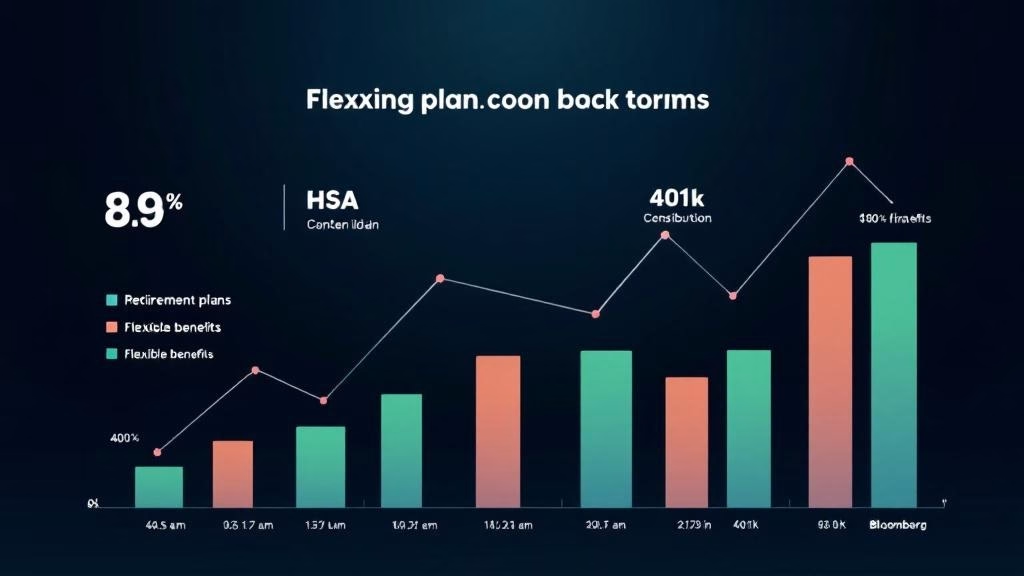
For advisors with clients who are mid-career professionals, three implications.
Roth conversion ladders may need timeline adjustment. If SECURE 3.0 changes the Roth election framework, the 5-year and 10-year ladders being built today should incorporate scenario flexibility. This builds on the OBBBA framework we covered in our prior piece.
HSA and 401(k) coordination conversations get richer. If OPTIONS passes in some form, the choice between HSA and 401(k) contributions becomes more dynamic. Clients need a framework for thinking about which dollar goes where, particularly when employer-flexible dollars enter the mix.
Auto-enrollment at existing plans changes default behaviors. If SECURE 3.0 extends auto-enrollment requirements, advisors should prepare clients (and HR contacts) for the operational changes that will roll out 12-24 months after enactment.
The intersection with the $15M estate tax exemption increase under OBBBA matters too. Wealthy clients no longer need to gift aggressively for estate tax reasons but now face a more nuanced retirement-account decisioning environment as new contribution pathways open up.
Realistic timeline
Three legislative scenarios for SECURE 3.0:
Best case (probability ~25%): Comprehensive SECURE 3.0 package passes in the late-2026 lame-duck session, signed in January 2027.
Base case (probability ~50%): Individual bills (OPTIONS, auto-enrollment expansion) pass piecemeal across 2026-2027 as parts of broader budget or tax legislation. No single “SECURE 3.0” bill, but the cumulative impact is similar.
Worst case (probability ~25%): Legislation stalls until 2028 due to election-year politics. Existing SECURE 2.0 provisions continue to roll out per scheduled effective dates.
Per Mercer Advisors’ 2026 retirement framework, the practitioner consensus is that the base case is most likely. Plan sponsors and advisors should plan for individual bills to land starting late 2026, with the full mosaic visible by mid-2027.
What advisors should do now
Three concrete preparations.
Update client communication templates to reference the legislative pipeline without overcommitting to specific outcomes. A short paragraph in the 2026 year-end client letter — “Here is what is moving in Washington and what it could mean for your plan” — sets expectations without making predictions.
Build the OPTIONS scenario into 2027 planning models. If clients have student loans, childcare costs, or other competing priorities for employer benefit dollars, model the impact of flex-direction at different employer contribution levels.
Engage with industry trade groups. The advisor influence over SECURE 3.0 is a function of organized industry input. NAPA, FSI, IAA, and the Bipartisan Policy Center all run working groups that shape draft language. Advisors who participate have direct lines to the bill text.
Three questions to bring to the next planning meeting
For advisors with clients in or near the retirement contribution sweet spot (ages 35-55):
Does the current planning conversation address the trade-offs between 401(k), HSA, and student loan repayment with a framework that flexes if the employer contribution structure changes?
For high-earning clients, has the firm modeled the cumulative effect of 2026’s Roth catch-up mandate, the 2026 IRA contribution increases, and the potential 2027 OPTIONS Act on cash flow and retirement projections?
For plan sponsor clients, what is the firm’s perspective on prepping for likely SECURE 3.0 changes (auto-enrollment expansion, decumulation defaults) so that plan documents can be updated efficiently when the legislation lands?
The next 18 months will see meaningful retirement legislation activity. Advisors who track the bills early and translate them for clients early will own the planning conversations that follow.
Sources: 401(k) Specialist on SECURE 3.0 framework and advisor input; Mercer Advisors 2026 contribution limits; Kiplinger on 2026 IRA, 401(k), HSA changes; Ascensus retirement plan updates 2026; BMF CPA 2026 SECURE 2.0 deadlines guide.
About Me

Founder and Chief Research Analyst at Trading Market Signals. Abdelali El Khadmaoui specializes in AI Wealth Intelligence, Wealth Management, Registered Investment Advisors (RIAs), Family Offices, Retirement Planning and Private Credit. He publishes in-depth research and data-driven analysis for financial professionals.