



The Internal Revenue Service published Notice 2026-13 on May 15, 2026, issuing the first full rewrite of the section 402(f) safe harbor explanations since Notice 2018-74. Plan administrators must hand the updated explanation to every participant receiving an eligible rollover distribution, and the new text folds in the SECURE 2.0 required beginning date change, the expanded 10 percent early-withdrawal exceptions, and the post-OBBBA tax brackets. For advisors, the practical question is no longer whether to update client-facing rollover memos. The question is which clients are most exposed if the old 2018 language keeps going out.
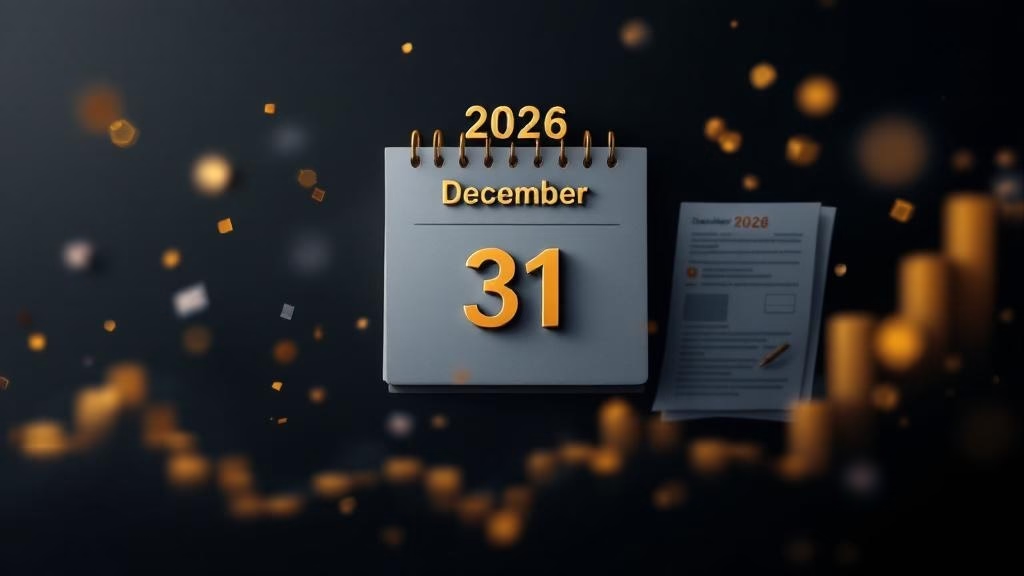
The notice arrived alongside the IRS 2025-2026 Priority Guidance Plan release and slots into a compliance window that closes December 31, 2026 for most qualified plans. Treasury kept the bifurcated structure of the prior safe harbor: one explanation for distributions that are not from designated Roth accounts and a separate explanation for Roth account distributions. The substance changed inside both, and the volume of new content materially extends the document.
Key Takeaways for Advisors
- IRS Notice 2026-13 replaces Notice 2018-74 as the model 402(f) safe harbor explanation for eligible rollover distributions
- The plan amendment deadline for most qualified plans is December 31, 2026; governmental and collectively bargained plans run to January 1, 2027
- Required beginning date is now age 73, shifting to 74 in 2033 and 75 thereafter per SECURE 2.0 §107
- Seven new early-withdrawal exceptions are reflected in the notice text, including the $22,000 federal disaster carve-out and the $10,000 domestic-abuse withdrawal
- Surviving-spouse RMD election rules were rewritten and now require fresh client conversations during 2026 estate updates
What Changed in the 402(f) Notice Text

The 2018 safe harbor ran 14 pages across two model explanations. The 2026 version runs longer, primarily because Treasury chose to spell out the SECURE 2.0 carve-outs rather than reference them by statute. According to the Groom Law Group analysis published the day of the release, the most substantive changes sit in four sections of the model explanation.
The required minimum distribution paragraph now reflects age 73 as the default required beginning date, with the staged transition to 74 in 2033 and 75 thereafter built into the model language. This matters because plans that have continued to distribute the 2018-era notice have been telling participants their RBD is 70½ or 72, both of which are now wrong for nearly every active participant cohort. KPMG flagged this exact gap in its TaxNewsFlash on related OBBBA guidance.
The early-distribution penalty section is the most heavily revised. The 2018 notice listed roughly eight exceptions to the 10 percent additional tax. The 2026 version adds the SECURE 2.0 exceptions for terminal illness, domestic abuse (up to $10,000 indexed), federally declared disaster (up to $22,000), private-sector firefighter retirement, long-term care insurance premiums in plan, and the $1,000 unforeseeable emergency withdrawal. The text walks through each with eligibility criteria so plan administrators do not have to draft their own summary.
The eligible rollover distribution definition section folds in the new treatment of qualified birth or adoption distributions, which can now be repaid within three years rather than the indefinite period the 2018 notice contemplated. Treasury also tightened the explanation of mandatory withholding for distributions that are not direct rollovers, the 20 percent default that remains the single largest source of client surprise during retirement distribution events.
How the Surviving-Spouse Rules Rewrite Widow Planning
The surviving-spouse RMD election rules in Notice 2026-13 reflect SECURE 2.0 §327, which allows a surviving spouse to be treated as the deceased employee for purposes of the RMD rules if elected. Functionally, this lets a younger surviving spouse delay RMDs until the deceased participant would have reached their RBD, rather than starting based on the surviving spouse’s own age.
For estate planners, this changes the calculus on rollovers to inherited IRAs versus leaving assets in the plan. Under the old rules, the planning default was almost always to roll the deceased spouse’s plan benefit into the survivor’s own IRA. The new election creates scenarios where leaving the assets in the qualified plan, at least until the deceased’s hypothetical RBD, can produce a measurably better outcome for younger surviving spouses, particularly those still subject to the kiddie tax on their own income or those receiving Social Security survivor benefits that depend on taxable income thresholds.
Principal Financial’s SECURE 2.0 guidance digest noted in late 2025 that recordkeepers were waiting on exactly this guidance before updating their participant distribution platforms. With Notice 2026-13 now public, plan sponsors should expect updated distribution forms from their recordkeepers across the second half of 2026.
Which of the Seven New Early-Withdrawal Exceptions Clients Can Use
The seven SECURE 2.0 exceptions to the 10 percent early-withdrawal penalty are now uniformly available in the safe harbor language, but actual client use varies sharply by exception type.
The $1,000 emergency personal expense withdrawal under SECURE 2.0 §115 has the broadest applicability. A participant can take one such distribution per calendar year without medical, hardship, or other certification. Most large recordkeepers (Fidelity, Vanguard, Empower) implemented this exception during 2024 and 2025, so the operational pathway is already live.
The $10,000 domestic-abuse exception under §314 requires self-certification but no third-party documentation, and participants have three years to repay. The $22,000 federally declared disaster exception under §331 requires that the participant’s principal residence be in a federally declared disaster area and that they sustained economic loss. With the 2025 hurricane season activating disaster declarations in Florida, Louisiana, Texas, and the Carolinas, and the 2026 wildfire season already producing California declarations, this exception is in active use across financial planning practices in those states.
The terminal-illness exception under §326 is more restrictive than it appears. The participant must obtain physician certification of a terminal illness with death expected within 84 months. For clients in the early stages of a serious diagnosis, the documentation burden is meaningful, and the exception is best layered into a broader retirement-distribution plan rather than triggered ad hoc.
Plan Sponsor Liability if the Old Notice Keeps Going Out
The amendment deadline matters more than the notice deadline for most sponsors, but the two interact. Plan sponsors who continue to distribute the 2018-era safe harbor explanation through year-end 2026 are not technically out of compliance with the safe harbor until the plan amendment deadline passes. They are, however, providing materially incomplete information to participants who are exercising rollover rights, and that creates fiduciary exposure under the Department of Labor’s participant disclosure framework.
The risk concentrates in three operational areas. First, recordkeepers that have not migrated to the new model language by Q3 2026 are likely to keep printing the 2018 version on every distribution package. Second, third-party administrators serving smaller plans typically lag the large recordkeepers by six to twelve months on these updates. Third, plans that print the 402(f) notice as part of a bundled retirement kit (often combined with the summary plan description) may not get the updated text until their next SPD cycle.
The advisor playbook here is straightforward. For any client over 55 who is approaching a distribution event, ask the recordkeeper directly which version of the 402(f) safe harbor is being sent in the distribution package. If the answer is still the 2018 version, supplement with a client memo that captures the SECURE 2.0 exceptions and the RBD shift.
What Plan Amendments Look Like by December 31, 2026
The plan amendment deadline of December 31, 2026 for most qualified plans (January 1, 2027 for governmental and collectively bargained plans) sets the compliance backstop. Plans that have not formally adopted SECURE 2.0 amendments by that date risk operational failures that flow through to Form 5500 and to participant distributions handled during the gap period.
The notice itself does not require sponsors to adopt the model language verbatim. Plans can use the model safe harbor or develop their own equivalent. In practice, most plan documents adopted off prototype or volume submitter platforms will adopt the model language because the operational efficiency outweighs any customization benefit. Custom plans, particularly large 401(k) plans with internal ERISA counsel, may produce tailored versions that reference the same statutory citations using firm-specific language.
For advisors working with plan-sponsor clients, the practical sequence runs through three checkpoints during the second half of 2026. The recordkeeper system update for the new safe harbor language. The plan document amendment adoption resolution by the board or plan committee. And the participant communication around the amendment, which is separately required under the regular participant notice rules.
Advisor Playbook for Q3 2026
The IRS notice creates two parallel advisor workstreams. The plan-sponsor side requires checking that recordkeepers are migrating to the new language and that plan amendments hit the December 31, 2026 deadline. The participant side requires reviewing every active client distribution plan and confirming the language clients are receiving reflects 2026 rules rather than 2018 rules.
For practices serving individuals approaching retirement, the surviving-spouse RMD rewrite is the highest-value conversation. Estate plans built around the old assumption that the surviving spouse rolls everything into an IRA at the moment of death need a fresh look. The new election creates planning opportunities that did not exist before, particularly when the surviving spouse is more than ten years younger than the deceased participant.
For practices serving plan sponsors, the recordkeeper conversation should happen on the next scheduled service review. The question to ask is direct: which version of the 402(f) safe harbor is your platform distributing today, and what is your timeline for migrating to Notice 2026-13 language? If the recordkeeper cannot answer with a specific date, that itself is the diagnostic finding worth flagging to the plan committee.
The broader compliance frame also matters. Notice 2026-13 follows a string of SECURE 2.0 guidance pieces that have arrived in pieces since 2023, including the auto-enrollment mandate that took effect January 1, 2026 and the super catch-up rules for ages 60-63 that are now active. Plans that adopt the model 402(f) language without checking whether they also need amendments for these other provisions will end up amending again in 2027.
Three Questions Advisors Should Ask the Plan Committee
The next plan committee meeting (or the next discovery call with a new plan-sponsor prospect) is the natural venue to surface Notice 2026-13. Three questions cut to the operational risk.
First, which version of the 402(f) safe harbor explanation is the recordkeeper distributing as of today, and when will the migration to Notice 2026-13 language be complete? An answer of “we are checking” is acceptable in May 2026 but should not be acceptable by September.
Second, has the plan adopted formal SECURE 2.0 amendments reflecting the §107 RBD changes, the §327 surviving-spouse election, and the §326 terminal illness exception, or are these still pending board action? If pending, what is the calendar to December 31?
Third, for participants who received distributions during 2024 or 2025 under the old 402(f) language, is there any remediation exposure if the prior notice failed to disclose now-available exceptions? In most cases the answer is no because the exceptions ran from their statutory effective dates, but the documentation trail matters if an audit ever surfaces.
The plans that get to the end of 2026 with all three answers cleanly documented will be in a different posture than the plans that drift. The work to get there is mechanical, but it has to be scheduled. Notice 2026-13 just made the schedule unavoidable.
Closely related coverage on this site: the Roth catch-up mandate for high earners covers the parallel SECURE 2.0 compliance track that plans amending for Notice 2026-13 should be hitting at the same time.
About Me

Founder and Chief Research Analyst at Trading Market Signals. Abdelali El Khadmaoui specializes in AI Wealth Intelligence, Wealth Management, Registered Investment Advisors (RIAs), Family Offices, Retirement Planning and Private Credit. He publishes in-depth research and data-driven analysis for financial professionals.