



Echelon Partners published its Q1 2026 RIA M&A Deal Report on May 5, showing 142 transactions in the first quarter — a new all-time record, beating the previous high of 125 deals set in Q3 2024. Total AUM transacted reached $1.67 trillion, more than double the $805 billion recorded in Q1 2025.
That doubling of transacted AUM in a single year deserves some unpacking. It is not just more deals. It is larger deals. Average assets per transaction in Q1 2026 reached $1.8 billion, the highest since 2021, which was itself an outlier quarter.
The PE engine behind the numbers
Private equity-involved transactions accounted for 102 of the 142 Q1 deals — 71.8% of total activity, and an all-time high for PE-sponsored involvement. Within that, 95 transactions were PE-sponsored, meaning a PE-backed aggregator was the buyer, and the remaining 7 involved PE firms taking direct stakes.
This is not a new trend, but the concentration is intensifying. In Q1 2024, PE-linked deals accounted for roughly 60% of activity. Two years later it is closer to three-quarters.
The practical question this raises: if PE firms are driving nearly three-quarters of all RIA acquisitions, what exactly are they buying — and are the economics working for sellers?
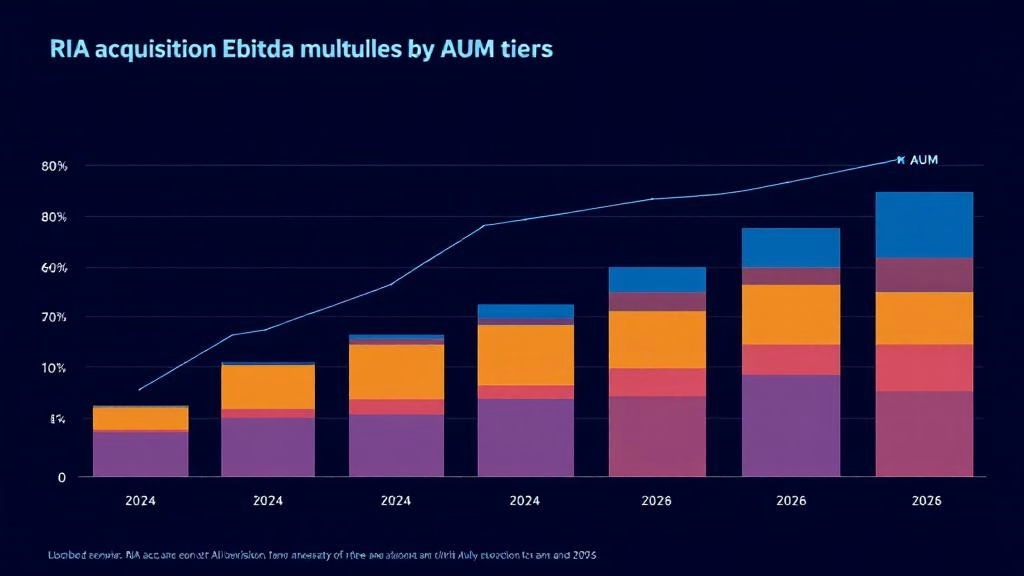
According to Echelon, the answer is yes, for now. Valuations for at-scale firms, defined as $500 million AUM and above, have held at elevated multiples. Buyers are reportedly paying 8-12x EBITDA for well-run practices with sticky AUM. Several of the larger PE-backed aggregators closed fresh fund raises in Q4 2025, and that capital needs to deploy.
The pressure point is the sub-$500 million firm. Deal volume at that size has softened relative to 2024 as aggregators focus on larger targets with better unit economics. Small RIAs looking to sell are finding a narrower buyer pool and longer timelines than they would have two years ago.
Creative Planning crosses the Atlantic

The most structurally interesting deals in Q1 2026 were not domestic. Creative Planning, the Kansas-based fee-only RIA managing more than $300 billion in assets, completed two international acquisitions in the quarter.
In January, Creative Planning acquired Baseline Wealth Management, a Swiss firm. In March, it bought MASECO Private Wealth, a UK-registered investment adviser managing more than $5 billion on behalf of American expats and dual nationals living in Britain.
The MASECO acquisition is the more significant of the two strategically. MASECO’s client base — U.S. citizens and green card holders abroad — carries specific planning complexity: tax treaty issues, PFIC exposure from foreign mutual funds, FBAR filing requirements, and Social Security coordination across two jurisdictions. This is not Creative Planning expanding into a generic international wealth management business. It is picking up a defined, underserved client segment with genuine planning depth.
This follows a broader pattern of U.S. RIA aggregators treating European and Australian markets as the next frontier. Echelon flagged international expansion as an emerging theme in the Q1 report, noting several other acquirers made early-stage inquiries into UK and European firms during the quarter.
What 475 deals would mean for the full year
Echelon’s projection for full-year 2026 is approximately 475 transactions. If that holds, it would exceed 2025’s record of roughly 390 deals by about 22%.
More importantly, if Q1’s average of $1.8 billion in AUM per deal holds through the rest of the year, total 2026 transacted AUM could approach $3.5 trillion. Even accounting for double-counting in platform rollups, that represents a meaningful consolidation of independent advisory assets in a single calendar year.
This pace has a supply-side implication. At some point, the pool of attractive acquisition targets at scale gets thinner. Echelon’s research has previously flagged that the “sweet spot” cohort of $500 million to $2 billion RIAs has been shrinking year-over-year as those firms either sell up into aggregators or grow past the $2 billion threshold through organic growth and smaller bolt-ons.
The private equity concentration in RIA deals has been building for two years. The record 2025 advisor movement data from Cerulli — 39,171 advisors changing firms — provides the supply-side context: there is a continuous pool of advisors looking for better platforms, and the aggregators have built the infrastructure to absorb them.
The international angle: what advisors should know
The Creative Planning-MASECO deal has prompted conversations among independent RIAs about whether international AUM represents a viable growth frontier.
The reality is more complicated than the headline suggests. Serving U.S. clients abroad is a compliance-heavy, operationally demanding business. FINRA registration alone does not cover international operations. UK firms serving U.S. persons need FCA registration, and managing PFIC exposure or pension treaty elections requires tax specialists most advisory firms do not have on staff.
This is a business for firms with genuine infrastructure, not a bolt-on. RIAs considering international expansion through acquisition should be examining:
- Whether the target has compliance counsel experienced in cross-border U.S. person taxation
- Whether custodial relationships extend to international accounts (Schwab and Fidelity both have international custody capabilities, but the setup is not automatic)
- Whether the advisor team at the acquired firm holds Series 65 or equivalent credentials for U.S. regulatory purposes
For advisors not considering acquisition, the MASECO deal is a concrete reminder that roughly 9 million Americans live outside the U.S., according to State Department data, and most are underadvised on the interaction between U.S. tax obligations and their local financial planning context. That is a niche with real demand and very few practitioners who handle it well.
Comparing with the DeVoe Q1 data
Q1 2026 RIA M&A had already drawn attention in late April based on separate data from DeVoe & Company. The Echelon figures capture more of the middle market than the DeVoe methodology, which may explain the higher transaction count. The two reports are complementary rather than contradictory.
What Echelon adds is the AUM concentration picture. A small number of very large deals is pulling the aggregate AUM number up significantly. The median deal in Q1 was still a sub-$1 billion firm. The mean is inflated by a handful of multi-billion-dollar transactions.
The LPL acquisition of Mariner Advisor Network at $31 billion is a good example of how a single deal reshapes the quarterly average. Strip out the top five transactions in Echelon’s Q1 dataset and the picture looks somewhat more like previous quarters. But the top five are real deals, and they represent real consolidation at scale.
Three questions to bring to your M&A conversations
- If PE-backed aggregators are paying 8-12x EBITDA for firms above $500 million AUM, what is the realistic valuation for a $200-400 million firm today — and has your last independent valuation been updated in the past 18 months?
- Given that 71.8% of deals involve PE buyers, what is the realistic exit path from a PE-backed aggregator in five to seven years, and is that timeline consistent with your succession goals?
- For firms considering international growth: does your current compliance infrastructure handle cross-border U.S. person issues already, or would you be building that from scratch post-acquisition?
About Me

Founder and Chief Research Analyst at Trading Market Signals. Abdelali El Khadmaoui specializes in AI Wealth Intelligence, Wealth Management, Registered Investment Advisors (RIAs), Family Offices, Retirement Planning and Private Credit. He publishes in-depth research and data-driven analysis for financial professionals.