Roundhill Investments’ Memory ETF (DRAM) crossed $3 billion in assets under management by early May 2026 — roughly five weeks after its April 2 debut. It passed $1 billion in just 10 trading days. No thematic ETF has grown that fast.
That speed matters beyond the headline number. It tells you something about what investors are looking for in 2026, and about what the ETF industry has figured out about capturing that demand quickly.
What DRAM actually holds
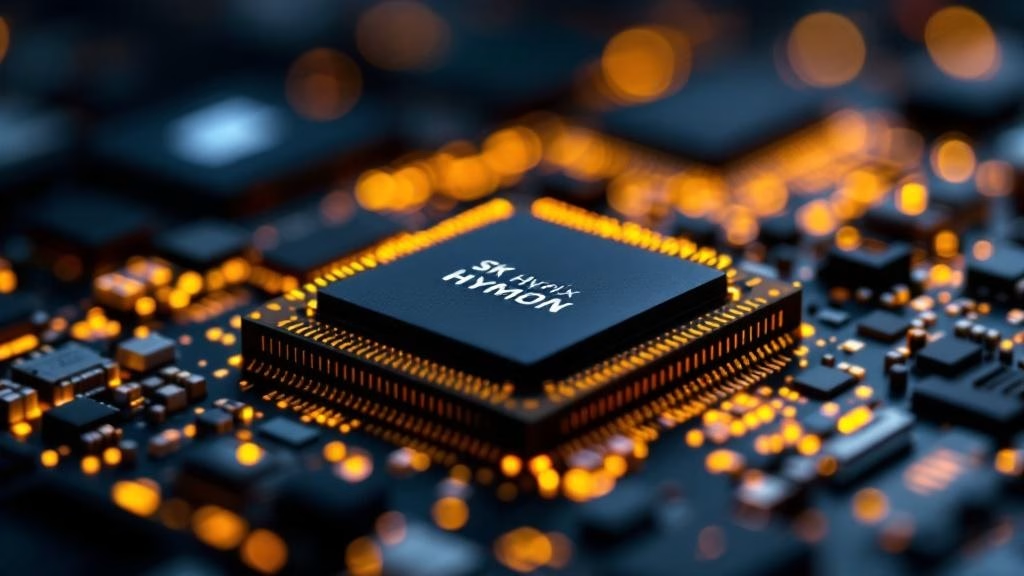
The fund targets global memory chip producers: companies making High Bandwidth Memory (HBM), NAND flash, and DRAM. These are the semiconductors hitting capacity constraints as AI infrastructure buildouts accelerate. SK Hynix, Samsung, and Micron are the core holdings. The gross expense ratio is 0.65%.
Roundhill’s pitch is straightforward. If you believe AI spending continues and memory is the bottleneck, this is a cleaner way to own that thesis than buying broad chipmakers. Whether that thesis holds over three years is a different question. The $3 billion says a lot of people wanted in fast regardless.
Why the launch was different
Most thematic ETFs spend their first six months fighting for visibility. DRAM did not have that problem, for several reasons.
The memory semiconductor story was already running in the financial press well before launch. SK Hynix’s HBM revenue grew more than 300% year-over-year in 2025. Micron’s December 2025 earnings call showed HBM average selling prices had roughly doubled since early 2024. By the time DRAM listed on April 2, the narrative was pre-warmed.
Roundhill also ran an early marketing push aimed at advisors and RIA platforms. The ETF was seeded with enough capital to clear liquidity minimums on major platforms from day one — an operational detail that often delays institutional adoption for smaller fund companies. That matters.
Timing helped too. April 2 was the second day of what became a volatile stretch for equity markets. In a period where investors were hunting for targeted, liquid, single-theme exposure and willing to move fast, a well-packaged new ETF had an easier path than it would in a quieter period.
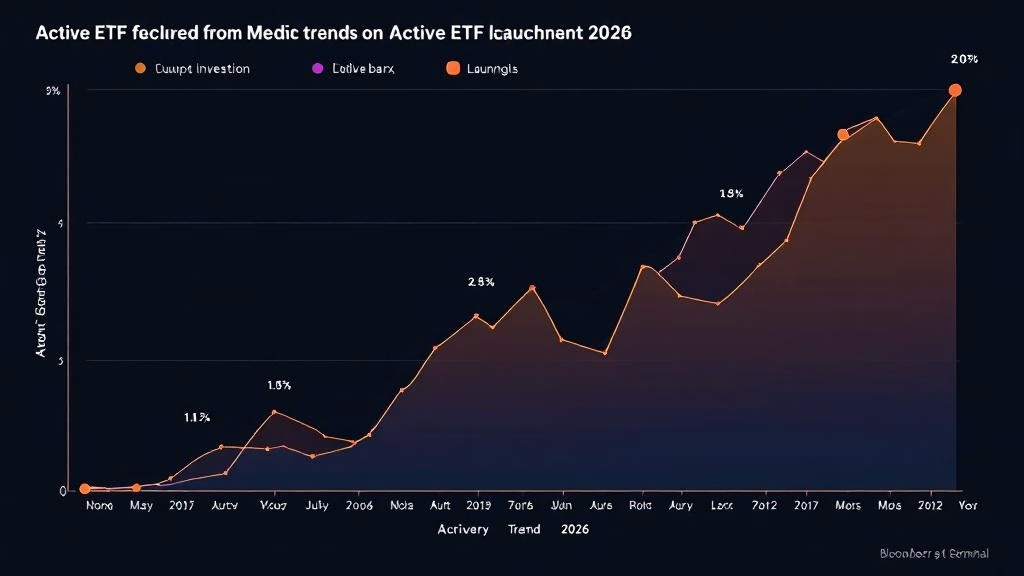
370+ ETF launches in 2026 — and 80% are active
DRAM is the standout example in a launch environment that has already turned record-setting. According to ETFdb.com’s May 2026 tracker, new ETF launches have surpassed 370 year-to-date, on pace to exceed the 2024 full-year record by a wide margin.
The distribution of those launches is worth sitting with. Active ETFs account for roughly 80% of the 2026 launch count. Not semi-active, not factor-based quasi-index funds — genuinely active strategies where a portfolio manager makes daily decisions.
That shift has been building for years. We have covered JPMorgan’s emergence as the largest active ETF issuer by asset count and the structural milestone of the mutual fund count falling to its lowest level since 1983. But the 2026 launch count suggests the shift has moved from gradual to aggressive. About 42% of total ETF flows year-to-date have gone into active strategies, per ICI and etf.com data through early May.
What the weekly flow numbers say
For the week ended April 29, 2026, the ICI reported total long-term mutual fund outflows of $16.84 billion. In the same week, ETF net issuance came in positive at $24.93 billion.
That roughly $42 billion weekly spread is notable not because it is unprecedented, but because it now happens routinely. The structural rotation that began in the late 2010s has not slowed.
Within ETF flows, U.S. fixed income led with $4.85 billion in net inflows on May 5 alone. That fixed income ETF demand connects directly to Vanguard’s $250 million fee cut across 53 funds. When investors are moving into fixed income ETFs at scale, they increasingly land in products where the cost floor is below 0.10%. Active funds in that space charging 0.35% or more face harder questions than they did two years ago.
Thematic ETF saturation: the other side
The DRAM story is compelling but it should not be read as evidence that thematic ETFs broadly succeed. For every DRAM, there are dozens of launches that fail to cross $50 million in year one.
Morningstar data from 2024 showed the median thematic ETF launched between 2018 and 2022 had either closed or fallen below $100 million by 2024. The category has a high attrition rate. Investors who land in the top-percentile performers do fine. Investors who pick the wrong theme — blockchain ETFs from 2021 come to mind — learn an expensive lesson.
Roundhill has track record in thematic ETF execution. Their earlier funds include the Roundhill Magnificent Seven ETF (MAGS) and several other concentrated thematic strategies. DRAM is not their first rodeo, and it showed in the operational execution.
What fund selectors need to examine now
Fund selectors at RIA home offices and 401(k) platforms will face a version of this question increasingly: when a new thematic ETF grows to $3 billion in five weeks, does it earn a place on your platform?
The liquidity argument used to be the default no. Most due diligence checklists required 12 months of trading history. That threshold is under pressure as more funds arrive well-seeded, with institutional market-making agreements in place from day one.
The questions that actually matter now are different:
- Does the fund’s index methodology carry survivorship-bias risk — is it targeting a theme that may be obsolete in three years?
- What is the overlap with broader semiconductor ETFs already on the platform?
- Is the 0.65% expense ratio defensible relative to what a broader chip fund gives you at 0.35%?
The cash parked in money market funds provides a secondary signal. If the $7.6 trillion in money markets starts rotating into equities in any volume, thematic ETFs with pre-existing demand tend to benefit disproportionately in the early months of that rotation.
What to watch in Q2 2026
The memory semiconductor theme has a specific catalyst calendar. Micron’s next earnings call is the most direct read on whether HBM pricing is holding. Any guidance revision there will move DRAM more than it moves the broader chip ETFs.
If HBM pricing cracks — which some analysts consider the base case by late 2026 as supply comes online — a fund that grew to $3 billion partly on narrative momentum will face redemption pressure. The liquidity structure can handle it. But it will show up clearly in flows.
Three questions your investment committee should be asking
- Does the portfolio already own meaningful semiconductor exposure through broad tech or factor ETFs, and does adding DRAM create genuine concentration rather than diversification?
- For clients asking about AI exposure specifically: is memory semiconductor the most durable way to own that thesis, or is direct HBM exposure better accessed through the underlying companies at lower cost?
- If a thematic ETF with five weeks of trading history crosses your liquidity minimum, what is the documented process for reconsidering the 12-month history requirement?
About Me

Tradingmarketsignals serves as the definitive digital ecosystem for the modern wealth management community. As a premier source of intelligence, it delivers high-level analysis, regulatory updates, and technological insights tailored specifically for independent financial advisors, RIA leaders, and investment professionals.