



Key Takeaways – The Congressional Budget Office’s February 2026 baseline moves OASI trust fund exhaustion to fiscal year 2032, one year sooner than the 2025 Trustees Report projected. – Under current law, depletion triggers roughly a 7% benefit cut in 2032, deepening to an average of 28% annually from 2033 to 2036 (CBO illustrative scenario). – The Social Security Fairness Act’s $17 billion in retroactive WEP/GPO payments to 3.1 million beneficiaries is among the factors accelerating the depletion timeline. – For clients aged 55–65, the 2032 date falls inside the standard claiming window, making income diversification and dual-scenario modeling non-optional. – Advisors should run two projections: one at 100% benefits, one at 77 cents on the dollar, and present both as a planning range.
The Congressional Budget Office updated its Social Security baseline in February 2026, projecting the OASI trust fund will exhaust reserves in fiscal year 2032, one year earlier than the 2025 Trustees Report estimated. Without congressional action, the program would pay approximately 72% to 77% of scheduled benefits once the fund runs dry.
For advisors whose clients are approaching their late 50s and early 60s, the math just changed. The 2032 date falls squarely within the claiming window for clients born between 1962 and 1970, people who are 56 to 64 today.
What Moved the Depletion Date to 2032?
The timeline moved for several reasons, and their interaction matters more than any single cause.
The Social Security Fairness Act, signed on January 5, 2025, repealed the Windfall Elimination Provision (WEP) and the Government Pension Offset (GPO). The Social Security Administration processed over 3.1 million retroactive payments totaling $17 billion by mid-2025, covering benefit increases retroactive to January 2024. Those payments drew directly from trust fund reserves, legitimately owed but an accelerant the 2025 baseline had not fully priced in.
Demographics added pressure. Approximately 10,000 Baby Boomers turn 65 every day, a pace that continues through 2029. Benefit outlays are outrunning payroll tax contributions by a widening margin.
Higher-than-expected inflation in 2024 and 2025 also triggered larger cost-of-living adjustments. Each COLA locks in a higher baseline for all future payments, compounding outflows year over year.
The combined OASDI fund (OASI plus the smaller Disability Insurance trust) depletes in 2033, per the same CBO baseline. Congress could merge the two funds to buy a year, as it did in 1983. That is a bridge, not a fix.
What Does a 28% Benefit Cut Actually Mean for a Retired Client?

The CBO’s illustrative benefit-reduction scenario is the most planning-relevant figure advisors have. Under the February 2026 baseline, benefits fall by approximately 7% in 2032, then average 28% annually from 2033 through 2036 as reserves wind down.
A client receiving $3,200 per month in 2033 would see payments drop to roughly $2,304 under a 28% cut, a loss of $10,752 per year. For a married couple each receiving $2,800, the combined shortfall would exceed $19,000 annually.
Social Security replaces approximately 40% of pre-retirement income for the median worker, according to SSA data. A 28% reduction to that 40% floor removes a structurally significant income layer from plans built around it.
The 77 cents-on-the-dollar figure (a 23% cut) reflects the steady-state scenario after reserves are gone, when incoming payroll taxes cover remaining benefits. The CBO’s 28% average over 2033–2036 accounts for the transition period when the fund winds down faster than payroll tax income fills the gap.
How Does the Social Security Fairness Act Change the Picture for Former Public Employees?
The WEP/GPO repeal introduced a planning complexity that most advisors have not yet fully worked through.
Former teachers, firefighters, and federal employees covered by the Civil Service Retirement System now receive Social Security benefits they were previously denied or reduced. Many received lump-sum retroactive payments dating to January 2024. By mid-2025, the SSA had disbursed $17 billion in such payments across 3.1 million beneficiaries, per SSA data.
The planning complication: those lump sums and the new ongoing SS stream count as provisional income. A retired teacher who received an $18,000 retroactive payment in 2025, combined with pension income, may have crossed the $44,000 married-filing-jointly threshold at which 85% of Social Security benefits become federally taxable.
Advisors with public-sector clients should audit 2025 provisional income. Those who crossed either threshold — $32,000 MFJ for 50% taxability, $44,000 MFJ for 85% — may benefit from Roth conversion strategies in 2026 and 2027 to reduce future provisional income before required minimum distributions begin.
There is also an unresolved retroactivity dispute. As of March 2026, some surviving spouses and late filers are challenging SSA’s interpretation of the six-month retroactivity cap for spousal and survivor benefits, per Government Executive and FedWeek reporting. Clients in that category should be flagged for potential back-benefit recovery if the SSA’s position is overturned.
Is the Standard Delay-to-70 Advice Still Valid Under a Benefit-Cut Scenario?
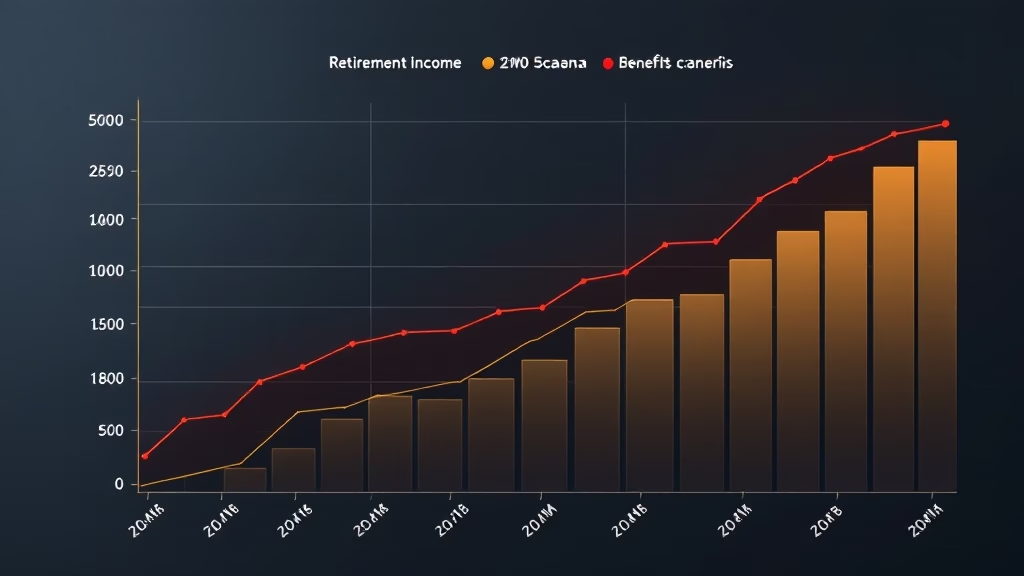
The conventional wisdom to delay Social Security claiming until 70 rests on an assumption of 100% benefits through the claimant’s lifetime. The 2032 depletion date puts pressure on that assumption.
A client born in 1965 reaches full retirement age of 67 in 2032, the same year the CBO projects the first cut. If they claim at 62 today, they receive 70% of their primary insurance amount (PIA) at a permanently reduced level. If they delay to 70, they receive 124% of PIA, but under a 28% cut, that effective value drops to roughly 89% of PIA.
For clients in their early to mid-60s, the break-even calculation between claiming at 67 and 70 narrows meaningfully once a probability-weighted benefit-cut scenario is applied. Morningstar’s retirement income research published in 2025 recommends dual-scenario modeling (100% benefits and 77 cents on the dollar) as the new baseline for any comprehensive retirement plan.
The optimal claiming age depends on health, other income sources, portfolio size, and each client’s read on congressional action probability. Model multiple claiming ages against both scenarios rather than defaulting to the delay-to-70 heuristic.
Also relevant: our earlier analysis of the IRS 2026 retirement contribution limits and their interaction with Social Security income thresholds is available at IRS 2026 Retirement Limits: The Advisor Playbook.
Six Planning Moves for Advisors With Clients Aged 55–65
- Run dual-scenario projections. Model 100% benefits and a 23% haircut (77 cents on the dollar). Present both as a planning range, not a prediction. The goal is not to alarm but to show whether the plan holds under a reasonable stress scenario.
- Audit provisional income for WEP/GPO clients. Former public employees who received retroactive payments in 2025 may have crossed taxability thresholds. Review 2025 returns before the October extension deadline and adjust 2026 withholding if needed.
- Revisit claiming-age break-even. For clients born 1963–1970, the delay-to-70 default needs a benefit-cut overlay. Rerun break-even calculations with a probability-weighted assumption (50% probability of a 20% cut, for example) and document the analysis in the client file.
- Prioritize Roth conversions in 2026–2030. The OBBBA’s permanent tax rates create a known planning window. Converting traditional IRA assets now reduces provisional income in retirement and builds a tax-free reserve that does not depend on SS benefit levels. Our analysis of Roth Conversion Strategy Under OBBBA Permanent Tax Rates covers the income bracket math in detail.
- Add floor income for clients within 10 years of retirement. Single-premium immediate annuities or deferred income annuities provide guaranteed income regardless of congressional action. For clients with minimal pension income, a 20–25% annuity sleeve reduces Social Security dependency and lowers sequence-of-returns exposure.
- Update portfolio withdrawal assumptions. If Social Security provides 30%–35% of income (down from 40%), the portfolio must carry more weight, pushing required withdrawal rates higher. William Bengen’s 4.7% rule, discussed in our 2026 Safe Withdrawal Rate analysis, holds in a diversified portfolio, but the blended income floor assumption changes when Social Security is haircut.
What Questions Should Advisors Bring to the Next Client Review?
- If your Social Security benefit were reduced by 23% starting at age 67, which other income sources would cover the gap, and are those sources currently funded in your plan?
- For former public employees who received a retroactive WEP/GPO payment in 2025: has your tax advisor confirmed whether that lump sum changed your provisional income threshold, and did we adjust your 2026 estimated tax payments accordingly?
- At what claiming age does your retirement plan remain funded through age 90 under a 23% benefit reduction, and have we stress-tested that scenario together with your current portfolio balance?
About Me

Founder and Chief Research Analyst at Trading Market Signals. Abdelali El Khadmaoui specializes in AI Wealth Intelligence, Wealth Management, Registered Investment Advisors (RIAs), Family Offices, Retirement Planning and Private Credit. He publishes in-depth research and data-driven analysis for financial professionals.