

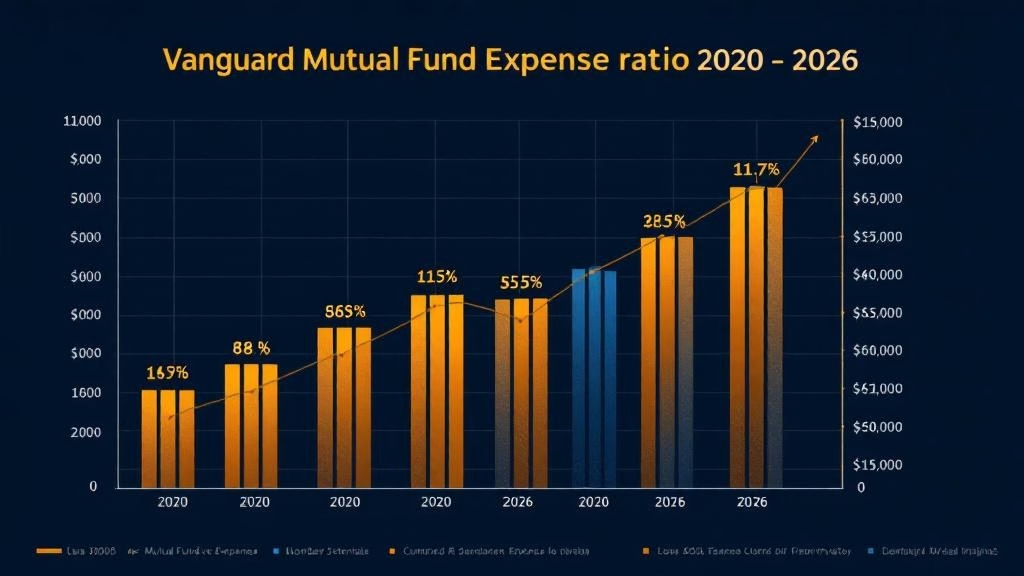
On February 2, 2026, Vanguard lowered expense ratios on 84 share classes across 53 mutual funds and ETFs — delivering what the firm estimates as nearly $250 million in annual savings to its investors. The average reduction across affected funds was 27%. Vanguard’s overall average expense ratio now sits at 0.06%.
That last number deserves a moment. A 6-basis-point average across a $11.5 trillion fund complex is not a fee — it’s rounding error. And that’s exactly the point.
This is the second broad round of cuts in 12 months. Combined with the $350 million in savings delivered across the final 11 months of 2025, Vanguard will have returned an estimated $600 million to investors over two years — what the firm calls its “largest-ever two-year combined cost reduction.”
Fund selectors, plan sponsors, and the RIA model builders who use Vanguard as a core allocation should understand what this move actually changes. Because it changes more than a few basis points on a fact sheet.
What Got Cut and by How Much
The affected funds span equity, fixed income, money market, and multi-asset strategies. Morningstar data shows the median expense ratio of this group was already just 0.06% before the announcement. The median cut was 0.01% — one basis point.
That sounds trivial. Over 30 years on a $1 million portfolio, one basis point of annual fees compounds to roughly $30,000 in additional investor wealth. Multiply that by the assets affected — roughly 10% of Vanguard’s U.S. book — and the arithmetic starts to look significant.
On the fixed-income side specifically, Vanguard says 100% of its active fixed-income funds and 89% of its fixed-income ETFs are now priced in the lowest cost decile of their respective Morningstar categories. That is a competitive position that most active bond managers cannot match, even before you account for the performance comparison.
Why Now — and Why It Keeps Happening
Vanguard is structured as a mutual company owned by its funds, which are owned by their shareholders. There are no external shareholders demanding margin expansion. When scale generates savings, the model requires passing them through — there is no profit center to absorb the surplus.
This is structurally different from what BlackRock, Fidelity, or T. Rowe Price face. They run competing fiduciary duties: investors on one side, public shareholders (or in Fidelity’s case, family ownership priorities) on the other. Cutting fees at Vanguard requires an accounting decision. Cutting fees at a publicly traded asset manager requires a capital allocation argument. Those are very different conversations.
Vanguard brought in about $115 billion in net new money during 2025, according to Morningstar estimates. That inflow growth provides the scale that makes further fee cuts possible. It is a feedback loop — lower costs attract flows, flows drive scale, scale enables lower costs.
The industry has been watching this dynamic play out for 15 years. But the pace has accelerated since 2020, when the shift from active to passive strategies became less of a trend and more of a structural rerouting of capital. As we noted when active ETF counts hit their highest level while the mutual fund count dropped to its lowest since 1983, the industry is splitting: fee compression at the commodity end, and a flight to genuine alpha at the top.
What Active Managers Are Watching
The practical pressure on active fund managers is not from this cut in isolation. It is from the cumulative effect of 15 years of cuts, and from the fact that Vanguard’s fixed income lineup in particular now overlaps with territory where active managers thought they had defensible ground.
Intermediate-term bond funds, for example, have been a category where active managers historically justified fees through credit selection and duration management. With Vanguard’s active fixed-income funds now in the lowest cost decile — while carrying active management mandates — that justification becomes harder.
Short-duration credit, multi-sector bond, and core-plus categories are the three spaces where plan sponsors and 401(k) platforms should be re-examining their active fund selections most carefully in 2026.
Cerulli Associates has tracked a steady shift of plan sponsor allocations from actively managed fixed income to index and semi-active funds. That trend was already in motion before this announcement. It accelerates now.
The Fee War’s Next Frontier: Model Portfolios
Vanguard launched four new fixed-income model portfolios in late March 2026 under its BondBuilder program, pitched directly to RIA home offices and TAMPs as ready-to-use building blocks. Those models now sit on a fund lineup where the underlying holding costs are, in several cases, a single digit number of basis points.
For RIA firms building their own model portfolios, this creates an awkward question: is there a justification for using a third-party active bond fund at 0.45% when a Vanguard active fixed-income fund in the same category costs 0.07%? The answer depends on the specific strategy, the advisor’s due diligence process, and the performance attribution — but the bar for justifying the premium is higher than it was a year ago.
JPMorgan, now the largest active ETF issuer by asset count, is responding through product differentiation — tilting toward factor strategies, alternatives exposure, and structured credit rather than vanilla core fixed income. That is where active fee premium can still be defended. Plain-vanilla active bond funds without a clear alpha track record face a harder road.
What the $600 Billion in Money Market Flows Means for This

Vanguard also manages some of the largest money market mutual funds in the U.S. — a category that has collected extraordinary inflows over the past two years as the cash wall in money market funds grew past $7.6 trillion on the back of elevated short-term yields.
The February fee cuts included money market share classes. With prime and government money market fund expense ratios now compressed even further, the yield pickup available to fund selectors who want to stay in the short-duration camp — but want maximum yield net of fees — continues to favor Vanguard’s institutional share classes over higher-cost competitors.
This matters for plan sponsors managing stable value alternatives and for RIA cash management strategies. A difference of 3-5 basis points in money market fees, compounded across a client book with significant cash allocations, is real money.
What to Watch Before Q3 2026
Three questions that fund selectors and plan sponsors should be asking their investment committees now:
- Which active fixed-income allocations in our current lineup are now within 20 basis points of equivalent Vanguard passive or semi-active options — and do we have performance data that justifies the gap?
- Has our model portfolio review process been updated to reflect the February 2026 expense ratio changes, or are we still running last year’s cost comparisons?
- For money market allocations in 401(k) plans: are we in the share class with the lowest expense ratio available to plan participants, or are we paying institutional-level fees for retail-level access?
The Vanguard fee cut does not require an immediate portfolio overhaul. But it does raise the bar for every active manager trying to justify a premium. Advisors who are not updating their cost basis comparisons this quarter are doing their clients a disservice.
Sources: Vanguard press release (February 2, 2026); Morningstar fund data; Cerulli Associates; 401k Specialist magazine; AdvisorPerspectives.
About Me

Tradingmarketsignals serves as the definitive digital ecosystem for the modern wealth management community. As a premier source of intelligence, it delivers high-level analysis, regulatory updates, and technological insights tailored specifically for independent financial advisors, RIA leaders, and investment professionals.