


Tax season ended April 15. The planning season — if you are doing this right — started April 16.
Two changes embedded in the One Big Beautiful Budget Act of 2025 (OBBBA) and the expiration of the American Rescue Plan’s enhanced subsidy provisions are hitting simultaneously in 2026. Each one alone would warrant a client conversation. Together, they represent one of the more complex household tax planning environments in the past decade for advisors serving upper-middle-income and high-income clients.
This is not a “wait until year-end” situation. Both changes have household income thresholds that interact with each other, and with other planning tools like Roth conversions and QCDs, in ways that need to be mapped now — not in November.
SALT Is $40,000. But It’s Not $40,000 for Everyone
The OBBBA quadrupled the state and local tax deduction cap from $10,000 to $40,000 for tax years 2025 and 2026. Specifically, the cap for 2026 is $40,400, indexed for inflation annually until it reverts to $10,000 in 2030.
For homeowners in high-tax states — California, New York, New Jersey, Massachusetts, Connecticut, Illinois — this is a material change. A dual-income household paying $25,000 in property taxes and $18,000 in state income taxes on a combined $450,000 of earned income can now deduct the full $40,400. Under the old $10,000 cap, they were leaving $33,000 of legitimate deduction on the table.
The problem is the phaseout. And the phaseout is steep.
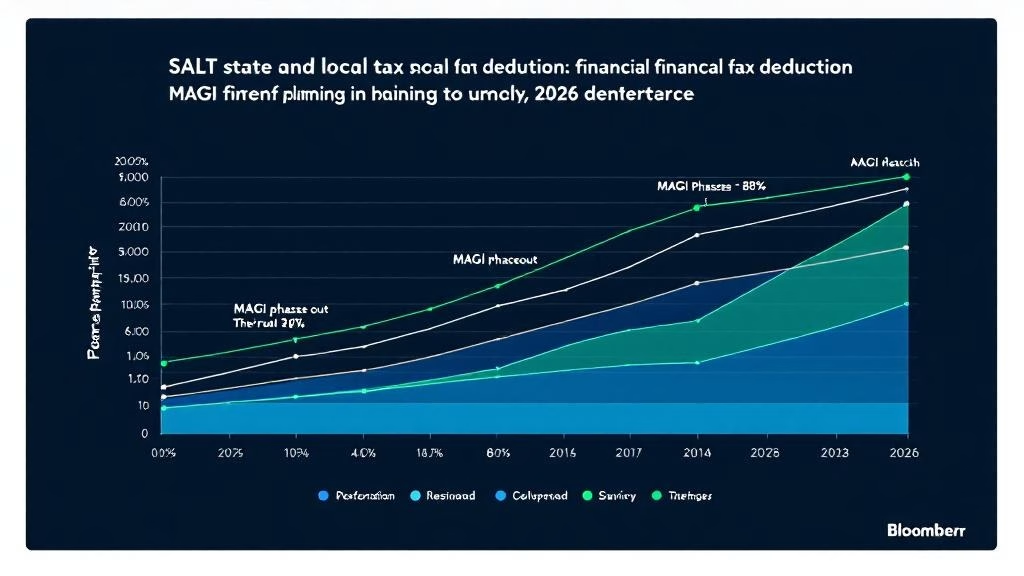
For households with modified adjusted gross income above $500,000 ($250,000 for married filing separately), the $40,400 cap begins to phase out at a rate of 30 cents for every dollar of MAGI above the threshold. A household earning $600,000 faces a reduction of $30,000 — which brings their effective SALT cap back down to $10,400. At $633,000 of MAGI, the cap is fully phased back to the $10,000 floor.
So the SALT change is transformative for households earning $200,000–$490,000 in high-tax states. Above $500,000, the benefit erodes rapidly. Above $633,000, it disappears entirely. Kahn Litwin Foti’s tax advisory group has flagged this phaseout cliff as one of the most planning-relevant features of the OBBBA for their high-income client base.
The practical implication: for clients in the $450,000–$550,000 MAGI range, income management becomes more valuable than it was before. A client at $520,000 of MAGI who can contribute an additional $20,000 to a traditional 401(k) — bringing MAGI to $500,000 — may preserve the full $40,400 SALT deduction. That is a $30,400 swing in deductible expenses.
This is the kind of planning that was irrelevant when the cap was $10,000 flat. It matters now.
The Roth Conversion Interaction
For clients considering Roth conversion strategies in 2026, the SALT phaseout adds a new variable. A Roth conversion increases MAGI dollar-for-dollar. A client at $480,000 of pre-conversion MAGI who does a $50,000 Roth conversion lands at $530,000 — above the phaseout threshold.
The tax cost of that conversion is not just the ordinary income tax on $50,000. It also includes the loss of $9,000 in SALT deduction (30% of the $30,000 in excess MAGI). For a client in a 37% marginal bracket paying 13% state income tax, that lost deduction costs roughly $4,500 in additional taxes.
This does not mean Roth conversions are wrong. It means the breakeven analysis needs to incorporate the SALT impact alongside the bracket comparison. Advisors using software that does not account for the SALT phaseout in Roth conversion modeling should flag this gap.
The same logic applies to decisions about 401(k) super catch-up contributions for ages 60–63. The 2026 super catch-up limit is $11,250. For a client sitting just above the SALT phaseout threshold, contributing the maximum to a pre-tax 401(k) can pull MAGI back below $500,000 — restoring the full SALT deduction. The tax value of that combined move can significantly exceed the deduction value of the retirement contribution alone.
The ACA Cliff Is Back — and Early Retirees Are Exposed
The second major change in 2026 is the expiration of the enhanced premium tax credits that were introduced under the American Rescue Plan in 2021 and extended through 2025 under the Inflation Reduction Act.
Starting January 1, 2026, the old ACA subsidy structure is back in effect. That means:
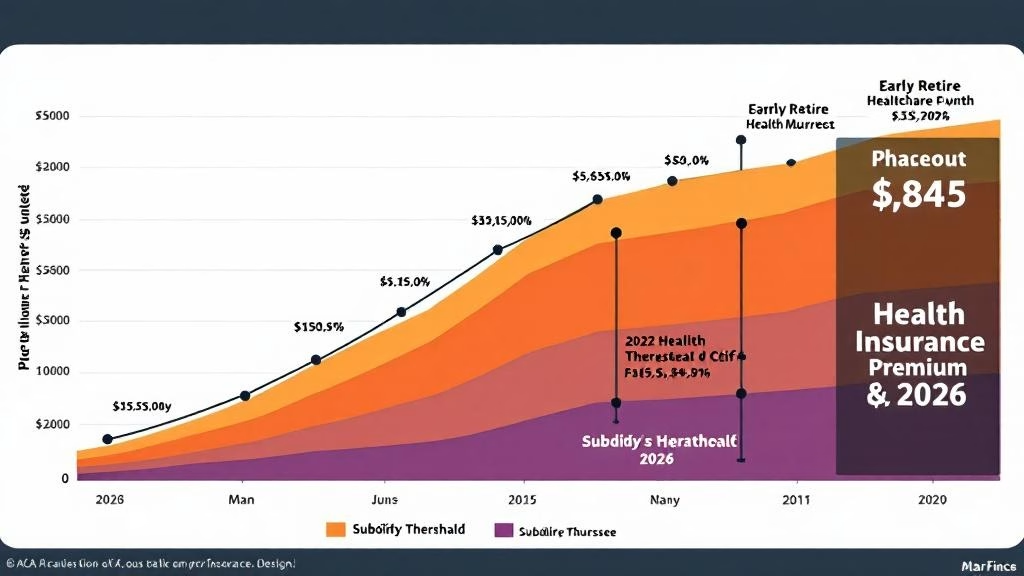
- Households earning above 400% of the federal poverty level (roughly $84,600 for a couple in 2026) are no longer eligible for any premium tax credit.
- Households between 300%–400% FPL see their premium tax credit reduced significantly.
- The “subsidy cliff” has returned: a household earning $84,601 — $1 above the threshold — owes the full, unsubsidized premium on a marketplace plan.
For clients in early retirement — those who left the workforce at 57, 60, or 62 and are not yet Medicare-eligible at 65 — this is a planning crisis that may have arrived without enough warning. Many of these clients adjusted their retirement spending and drawdown plans during 2021–2025 based on access to subsidized marketplace coverage. That access is gone.
The unsubsidized premium for a 60-year-old couple on a silver-tier marketplace plan in a high-cost state like Massachusetts or California can reach $28,000–$36,000 per year. That is a meaningful line item in a retirement budget.
What Early Retirees and Pre-Medicare Clients Need to Hear Now
For pre-Medicare clients who relied on enhanced ACA subsidies, advisors need to revisit the income management strategy.
The core tool remains MAGI management. ACA premium tax credits are calculated on MAGI, which for most retired clients is the sum of taxable distributions, Roth conversions, Social Security (if applicable), and taxable portfolio income. Clients who can hold their MAGI below 400% FPL — roughly $84,600 for a couple — may still qualify for partial premium tax credits under the legacy structure.
The tools for keeping MAGI below the threshold include:
Roth distribution sequencing. Qualified Roth IRA distributions are not included in MAGI. A client who has been building Roth assets — either through direct contributions or the Roth conversion work done in prior years — can draw from those accounts without triggering the ACA income calculation. This is exactly why the HSA expansion under the OBBB Act matters: pre-Medicare retirees who can fund an HSA-eligible plan are building a tax-advantaged medical expense reserve that doesn’t count against ACA income limits when spent on qualified healthcare.
QCD planning for Social Security-claiming clients. For clients over 70½ who are also receiving Social Security and taking required minimum distributions, qualified charitable distributions from IRAs reduce MAGI directly by offsetting the RMD without counting as income. For a couple with $90,000 in combined RMDs who want to stay below the ACA threshold, a $6,000 QCD brings reportable income down materially. Combined with Medicare IRMAA planning considerations, QCD strategy in 2026 is doing more planning work than at any point in recent history.
Capital gain deferral. Clients with appreciated positions who were planning to rebalance should delay voluntary realizations if doing so keeps them below the 400% FPL threshold. Long-term capital gains count as MAGI for ACA purposes. A $15,000 gain realization that pushes a couple from $82,000 to $97,000 of MAGI could cost more in lost premium tax credits than the investment benefit of the rebalancing.
The $500K MAGI Bracket — Where Both Pressures Meet

There is a client segment where both the SALT phaseout and the ACA cliff require coordinated attention: the household that is straddling the $84,600 FPL threshold during the early retirement years, but expects MAGI to move upward as RMDs begin at 73.
This client is not rare. A 62-year-old couple who retired with $2.5 million in pre-tax IRAs and $800,000 in taxable accounts faces a 10-year window before RMDs start pushing MAGI above ACA limits. How they manage that window — through strategic Roth conversions, gain harvesting, income sequencing — will determine whether they have subsidized healthcare or pay full market rates for three years.
The SALT change adds a layer: if one spouse goes back to work part-time, or if the couple has a small business generating Schedule C income, the SALT deduction interacts with the ACA income calculation in ways that are not always obvious in standard planning software.
This is not an argument for complexity for its own sake. It is an argument for the kind of comprehensive annual review that maps tax projections, healthcare costs, and investment distributions against each other — in the actual calendar year, not in a hypothetical.
What to Bring to the Next Client Meeting
Three questions every financial planner should be working through with clients in the $80,000–$550,000 MAGI range right now:
- For clients in high-tax states with MAGI between $200,000 and $500,000 — have we modeled the full SALT deduction impact of additional pre-tax retirement contributions, and does that change the Roth vs. traditional split for this year?
- For early retirees who were covered under the ACA during 2021–2025 — have we recalculated their 2026 healthcare premium under the restored pre-enhanced-subsidy rules, and does their current income sequencing plan still keep them below the 400% FPL threshold?
- For clients approaching 73 with large pre-tax IRA balances — has the interaction between future RMDs, the ACA phaseout horizon, and the SALT phaseout been mapped out year by year, and are we executing on Roth conversions now while MAGI is still manageable?
None of these conversations are simple. But all of them have answers. And the advisors who are having them in May — rather than October — are giving their clients the planning runway to act.
Sources: Kahn Litwin Foti tax advisory; IRS 2026 income thresholds; AJMC ACA subsidy analysis; Fidelity 2026 tax planning guide; Wintrust Wealth Management; LebelHarriman 2026 planning numbers.
About Me

Founder and Chief Research Analyst at Trading Market Signals. Abdelali El Khadmaoui specializes in AI Wealth Intelligence, Wealth Management, Registered Investment Advisors (RIAs), Family Offices, Retirement Planning and Private Credit. He publishes in-depth research and data-driven analysis for financial professionals.