


The Internal Revenue Service released new guidance in early 2026 explaining how the One Big Beautiful Bill Act expands Health Savings Account eligibility starting January 1, 2026. The rule changes are narrower than the broader OBBB tax provisions but practically meaningful for several million Americans who were previously excluded from HSA contributions. Per 401(k) Specialist’s coverage of the IRS guide, the changes target two specific groups: enrollees in Affordable Care Act bronze and catastrophic plans, and individuals using direct primary care arrangements.
For financial advisors with clients on Exchange-purchased coverage or with employer-provided DPC benefits, the eligibility expansion opens a new tax-advantaged savings vehicle that did not previously fit. For clients already eligible, the broader OBBB context reinforces the case for treating HSAs as a top-tier retirement vehicle.
Here is what changed, who benefits, and what advisors should be doing now.
What OBBB actually changed
Three specific eligibility expansions took effect on January 1, 2026.
Bronze and catastrophic Exchange plans now qualify as HDHPs. Before OBBB, HSA contributions required enrollment in a plan meeting the IRS’s High Deductible Health Plan definition (specific deductible and out-of-pocket maximum thresholds). Many ACA bronze plans technically failed the test on out-of-pocket maximums. Catastrophic plans (typically available only to those under 30 or with hardship exemptions) also did not qualify. Beginning 2026, bronze and catastrophic plans purchased through an Exchange are deemed HSA-compatible regardless of whether they meet the standard HDHP definition.
Direct primary care arrangements no longer disqualify. Previously, paying a periodic membership fee to a direct primary care practice (DPC) made an individual ineligible for HSA contributions, because the DPC was treated as “other health coverage” that voided HDHP qualification. Beginning 2026, an otherwise-eligible individual can be enrolled in a DPC and continue to contribute to an HSA. They can also use HSA funds tax-free to pay periodic DPC fees.
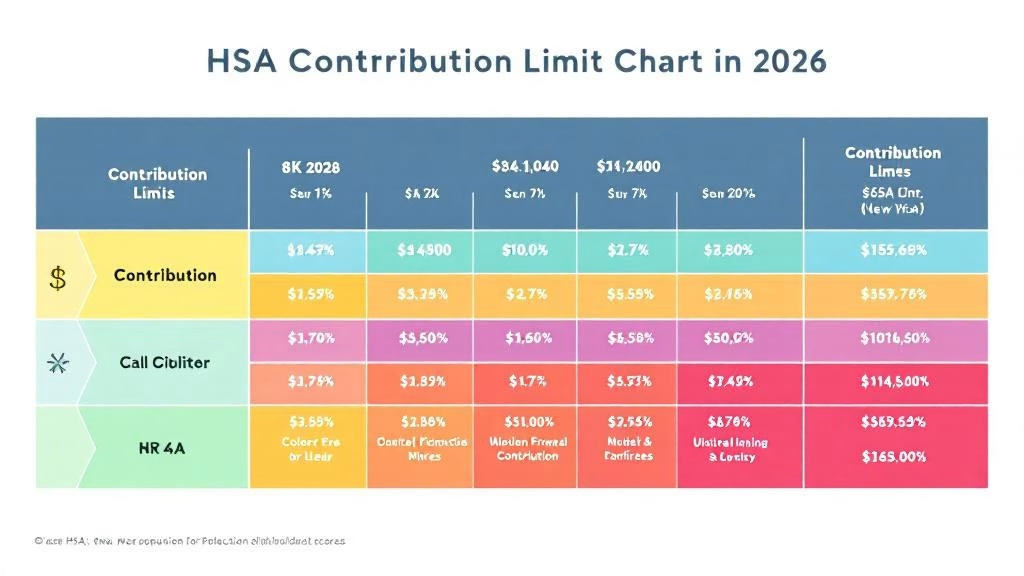
Increased contribution limits: separately from the OBBB eligibility changes, 2026 HSA contribution limits rose to $4,400 for self-only coverage and $8,750 for family coverage, with a $1,000 catch-up contribution available to those age 55 and older.
Why the eligibility expansion matters
The bronze plan change is the largest practical impact. ACA bronze plans are the most-purchased Exchange tier among self-employed professionals, gig workers, and early retirees who buy individual coverage to bridge to Medicare. Excluding them from HSAs effectively shut a large group out of the most tax-advantaged retirement vehicle in the US tax code.
The DPC change is smaller in scope but significant for the growing number of employers offering DPC benefits as an alternative to traditional health insurance. DPC has grown roughly 30% annually for the past decade. Allowing DPC participants to also use HSAs solves a tax inefficiency that had been quietly frustrating early adopters.
For advisors, the planning shift is concrete. Self-employed clients who previously could not use HSAs now have a new tool. Clients near retirement on bridge coverage can now build a tax-free medical reserve before Medicare. Employees in DPC programs can now stack HSA contributions on top of the DPC fee structure.
The HSA-as-retirement-vehicle case
HSAs remain the most tax-advantaged account in the US Internal Revenue Code, ahead of even 401(k)s and Roth IRAs by certain measures. The triple tax advantage:
- Tax-deductible contributions (or pretax through payroll)
- Tax-free growth of invested balances
- Tax-free withdrawals for qualified medical expenses, at any age
Per Kiplinger’s guide to 2026 retirement account changes and Charles Schwab’s analysis, the optimal HSA strategy for retirement-focused clients is:
- Contribute the maximum each year (or stop just before payroll cap optimization issues)
- Pay current medical expenses out-of-pocket from cash flow rather than from the HSA
- Save medical receipts for decades — they can be reimbursed at any time, tax-free
- Invest the HSA balance in low-cost equity index funds for long-term growth
- At retirement, the accumulated balance is available tax-free for medical expenses (which retirees inevitably have) or, after 65, for any purpose with regular income tax (effectively functioning as a traditional IRA at that point)
A client who contributes $8,750 annually for 25 years, invested at 7% real return, accumulates roughly $580,000 in real-dollar purchasing power. That balance, deployed against medical expenses in retirement, dwarfs what most clients have set aside specifically for healthcare costs.
Who newly qualifies in 2026
Three client profiles where the eligibility expansion creates new planning opportunities.
Self-employed professionals on bronze ACA plans: a 45-year-old freelancer paying $400/month for a bronze plan could not previously contribute to an HSA. Beginning 2026, they can. The $4,400 self-only contribution becomes a tax-deductible savings vehicle that did not exist for them before.
Pre-Medicare retirees on bridge coverage: a 62-year-old retiree using bronze coverage to bridge to Medicare at 65 has 3 years of new HSA contribution eligibility. Even without the catch-up contribution, that is roughly $13,200 in new tax-advantaged savings.
Employees with DPC employer benefits: roughly 5% of employer plans now include DPC. Those participants could not previously double-up with HSA. Now they can. For families, this could mean an additional $8,750 of annual tax-advantaged savings.
Coordinating with OBBB’s broader tax changes

The HSA expansion sits alongside several other OBBB provisions that financial planners should integrate.
The $15M estate tax exemption changed the gifting calculus for high-net-worth clients. The HSA does not flow through the estate exemption math directly, but it does become more important for HNW clients who no longer need aggressive lifetime gifting to manage estate tax. Their planning capacity now redirects toward income-tax-efficiency vehicles, which puts HSA in scope.
The Roth catch-up mandate for high earners that took effect in 2026 redirects $8,000 of catch-up contributions to Roth treatment. The HSA contribution sits outside this rule, which means HSA capacity becomes one of the few remaining pretax-deductible savings options for high earners.
The OBBB permanent extension of the 2017 tax brackets changed Roth conversion timing. With less urgency to convert traditional IRAs to Roth, clients have more capacity to optimize HSA contributions instead.
Together, these changes shift the optimal contribution sequence for many clients toward more aggressive HSA use. The exact answer depends on the client’s tax bracket, healthcare costs, and retirement timing.
What advisors should do now
Three concrete actions for the next planning conversation.
Re-screen the client base for new HSA eligibility. Pull a list of clients on Exchange coverage (especially bronze) and clients with DPC employer benefits. The list of newly-eligible HSA contributors may be larger than expected. Each of them needs a 2026 HSA decision.
Update the contribution sequence template. For clients who can max all their savings vehicles, the optimal order in 2026 is typically: 401(k) match → HSA → 401(k) up to limit → IRA → backdoor Roth → taxable. The HSA position in that order has hardened given OBBB and SECURE 2.0 changes.
Audit existing HSA balances. Many clients with old HSAs have not invested the balance. They are sitting on cash earning sub-1% in HSA bank accounts when the same dollars in low-cost equity index funds would have produced 7% real returns. A simple “invest your HSA” conversation can compound to material wealth differences over 20 years.
What to watch through Q3 2026
Three regulatory or legislative signals.
IRS clarification on employer-sponsored DPC. The current guidance addresses individually-purchased DPC clearly. Employer-sponsored DPC arrangements have some open questions on how they coordinate with HSA contribution limits. Expect IRS sub-regulatory guidance through Q3.
State-level HSA rule alignment. A handful of states (California, New Jersey) tax HSA contributions at the state level. The federal expansion does not change state law, but advocates are pushing state-level alignment in legislative sessions through 2026.
SECURE 3.0 retirement bill development. Per our coverage of the SECURE 3.0 framework, several pending bills could change HSA contribution mechanics through employer flex-benefit constructs. Watch the OPTIONS Act specifically.
Three questions for the next client meeting
For advisors with clients in or near the eligibility expansion window:
Is the client currently eligible for HSA contributions in 2026 — and if they were not previously, has the planning model been updated to include this new vehicle?
For clients with existing HSA balances, are the funds invested in equities or sitting in cash, and what is the cost of the cash drag over the planning horizon?
For HNW clients, does the post-OBBB planning conversation incorporate HSA capacity as one of the few remaining pretax savings vehicles, given the Roth catch-up mandate has eliminated other pretax options for high earners?
The HSA eligibility expansion is one of the cleaner tax planning wins of 2026. It is narrow in legislative scope but practical in client impact. The advisors who refresh their HSA conversations before year-end will deliver visible value to a measurable number of clients. Those who treat the change as a footnote will leave that value on the table.
Sources: 401(k) Specialist on HSA eligibility expansion under OBBB; Kiplinger on changes to IRAs, 401(k)s, HSAs in 2026; Landmark CPAs on HSA eligibility 2026; Clarity Benefits on HSA retirement strategy 2026; Charles Schwab on long-term HSA investment benefits; Lebel Harriman 2026 financial planning numbers.
About Me

Tradingmarketsignals serves as the definitive digital ecosystem for the modern wealth management community. As a premier source of intelligence, it delivers high-level analysis, regulatory updates, and technological insights tailored specifically for independent financial advisors, RIA leaders, and investment professionals.