


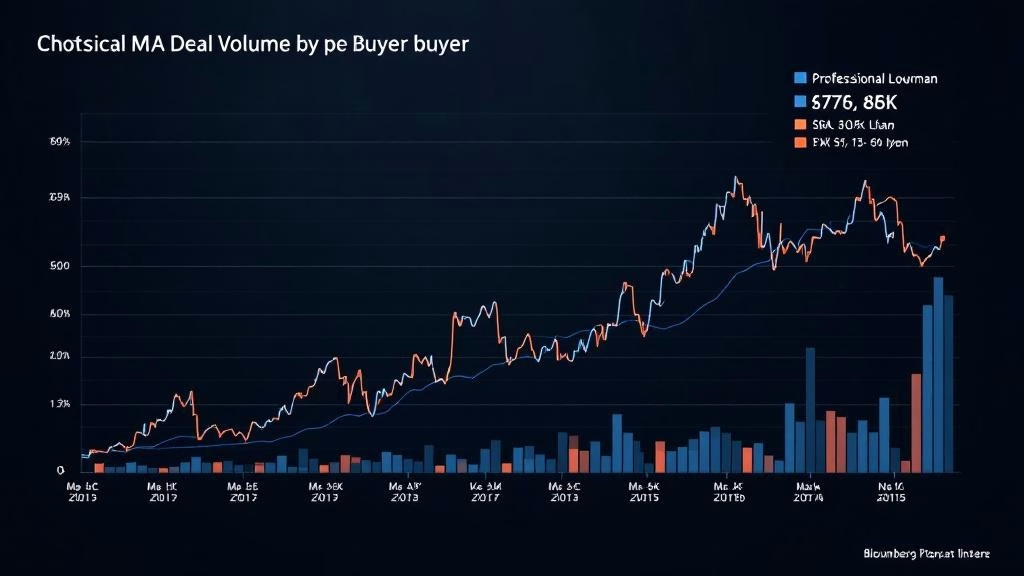
The number that defines the wealth management M&A market in 2026 is 90%. That is the share of all RIA transactions in 2025 and the first months of 2026 attributable to private-equity-backed buyers, per DeVoe & Company and corroborated across multiple industry trackers. The independent acquirer — the next-generation founder buying a smaller competitor with cash and rolled equity — has been almost entirely displaced by aggregators and platforms backed by PE capital.
The consequences are visible in every deal that crosses the tape. Wealth Enhancement Group announced its third $1B+ deal of 2026 on April 25, adding a $1.2 billion Merrill Lynch breakaway team. Sanctuary Wealth simultaneously closed an $800 million Merrill team breakaway through its Soteris Private Wealth platform. Mariner Independent launched the $1.3B Beach Cities Wealth Advisors team in late April. The Q1 2026 record of 93 RIA M&A deals was driven almost entirely by these PE-funded platforms.
This is no longer a question of whether consolidation is happening. The market has consolidated. The remaining questions are about who wins, who gets bought, and what the experience looks like for the advisors and clients caught in the middle.
Why PE took the deal pipeline
Three forces converged.
Aging founders, finite exits. The first generation of independent RIAs that grew out of the 1990s-2000s wirehouse breakaway wave is reaching retirement age in volume. The classic succession options — selling to a junior partner, recapitalizing internally, or going to a strategic acquirer — are all slower and lower-multiple than selling to a PE-backed aggregator that has fresh capital and a defined acquisition playbook.
Capital availability. Private equity raised an unprecedented amount of capital targeted at wealth management in the 2022-2024 vintages. Hightower, Mercer Advisors, Captrust, Wealth Enhancement Group, Mariner, and a dozen other aggregators are sitting on committed capital that needs to be deployed before vintage clocks expire. The math forces them to be aggressive bidders.
Operational maturity. Aggregators have spent ten years refining the post-acquisition integration playbook. They have technology platforms, model portfolios, compliance infrastructure, marketing engines, and recruiting operations that can absorb a $1B+ acquisition without breaking. The first wave of aggregator deals had high integration risk; today’s deals are largely standardized.
The result is that a $500M-to-$3B RIA evaluating its options in 2026 finds the buyer field dominated by 8-12 PE-backed platforms. Strategic buyers (banks, large RIAs without PE backing) make up the remainder.
What “90% PE-backed” actually means

The headline percentage masks a more textured reality. The 90% includes:
- Direct PE acquisitions: a sponsor buys a controlling stake in an RIA and runs it as a portfolio company
- Aggregator-led deals: an existing PE-backed aggregator (Mercer, Hightower, Wealth Enhancement, Captrust) acquires a smaller firm using the platform’s balance sheet
- Roll-up financing: PE provides debt or preferred equity to support a strategic acquirer’s purchase
- Continuation funds: a sponsor sells the RIA from one fund vintage to a successor fund at a higher mark, generating LP liquidity
Each structure has different implications for the seller. Direct PE typically delivers the highest cash component but the most operational change. Aggregator-led deals offer integration into a known platform but with less negotiation leverage on operating model. Continuation funds are largely invisible to the seller but signal that the original sponsor saw enough remaining upside to keep capital deployed.
For advisors evaluating offers, understanding which structure a buyer is using is more useful than focusing on the headline multiple.
Inside Wealth Enhancement’s $1.2B add
The Wealth Enhancement transaction announced April 25 is a clean example of the modern PE-backed aggregator playbook. Per WealthManagement.com:
- Seller: a six-advisor team breakaway from Merrill Lynch in Overland Park, Kansas
- Assets: $1.2 billion in client assets
- Buyer: Wealth Enhancement Group, owned by TA Associates and Onex
- Structure: equity-rich earn-out aligned to retention and growth metrics
This is the third $1B+ transaction Wealth Enhancement has closed in 2026. The firm now manages roughly $98 billion in client assets across more than 100 acquired practices. The pattern — multiple $1B+ deals per year, each integrating onto the same technology and operations platform — is what defines the modern aggregator.
The Sanctuary Wealth $800M Merrill move (Soteris Private Wealth launch) follows the same template, with the variation that Sanctuary structures the equity arrangement to give breakaway teams more brand and operational autonomy. The market has bifurcated between integration-heavy aggregators (Wealth Enhancement, Mercer, Captrust) and autonomy-preserving platforms (Sanctuary, NewEdge, Mariner Independent), and breakaway advisors are increasingly choosing based on which model fits their practice.
What advisors are seeing on the buy side
The economics for sellers in 2026 are favorable but more discriminating than they were two years ago. Per Echelon Partners’ Q1 commentary:
- Median enterprise value multiples are 11.6x EBITDA for premium sellers, but the spread between premium and average has widened. Average sellers transact closer to 7-8x.
- Sellers with double-digit organic growth, a defined client niche, an engaged second generation, and clean operational data command the top of the range. Sellers without those traits face heavier earn-outs and equity rollover.
- Cash-at-close percentages have compressed slightly as buyers protect against integration risk. Earn-outs are longer (4-5 years vs. the historical 3) and tied to harder retention metrics.
For founders weighing a sale, the question is no longer “is now a good time?” The market is open and active. The question is “what kind of buyer fits the practice?” — and that answer determines outcomes more than the multiple.
What it means for advisors not selling
Most independent RIAs are not selling in 2026. The 90%-PE statistic still affects them.
Talent competition intensifies. Aggregators recruit aggressively from independent RIAs as well as wirehouses. A firm that does not have a clear equity story for senior employees risks losing them to the platforms that do.
Vendor pricing shifts. Custodians, technology providers, and compliance vendors increasingly tailor pricing and service to the aggregator scale. Independent firms below $500M can find themselves on standard pricing while aggregators get bespoke deals.
Client questions get harder. Sophisticated clients increasingly ask whether their advisor’s firm is independent and what the succession plan is. Founders without a credible answer face client retention risk.
The mid-tier independent RIA (the vanishing middle we documented earlier) is squeezed in 2026 by the same forces that produce the 90% PE statistic.
What clients should ask
For clients of an RIA in the $500M-$5B band, the question whether your advisor’s firm has been or will be acquired is not paranoid. It is reasonable due diligence in the current market. Three questions to ask at the next review:
Has the firm received an unsolicited acquisition offer in the past twelve months, and how was it evaluated? A simple “yes, we declined and here is why” is a reasonable answer.
Does the firm have a documented succession plan that does not depend on a sale? Owners with no internal succession path are statistically more likely to sell within five years.
If the firm is acquired, what specific commitments protect the client experience — fee schedule continuity, advisor retention, custody platform stability? The answer should be in writing.
These questions are not aggressive. They are appropriate to a wealth management market where 90% of meaningful deal flow runs through PE-backed buyers.
What to watch through Q2 and Q3
Three signals will tell us whether the consolidation cadence holds, accelerates, or breaks.
First, whether any PE sponsor exits a wealth management investment at a meaningfully lower multiple than the entry mark. The asset class has been priced as if multiples only go up. The first material markdown changes the deal calculus across the industry.
Second, whether the wirehouse retention budgets keep climbing. Raymond James spent $107M on retention in Q1, per WealthManagement.com. If that line keeps growing, the breakaway pipeline that fuels aggregator acquisitions stays strong. If it stabilizes, the deal flow slows.
Third, whether new PE sponsors enter the space. Several large generalist PE firms are reportedly evaluating wealth management entry through dedicated funds. Those launches would extend the deal cycle by another vintage and push valuations further.
The 90% PE figure is not a forecast. It is the current state. Whether it remains the state through 2027 depends on whether capital, valuation, and exit dynamics hold together — and they have so far.
Sources: WealthManagement.com on Wealth Enhancement deal; WealthManagement.com on PE-driven RIA outlook; WealthManagement.com on RIA leaders’ 2026 outlook; Advisor Perspectives on RIA growth trends; AdvisorHub RIA consolidation trends.
About Me

Tradingmarketsignals serves as the definitive digital ecosystem for the modern wealth management community. As a premier source of intelligence, it delivers high-level analysis, regulatory updates, and technological insights tailored specifically for independent financial advisors, RIA leaders, and investment professionals.