



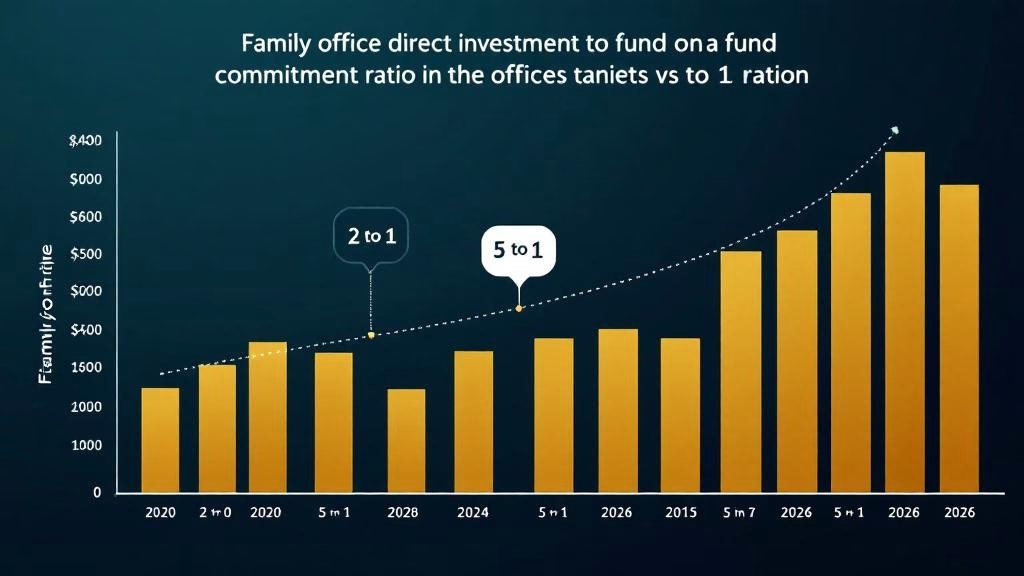
FINTRX added 119 family offices to its global research platform in Q1 2026, and the new entrants are tilting harder than ever toward direct deals. One participant told FINTRX their ratio of direct investments to fund commitments has moved from 2-to-1 to 5-to-1 in three years. The shift is rewriting how allocators evaluate general partners, what multi-family offices need to offer to keep mandates, and where co-investment dollars actually land.
Key Takeaways
- FINTRX added 119 family offices in Q1 2026, taking the total platform to 4,503 family offices and roughly 30,000 contacts worldwide (FINTRX Q1 2026 report).
- New entrants split 75 single-family offices (SFOs) to 44 multi-family offices (MFOs), with SFOs accounting for 63% of new profiles.
- 57% of new SFOs are entrepreneur-origin, concentrated in financial services, real estate, energy and technology.
- Goldman Sachs’s 2025 Family Office Investment Insights Report (245 respondents) shows U.S. family offices holding 46% in alternatives, down only one point from 47% in 2024.
- BlackRock’s 2025 Global Family Office Report puts alternatives at 42% of portfolios, with more than half of respondents bullish on private credit and infrastructure.
What Did FINTRX’s Q1 2026 Report Actually Show?
The Q1 2026 update to the FINTRX platform added 119 new family office profiles and 1,904 new contacts. Geographic distribution was unusually balanced for a single quarter: 49 from North America, 25 from Europe, 25 from Asia-Pacific and Oceania, 13 from Africa and the Middle East, and 7 from Latin America.
Of the new profiles, 75 were single-family offices and 44 were multi-family offices. Within the SFOs, 57% trace their origin to a first-generation entrepreneur exit, while 40% sit on generational wealth from real estate, agriculture or financial services. The remaining 3% spans family-business operating ventures and athlete/entertainer principal capital.
Patrick Galvin, FINTRX research associate, summarized the pattern in the report: “First-generation entrepreneurial families are investing in ways that look more like an extension of their business-building experience.” That observation matters because it predicts where the dollars go: into operating businesses the principals understand, with deal structures that favor control over diversification.
Why Are Family Offices Shifting Capital from Funds to Direct Deals?
The headline data from the FINTRX report and from Affinity’s family office direct investing study is the ratio inversion. A decade ago, a typical family office committed two dollars to direct deals for every dollar to private funds. The Q1 2026 report finds that ratio has flipped to roughly five-to-one in favor of direct, among the most active allocators.
Four mechanics drive the shift:
- Fee elimination. A 2-and-20 fund structure on $25 million committed costs roughly $500,000 a year in management fees alone before any carry. Direct investing cuts that to internal staff cost, which a $1 billion family office can absorb across 8 to 12 deals a year.
- Capital flexibility. Funds force commitment schedules and lock capital for 10 to 12 years. Direct deals let allocators size each ticket to conviction and exit when valuation, not vintage, dictates.
- Information rights. Direct equity buys a board seat or observer rights, real-time financials, and the ability to influence operating decisions. LP fund interests give quarterly capital calls and an annual investor meeting.
- Sector specialization. Entrepreneur-origin families know their vertical. A founder who built a software-as-a-service business sources deals through operating relationships that no fund GP can replicate.
The FINTRX data is consistent with what allocators tell Bloomberg Live’s New Family Office Playbook event series and Family Wealth Report’s recent coverage: families with deep sector expertise increasingly take the lead position on co-investment syndicates, and other families come in as followers on terms the lead negotiated.
Where Is the Direct-Deal Capital Going?

Three sectors dominate Q1 2026 direct deal flow tracked by FINTRX and Dakota’s Family Office Deal Tracker:
- Artificial intelligence and AI infrastructure. Compute, model training, application-layer SaaS. The capital intensity that retail venture funds increasingly cannot underwrite is exactly where family office checkbooks excel.
- Semiconductors and adjacent industrial AI. Memory, packaging, advanced logic. The thematic ETF launches covered in our analysis of Roundhill’s $3 billion DRAM thematic fund reflect the same investor demand that family offices are expressing through direct equity.
- Real estate and infrastructure equity. Data centers, cold storage, last-mile logistics. Rising rates have created cap-rate dispersion that benefits patient capital.
Goldman Sachs’s 2025 Family Office Investment Insights Report, which surveyed 245 family office decision-makers, confirms the alternatives weighting. U.S. family offices hold 46% of portfolios in alternatives, with private credit, private real estate and infrastructure all seeing modest increases at the expense of hedge funds. BlackRock’s 2025 report puts the figure at 42% with similar sector tilts and notes that “more than half of respondents are bullish on private credit and infrastructure.”
The Institutional Investor West Coast Family Office survey adds one more layer of detail. Among the 60% executive and 40% family member respondents, 34% reported allocating more than 40% of their portfolios to private investments, and more than 75% planned to maintain or increase those allocations through 2026-2027. Deployment size data shows 62% of respondents committed $1 to $5 million per fund as LPs in 2024, with roughly half writing $5 to $25 million tickets to new direct investments. The pattern is small enough to allow diversification across 15 to 25 deals over a vintage cycle, large enough to earn co-investor seat priority on the next deal in the syndicate.
For broader context on how private credit allocations are moving into traditional advisor channels, see our coverage of the BlackRock-GeoWealth public-private model portfolios launch, which placed 15% private credit allocation inside RIA UMAs.
How Do Multi-Family Offices Stay Relevant in a Direct-Deal World?
MFOs make up 52% of the FINTRX database and 37% of Q1 2026 additions. The direct-investing tilt threatens the traditional MFO value proposition, which historically rested on access to top-tier private fund managers and curated due diligence. If the principal wants direct, the MFO has to re-tool.
The MFOs growing fastest in 2026 are the ones doing four things at once:
- Direct deal sourcing as a service. Bringing pre-vetted opportunities to the family rather than waiting for the family to surface them.
- Co-investment syndication infrastructure. Operating the legal, KYC and capital-call mechanics that turn an interest in a deal into a closed allocation.
- Operating diligence depth. Hiring sector-specialist former operators rather than rotating MBAs.
- Governance and succession advisory. Helping families formalize next-gen councils and decision rights as the great wealth transfer accelerates.
That last point connects directly to a separate Institutional Investor survey of family office attendees at the West Coast Family Office Wealth Conference in Laguna Beach: 25% cited succession planning as their top concern, and nearly 75% lacked a formal succession plan. With Cerulli estimating $84 trillion expected to pass to younger generations over the next two decades, the MFOs that pair investment execution with governance discipline are the ones winning multi-decade mandates.
The pricing model is also under pressure. The traditional 0.50% to 1.00% AUM-based MFO fee was built on a service mix dominated by manager selection and reporting. As the sourcing service component grows, more MFOs are quoting blended fee models that combine a lower AUM percentage with retainers for governance work, advisory hourly rates for one-off projects, and explicit deal-level fees for direct investing support. The pure AUM model still works for families who want fully discretionary management, but principals who do their own underwriting are increasingly asking for itemized billing that mirrors what they pay outside legal counsel and operating consultants.
What Should Allocators Watch Through Q3 2026?
Four data points worth tracking on the FINTRX, Goldman Sachs, BlackRock and Citi 2026 reports as they release through the year:
- Direct-to-fund ratio in the median family office. If the 5-to-1 number from the most active allocators broadens to the median, it signals a structural rather than cyclical shift.
- MFO net new asset growth versus SFO formation rate. A widening gap in favor of new SFO formation would reinforce the disintermediation thesis.
- Private credit allocation inside the alternatives bucket. BlackRock and Goldman both flag this as the single asset class with the strongest allocation momentum into 2026-2027.
- Next-gen board representation. The Bernstein 2026 piece on next-gen councils argues this is the single best predictor of which family offices survive intergenerational transfer intact.
For allocators thinking about the broader wealth-management implications, the Q1 2026 private banking league table we published shows the institutional channels competing for the same family office mandates, while our coverage of SLAT trusts post-OBBBA covers the estate-planning side of the same conversation.
Three Questions for the Family Office Investment Committee
Before the next quarterly meeting, the principals and the CIO should be able to answer:
- Are we underwriting direct deals at the same speed as the co-investment leads we follow? A 60-day decision window is now the operational floor for syndicate participation.
- What is our written governance for sector-lead versus follower roles? The families that win the best terms are the ones that bring sector authority, not just capital.
- Do we have a written succession plan that addresses the next-gen council role? Three-quarters of family offices do not, and the IRS clock on the OBBBA $15 million exemption is permanent but the family clock is not.
The FINTRX Q1 2026 report is one snapshot, but the direction is unmistakable: family office capital is moving closer to operating businesses, further from intermediated funds, and faster than most MFO service models were built to handle. The allocators who recognize that early, and the MFOs that re-tool for it, will define the 2026-2030 family office league table.
As of Q1 2026 data. Sources: FINTRX Q1 2026 Family Office Report; Goldman Sachs 2025 Family Office Investment Insights Report (245 respondents); BlackRock 2025 Global Family Office Report; Affinity Family Office Direct Investing Study; Institutional Investor West Coast Family Office Wealth Conference survey; Dakota Family Office Deal Tracker (April 2026); Bernstein Insights 2026.
About Me

Tradingmarketsignals serves as the definitive digital ecosystem for the modern wealth management community. As a premier source of intelligence, it delivers high-level analysis, regulatory updates, and technological insights tailored specifically for independent financial advisors, RIA leaders, and investment professionals.