




The weak jobs report stocks sell-off on Friday, March 6, sent shockwaves through Wall Street as February’s Non-Farm Payrolls data revealed the U.S. economy unexpectedly lost 92,000 jobs — the worst employment reading since the pandemic recovery stalled in 2020. Combined with surging oil prices breaching $90 per barrel amid the escalating Iran conflict, investors are now staring down a potential stagflationary trap that could reshape portfolio strategies for months to come.
The S&P 500 dropped 1.3% to close at 6,740.02, while the Dow Jones Industrial Average plunged 453 points. The tech-heavy Nasdaq Composite fell 1.6%, and small-cap stocks bore the heaviest losses with the Russell 2000 declining 2.3%. For the week, the Dow posted its worst performance since October 2025, and the S&P 500 officially turned negative for 2026.
Weak Jobs Report Stocks Reaction: What the Numbers Show
The Bureau of Labor Statistics released the February employment report early Friday, and the numbers were staggering. The economy shed 92,000 jobs against a consensus estimate of +56,000 and a prior month reading of +126,000. The unemployment rate climbed to 4.4%, its highest level since 2021.
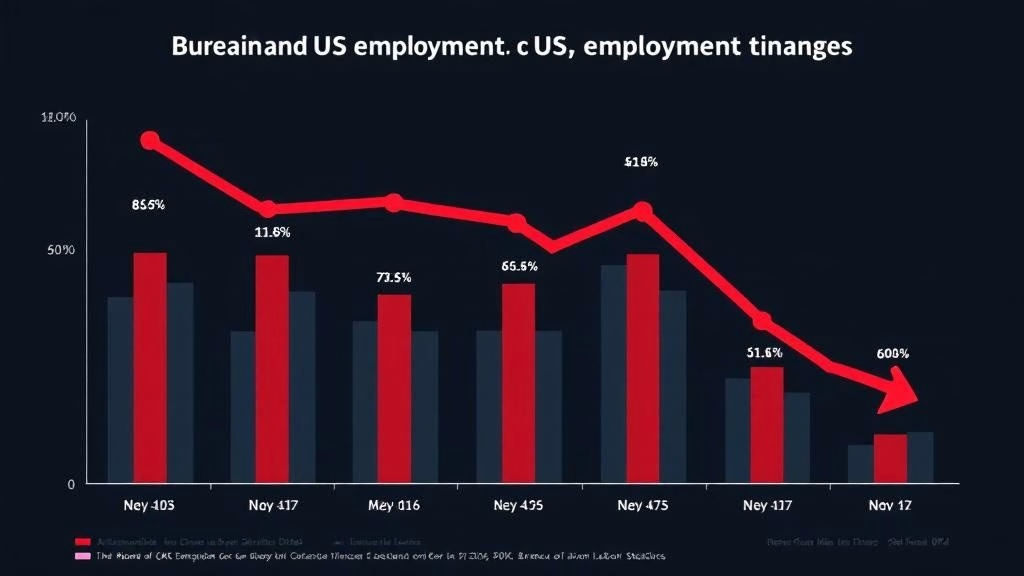
While healthcare sector strikes accounted for a portion of the decline, weakness in manufacturing and construction pointed to a broader economic cooling. The labor force participation rate dipped to 62.1%, and average hourly earnings growth slowed to 3.1% year-over-year — below the 3.4% expected by economists.
Several sectors were particularly affected:
- Manufacturing: Lost 28,000 jobs as factory orders continued declining
- Construction: Shed 19,000 positions amid housing market weakness
- Healthcare: Down 35,000 due to ongoing strikes
- Professional services: Added 12,000, one of few bright spots
- Government: Lost 22,000 amid federal spending cuts
Oil Prices Complicate the Fed’s Next Move
Making matters worse for the Federal Reserve and broader markets, crude oil prices surged past $90 per barrel as the Iran conflict in the Middle East intensified. Brent crude gained over 4% on Friday alone after reports that Iranian forces attacked a tanker in the Strait of Hormuz, through which roughly 20% of the world’s oil supply flows.

This creates a policy nightmare for Federal Reserve Chair Jerome Powell. The weak labor market data alone would typically support rate cuts, but rising energy costs are feeding into inflation expectations. The Fed Funds futures market is now pricing in only a 38% probability of a rate cut in May, down from 62% just a week ago.
“We’re in textbook stagflation territory,” said one prominent Wall Street strategist quoted by Reuters. “The Fed is stuck between a weakening economy and rising prices driven by geopolitical supply shocks.”
Energy Stocks Buck the Trend
While the broader market cratered, energy stocks emerged as clear winners. Exxon Mobil (XOM) gained 2.8%, Chevron (CVX) rose 2.1%, and Occidental Petroleum (OXY) advanced 3.4%. The Energy Select Sector SPDR Fund (XLE) was the only sector ETF to finish in positive territory on Friday.
This rotation into “Old Economy” stocks reflects a growing conviction among institutional investors that energy companies offer both inflation protection and strong cash flow generation in the current environment. With oil analysts at Bloomberg warning that prices could spike toward $100-$150 if the Strait of Hormuz disruptions persist, energy stocks may have further room to run.
Tech Stocks Lead the Decline
Mega-cap technology names, which had been the market’s leaders for much of 2025, faced relentless selling pressure throughout the week. The so-called “Magnificent Seven” stocks all finished lower on Friday:
- Nvidia (NVDA): Down 1.4%, extending weekly losses to over 5%
- Apple (AAPL): Fell 0.8% as consumer spending concerns grew
- Microsoft (MSFT): Declined 0.7% despite strong cloud fundamentals
- Alphabet (GOOGL): Lost 1.2% amid broader ad spending worries
- Meta (META): Dropped 1.1% on valuation compression
- Amazon (AMZN): Slipped 0.9% as retail outlook darkened
- Tesla (TSLA): Fell 1.1% amid macro uncertainty
The sell-off in tech reflects a broader market narrative shift. Investors are demanding more immediate returns on the massive AI infrastructure investments these companies have made, and rising interest rates — or at least the absence of expected rate cuts — make future earnings less valuable in present terms.
Corporate Earnings Provide Mixed Signals
Not every corner of the market was doom and gloom. Marvell Technology (MRVL) surged more than 10% after delivering record earnings results and issuing a bullish revenue forecast for fiscal 2027. The company highlighted surging demand for custom AI chips and connectivity solutions, suggesting that while broad tech names may be struggling, specific AI beneficiaries continue to thrive.
Dow Inc. (DOW) jumped 4% after receiving a JPMorgan upgrade to “overweight,” as analysts bet on improved pricing power in the chemicals sector — partly driven by the same energy price dynamics hitting other industries.
Meanwhile, Costco (COST) reported earlier in the week with revenue hitting $62.6 billion and comparable sales surging 7.4%, demonstrating that value-oriented retailers continue to capture consumer spending even as the economy weakens.
What Investors Should Watch Next Week
The coming week brings critical data points that could determine whether the current sell-off deepens or stabilizes:
Key Economic Reports
Consumer Price Index (CPI) — Wednesday: Perhaps the most important data release of the month. Economists expect headline CPI to show acceleration due to energy costs. A reading above 3.5% could effectively kill rate cut expectations for the first half of 2026.
Producer Price Index (PPI) — Thursday: The PPI will show whether rising oil costs are filtering through the supply chain. A hot reading here would confirm stagflation fears and likely trigger another round of selling.
University of Michigan Consumer Sentiment — Friday: Already near multi-year lows, another decline would reinforce the economic slowdown narrative and put additional pressure on consumer discretionary stocks.
Earnings Calendar
Several major companies report next week, including Oracle (ORCL), Adobe (ADBE), and Dollar General (DG). Oracle and Adobe’s results will provide further clarity on enterprise software spending trends, while Dollar General’s numbers could reveal how lower-income consumers are coping with rising prices.
Portfolio Strategy in a Stagflation Environment
For investors navigating this challenging landscape, several strategic considerations emerge:
1. Energy exposure matters. With oil potentially headed higher, portfolios lacking energy exposure face a significant headwind. Energy stocks offer both price appreciation potential and above-average dividend yields.
2. Quality over growth. Companies with strong balance sheets, pricing power, and stable cash flows tend to outperform during stagflationary periods. Think consumer staples, utilities, and healthcare (once strikes resolve).
3. International diversification. The global sell-off has created opportunities in markets that may recover faster than the U.S., particularly in regions less exposed to Middle East energy disruptions.
4. Cash is not trash. With money market funds still yielding above 4.5%, holding elevated cash positions provides optionality and downside protection while markets find a bottom.
5. Avoid bottom-fishing in rate-sensitive sectors. Real estate, utilities with high debt loads, and unprofitable growth stocks face the most pressure if the Fed delays rate cuts further.
The Bottom Line
Friday’s weak jobs report stocks sell-off underscored a market caught between two powerful forces: a cooling economy that wants rate cuts and an energy shock that prevents them. The S&P 500’s slide into negative territory for 2026 marks a significant psychological shift, and next week’s inflation data will likely determine whether this is a corrective pullback or the beginning of a more sustained downturn.
For now, the playbook is clear: favor energy and defensive sectors, maintain portfolio quality, and keep powder dry. The market is pricing in uncertainty — and until the geopolitical picture clarifies or the Fed provides guidance, volatility is likely to remain elevated. According to Yahoo Finance, the VIX fear index closed above 28 on Friday, its highest level since October 2025.
Investors who position correctly during this period of dislocation stand to benefit when clarity eventually returns — but patience and discipline will be the most valuable assets in the weeks ahead.