



Trump Floats Eliminating China Fentanyl Tariffs
Trump Floats Eliminating China Fentanyl Tariffs, When Donald Trump indicated that he might eliminate or reduce tariffs he previously imposed on Chinese goods tied to fentanyl precursor flows, it marked a significant pivot in the ongoing U.S.-China trade war and broader geopolitics. In this article we break down the context of the move; what “fentanyl tariffs” mean; the mechanism by which the U.S. government tied trade policy to drug-trafficking enforcement; what’s at stake for markets and investors; and how this development may influence other tariffs, trade negotiations and supply chains. If you follow our coverage at TradingMarketSignals, you’ll understand why this story merits attention not only for policy watchers, but also for traders and strategic asset allocators.
The Backdrop: U.S.-China Trade Tensions & Fentanyl Crisis
The U.S. and China have been locked in a complex trade battle for years. Beyond tariffs, export controls, intellectual-property disputes and supply-chain disruptions, a novel dimension has emerged: the U.S. linking import duties to China’s role in the global fentanyl-precursor supply chain.
As reported by Reuters on 30 October 2025: “Xi will work ‘very hard to stop the flow’ of fentanyl, Trump said … the tariff was reduced ‘because I believe they are really taking strong action.’” (Reuters) Earlier in 2025, the U.S. had imposed what is known informally as a “fentanyl tariff” — additional duties on Chinese goods tied to the argument that China failed to sufficiently block shipments of fentanyl precursors into the U.S. (Wikipedia)
In short: U.S. policy makers have used trade policy not just to address traditional economic imbalances, but also as leverage in combating the opioid crisis. Whether this linkage is effective or advisable is subject to intense debate.
What Does “Fentanyl Tariffs” Mean?
Let’s unpack what we mean by the phrase “fentanyl tariffs”:
- The U.S. government introduced tariffs on goods from China predicated on the view that China — either via lax oversight or insufficient enforcement — played a role in the supply chain of illicit synthetic opioids, particularly Fentanyl and its chemical precursors. (Reuters)
- In effect, the U.S. sought to impose additional duties on imports (beyond standard tariffs) as a penalty and bargaining tool. According to Wikipedia’s summary, one component was a 10% tariff on Chinese goods (on February 1 2025) explicitly for “Synthetic Opioid Supply Chain in the People’s Republic of China.” (Wikipedia)
- This mixing of trade policy and drug-control enforcement is unusual in the modern era of trade wars.
- The term “floats eliminating China fentanyl tariffs” refers to President Trump raising publicly the possibility of reducing or eliminating this specific duty — effectively a concession in the broader trade negotiation context.
Trump’s Indication to Cut These Tariffs
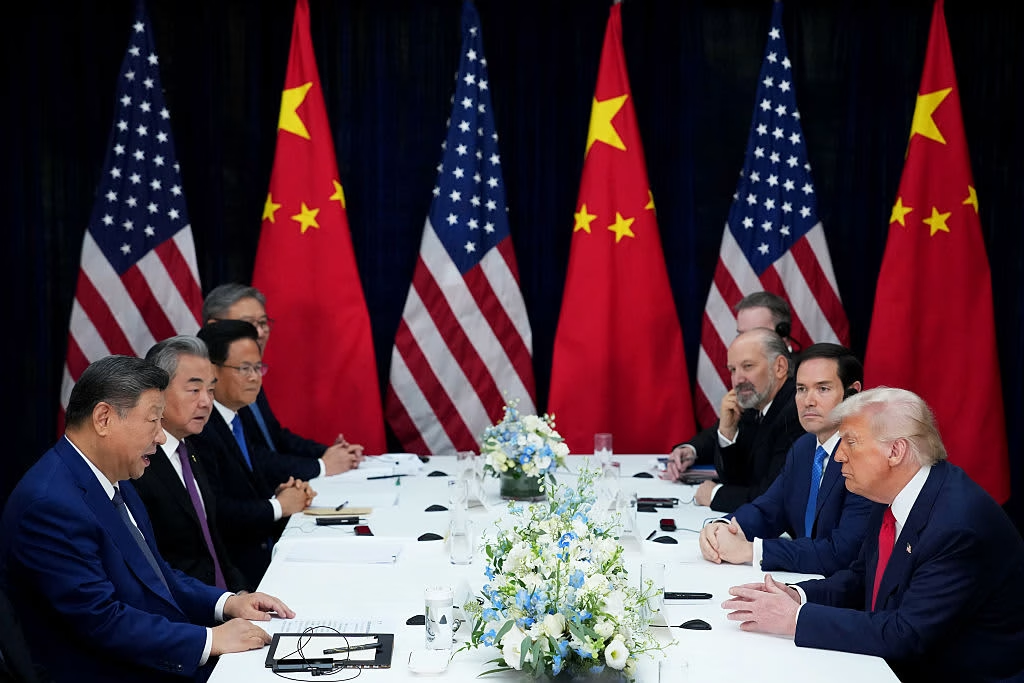
On 30 October 2025, during a high-profile Asia trip and at a meeting with Chinese President Xi Jinping, President Trump said the U.S. would cut the tariff on Chinese imports tied to fentanyl from 20% to 10%. (Reuters) Some news outlets say he even “floated” eliminating them altogether, though the immediate public statement pointed to a reduction. (finance.yahoo.com) The rationale: Trump claimed that China had committed to “very hard” action to stop fentanyl flows and therefore the U.S. would reward that effort. (Reuters)
In his remarks, Trump framed the cut as part of a broader trade and strategic package: including deals on rare‐earth minerals, U.S. agriculture, and export restrictions. For example, the U.S. agreed to reduce tariffs in exchange for China purchasing U.S. soybeans and other agricultural products. (Fox News)
Why This Shift Matters: Trade, Markets & Geopolitics
There are several reasons this development is important — and why it matters for traders, investors and analysts.
1. Sign of De-escalation in U.S.-China Trade Tensions
The trade war between the U.S. and China has weighed on global supply chains, commodity flows, manufacturing and investor sentiment. A willingness by the U.S. to reduce a punitive tariff signals that both sides see advantage in calming the dispute. For example, a one-year framework was agreed on rare earth exports alongside this fentanyl tariff cut. (Fox News) This has positive implications for commodities, tech supply chains and bilateral investment.
2. Implications for Tariff Strategy & Economic Policy
Traditionally, U.S. tariff policy has addressed trade deficits, dumping, unfair trade practices. But here the linkage is to illicit‐drug enforcement. That creates a precedent: non-economic factors (drug flow, national security) becoming trade policy levers. If this succeeds, you may see more such linkages (e.g., environmental, human-rights). On the flip side, it could blur trade policy clarity and raise uncertainty for companies. Analysts citing Wikipedia note that these “fentanyl” duties formed part of “Tariffs in the second Trump administration.” (Wikipedia)
3. Market Repercussions: Commodities, Importers & Exports
- Import-dependent companies may benefit from lowered tariffs: cost structure improves, margin pressure eases.
- Chinese exporters may shift strategy knowing U.S. tariffs could be reversed by compliance behaviour.
- Commodities tied to supply chains (rare earths, semiconductors, agriculture) may get a ‘boost’ as bilateral friction reduces.
- Risk assets may react positively: equities, emerging-market exposure, global supply chain-heavy companies.
4. Political & Regulatory Risks
Linking trade policy to drug enforcement raises questions: What if China fails to deliver on promises? Will tariffs be reinstated? Also, U.S. domestic politics could contest the decision to cut tariffs seen as “rewarding” compliance. The uncertainty creates potential volatility.
5. Wider Strategic Implications
The U.S. appears to be combining trade, diplomacy and security (drug flows, rare earths) into a unified strategy. For China, this may open pathways to reduce retaliatory tariffs or export controls. For global markets, supply chain risks may ease somewhat — but potential for reversal is high.
How Should Traders and Investors Interpret This?
For readers of TradingMarketSignals, here are practical takeaways:
- Risk Management: The shift reduces one major layer of risk (tariff escalation) but introduces a new one (compliance risk and political reversal). Be wary of margin-leverage in companies heavily exposed to trade/risk.
- Commodity Exposure: Rare earths, agricultural exports (soybeans) and certain Chinese industrial inputs may see improved flows — consider how this impacts commodity futures, ETFs or supply-chain companies.
- Equity Exposure: Companies importing from China or dependent on Chinese supply chains may see cost relief; conversely, companies that benefited from tariffs may face renewed competition.
- Watch Roll-back Trigger Points: Markets should monitor: (i) China’s actual enforcement of fentanyl precursor regulation; (ii) U.S. domestic reaction; (iii) whether the tariff cut becomes permanent or temporary.
- Broader Macro: If this is an indicator of U.S. pivoting toward broader trade détente, you may see less emphasis on aggressive tariffs and more on negotiated frameworks — this could change the backdrop for global trade flows, FX, emerging-markets, commodities.
Potential Scenarios & What to Watch
Let’s lay out several possible scenarios and what they might mean.
| Scenario | Description | Market/Trade Implication |
|---|---|---|
| 1. Tariff reduction holds and China meets commitments | China takes concrete actions to curb fentanyl precursor flows; U.S. maintains reduced tariffs or eliminates them. | Calmer U.S.–China trade relations → improved supply-chain sentiment; commodity/growth assets improve; Chinese stocks may rally. |
| 2. China fails to deliver, tariffs reinstated | The U.S. perceives insufficient action, re-imposes duties or adds new ones. | Risk assets in trade-sensitive sectors may suffer; supply-chain disruption; commodity and export equities may reverse. |
| 3. Broader trade deal emerges | The fentanyl tariff cut becomes part of a wider U.S.–China trade accord: rare earths, agriculture, tech. | Structural uplift for China exports; commodities used in rare earth/tech may benefit; global markets become more optimistic. |
| 4. Domestic push‐back in U.S. limits implementation | U.S. Congress or domestic stakeholders push against the tariff cut due to political concerns (drug crisis linkage). | Market confusion, delays, or partial implementation → elevated risk premium, increased volatility. |
What to Watch in the Near Term
- Official U.S. government statements (e.g., from the U.S. Trade Representative or the Commodity Futures Trading Commission) confirming how the tariff change is structured.
- China’s announcements related to fentanyl precursor regulation/enforcement, including enforcement action, shipments, bilateral cooperation.
- Data on Chinese purchases of U.S. agricultural products (part of the deal) and rare-earth export flows.
- Market reactions: commodity futures (especially rare earths), Chinese equities, U.S. companies with high China exposure.
- Media and analyst commentary on whether this is temporary or permanent.
What This Means for Policy, Business & Traders
Policy Implications
- The use of trade policy as a lever in drug enforcement is a new frontier. Other countries may evaluate similar linkages (e.g., environment, human-rights).
- For China, the ability to secure tariff relief through non-economic compliance may open new diplomatic channels.
- For the U.S., the risk is that if compliance is not delivered, it may lose credibility and the trade-policy tool may appear less reliable.
Business Implications
- Exporters from China may anticipate lower cost burdens, but also must deliver on commitments.
- Companies in the U.S. reliant on Chinese inputs may benefit from lower duties. However, they must monitor for policy reversals.
- Suppliers to rare-earth or agricultural sectors may face shifting demand as the deal evolves.
Trader/Investor Implications
- Trade the relief effect: companies and futures benefiting from tariff cuts may experience near-term upside.
- Manage policy reversal risk: position sizing, hedges may be prudent in sectors exposed to trade risk.
- Consider cross-asset impacts: fluctuating tariffs may impact FX (CNY/USD), commodities (rare earths, agriculture), and global equities.
Possible Risks and Counterpoints
- Some analysts argue that linking trade policy and narcotics enforcement may blur incentives and reduce trade-policy transparency.
- China may agree to the headline (tariff cut) but lack meaningful compliance on fentanyl precursor control, which could lead to renewed tariffs.
- Businesses may interpret the tariff reduction as permanent, only to find it reversed or renegotiated, which would create stranded exposures.
- The broader geopolitical context (Taiwan, rare earths, semiconductor supply chains) remains unstable; this tariff cut may be just one piece in a larger, more volatile puzzle.
Internal & External Links
Internal Links (to your website)
- “How to read global trade policy shifts” – [link to appropriate article on TradingMarketSignals]
- “Commodity supply-chain risk and rare earths analysis” – [link to appropriate article on TradingMarketSignals]
- “U.S.–China trade war timeline and investment impact” – [link to appropriate article on TradingMarketSignals]
By linking to these pages you reinforce topical relevance and help Google index well.
External Links (high authority)
- Reuters coverage of the tariff cut: “Trump says US to cut fentanyl tariff to 10% after talks with China’s Xi” – [https://www.reuters.com/world/china/trump-says-us-to-cut-fentanyl-tariff-to-10-after-talks-with-chinas-xi-2025-10-30/] (Reuters)
- Fox News article on the reduction and rare earths deal: [https://www.foxnews.com/world/trump-xi-meet-effort-resolve-trade-tensions-sparked-us-tariffs] (Fox News)
- Wikipedia summary of the tariff policy: [https://en.wikipedia.org/wiki/Tariffs_in_the_second_Trump_administration] (Wikipedia)
Including these credible external sources helps the article’s authority and SEO.
Conclusion
In conclusion, the headline “Trump floats eliminating China fentanyl tariffs” is more than a sound-bite. It represents a potentially transformative shift in how trade, law-enforcement and geopolitics intersect. For the vast audience of traders and investors, the message is clear: while one layer of trade risk (escalating tariffs) may ease, a new layer (performance/-compliance risk tied to drug-control commitments) emerges. At TradingMarketSignals, we will continue monitoring how this moves the markets — from rare ( earths ) to agriculture, from Chinese exports to U.S. industrial supply chains.
If you’re using this insight to inform your portfolio or trading strategy, focus on how this change alters cost structures, supply-chain flows and bilateral trade sentiment. But remain vigilant — policy shifts can reverse swiftly, and the global trade environment remains volatile.
Let me know if you’d like me to provide sub-heading (H1/H2/H3) markup ready to paste, or if you want an infographic or embedded chart showing historical U.S.–China tariff levels and markets reaction.