


The economics of leaving a wirehouse for an RIA platform have changed structurally. Per Wealth Management’s RIA outlook coverage, advisor moves from Morgan Stanley, Merrill Lynch, UBS, and Wells Fargo to RIA aggregators are tracking at multi-year highs in 2026, and the pattern is not slowing. The reason is the math, not the marketing.
A wirehouse retention bonus pays a multiple of trailing-12 production over a defined vesting period. Five years was standard. Nine years is now common. The advisor receives the cash up front (often as a forgivable loan) and pays it back through continued production at the firm.
A modern RIA lift-out deal pays a smaller upfront cash component but adds equity in the acquiring firm that can compound for the entire balance of the advisor’s career. Over a 15-year horizon, the equity component dominates. Wirehouse advisors who have run the math through their CPAs are increasingly arriving at the same conclusion: leaving is the better trade.
This article walks through how the math actually works in 2026, why the gap has widened, and what advisors evaluating a move should think about.
The 2026 retention bonus structure
Industry sources estimate that average wirehouse retention deals in 2026 look roughly like this for top producers:
- Cash upfront: 200-300% of trailing-12 production, paid as a forgivable note
- Vesting period: 9 years on average, with payback risk if the advisor leaves before vesting
- Performance hurdles: most retention deals require continued production at or above current levels
- Equity component: typically zero or token. Wirehouse advisors do not own the practice.
For a $5 million producer, a 250% retention deal pays $12.5 million upfront, vesting over 9 years. The advisor must continue to produce at $5 million per year and stay at the firm to keep the money. If they leave at year 5, they typically owe back roughly 44% of the original note.
That is the most generous wirehouse offer most advisors will see. Outside the top quartile, retention deals scale down meaningfully.
The 2026 RIA lift-out structure
A modern RIA aggregator (Mariner, Hightower, Mercer, Wealth Enhancement, Captrust, Sanctuary) typically structures a $5 million-producer lift-out as follows:
- Cash upfront: 100-150% of trailing-12 (lower than wirehouse retention)
- Stock or equity grant: 75-150% of trailing-12 in firm equity, vesting over 4-6 years
- Annual recurring payout: typically 65-80% of revenue (higher than wirehouse net payout once retention is amortized)
- Long-term equity participation: ongoing stake in firm value, with multiple liquidity events possible
- Practice ownership: in many structures, the advisor owns or co-owns their book of business
The cash component is smaller. The equity and ongoing payout components compound. Over 15 years, the equity-bearing path produces materially higher economics for any advisor who continues to grow their practice.
Running the comparison
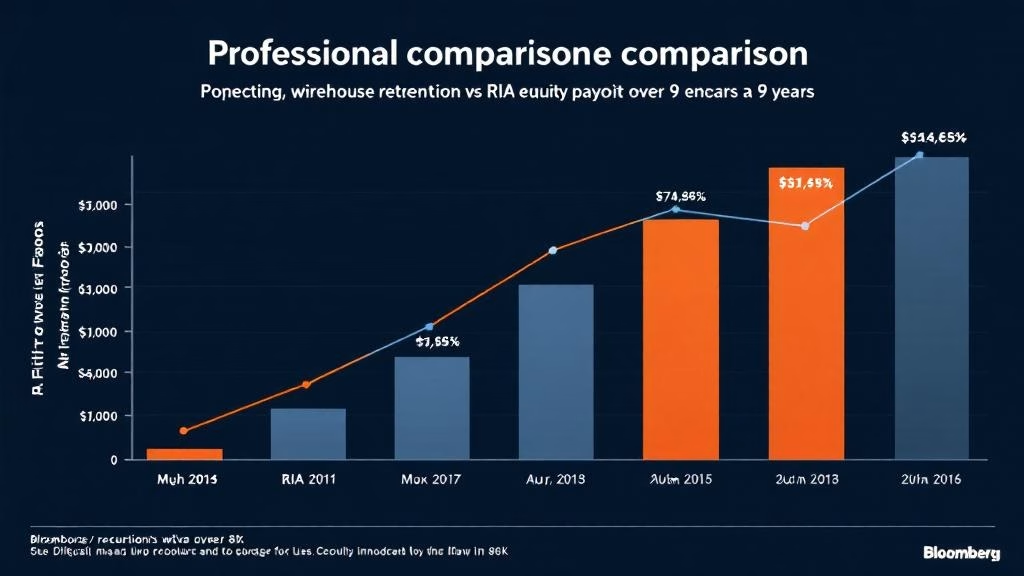
Take a $5 million producer choosing between staying at the wirehouse with a $12.5M retention or moving to an aggregator with $7.5M cash plus $7.5M in equity vesting over 5 years.
Year 5 outcome: – Wirehouse path: roughly $12.5M cash earned (vesting $1.4M/year), book grew at 6% to $6.7M production – RIA path: $7.5M cash + $7.5M equity now worth ~$11M (assuming 8% annual aggregator equity appreciation) = $18.5M, book grew at 8% to $7.4M (independent advisors typically grow faster)
Year 10 outcome: – Wirehouse path: $12.5M fully vested, no further upside, book at $9M – RIA path: equity now worth ~$16M, advisor still owns recurring revenue, possible secondary liquidity event
Year 15 outcome: – Wirehouse path: advisor approaching retirement, book transition to junior partner or external sale, no equity in firm – RIA path: equity stake in aggregator worth $25M+ assuming continued growth, plus ability to do internal succession with own team
The honest answer is that the spread depends on aggregator equity performance. If the aggregator does not grow, equity is worth less. If it grows above market average (which most large aggregators have done as PE-backed roll-ups compound), the equity dominates.
This is the math we documented when we covered the $1.3B Mariner Independent debut — three founders chose the equity path explicitly because of this calculus.
Why wirehouses can’t easily match
Three structural reasons wirehouses cannot offer comparable equity packages.
Public-company optics: Morgan Stanley, Merrill Lynch (Bank of America), UBS, and Wells Fargo are publicly traded. Their stock has long-term appreciation potential, but it is priced for diversified financial conglomerates, not focused wealth management. The growth rate is typically 5-8% annual versus 12-20% for focused PE-backed wealth aggregators.
Brand vs. partnership trade-off: a wirehouse advisor sells the firm’s brand. The firm captures most of the brand-driven goodwill. An advisor at a 50-person RIA captures more of the goodwill they personally create.
Compensation philosophy: wirehouse retention budgets are reviewed by board compensation committees that benchmark to broker-dealer norms, not aggregator norms. The structures are simply not in the wirehouse playbook to offer.
The result is that wirehouses are reduced to competing on the cash-up-front number. They can write bigger checks. They cannot write bigger long-term economics.
What is changing in 2026

The 2026 acceleration has three drivers we have been tracking across our recent coverage.
More aggregators competing: ten years ago, an advisor evaluating an RIA move had two or three legitimate aggregator options. Today, there are 15-20. Competition among aggregators has driven up the equity component of lift-out deals.
More PE capital deployed: as we documented in our piece on PE owning 90% of RIA deals, the supply of patient capital backing aggregators is at all-time highs. PE sponsors are willing to pay for talent.
Better post-deal experience: the early aggregator deals (2012-2018) often produced disappointed sellers who felt the integration was too heavy. The 2024-2026 vintage of aggregator deals is much more disciplined, with platforms like Mariner Independent and Sanctuary explicitly selling autonomy preservation.
The cumulative effect is that the modern lift-out experience is structurally better than it was, and the retention economics are structurally worse for staying.
What advisors should ask before moving
Three questions that separate well-structured deals from disappointing ones.
What is the aggregator’s actual equity performance over the last 5 years? Pro-forma growth projections are easy to manipulate. Historical realized returns are not. Ask for documented returns and any markdowns the firm has taken.
What does the deal look like if you stop growing? Most lift-out economics assume continued growth. If your practice plateaus, what happens to the equity vesting and the ongoing payout? Some platforms have downside floors. Others do not.
Who owns the client relationship contractually? In a lift-out, the advisor typically retains client portability. Some platforms structure deals where the platform retains contractual rights to the client. Read this section twice.
The intersection with LPL’s $31B Mariner Advisor Network deal is informative. Some advisors at acquired channels find the post-acquisition experience does not match the pre-deal pitch. The risk is real and the diligence matters.
What wirehouses are doing in response
Raymond James spent $107M on retention compensation in Q1 2026 alone, per our earlier coverage. Morgan Stanley, Merrill Lynch, and UBS have all increased deferred-comp packages. The cash numbers are bigger.
But the structural problem remains: wirehouses are paying more for the same product. Bigger retention notes do not change the equity gap. Some wirehouse advisors are taking the bigger retention check and then leaving anyway after vesting milestones, capturing both pots.
For wirehouses, the only durable response would be to offer real equity in the wealth management subsidiary. Morgan Stanley toyed with this idea internally years ago and shelved it because of public-company structural complications. Until that changes, the math favors leaving.
What to watch through year-end
Three signals.
Whether any wirehouse launches a real equity vehicle for advisors. This would be a tectonic shift. It would also be expensive for shareholders. The probability is low but rising.
Whether aggregator equity values hold up. A material aggregator markdown (PE sponsor selling at lower multiple) would change the equation. So far, aggregator vintages have continued to mark up.
Whether the 2027 retention cycle widens cash offers further. Wirehouses typically reset retention every 3-5 years. The next reset is approaching. Some shops are reportedly considering 350-400% trailing-12 deals, which would close some of the gap.
Three questions for advisors evaluating a move
For practitioners running the math:
Does your CPA’s projection of the move incorporate realistic equity appreciation assumptions, or is it using marketing materials from the aggregator?
Have you read the actual deal documents (vesting language, downside protection, client portability) rather than the term sheet?
Does your move thesis depend on a specific aggregator’s continued performance, and what is your plan if that aggregator gets sold to another platform mid-deal?
The 2026 lift-out market is the strongest it has ever been for advisors. The math has become unambiguous for top producers willing to commit to building rather than collecting. Wirehouses can write bigger checks. They cannot fix the structural gap.
Sources: Wealth Management on RIA leaders 2026 outlook; WealthManagement.com RIA news desk; Markets Group on $100B RIA M&A in 2026; Wealth Solutions Report on RIA M&A in 2026; Advisor Perspectives on RIA growth trends.
About Me

Tradingmarketsignals serves as the definitive digital ecosystem for the modern wealth management community. As a premier source of intelligence, it delivers high-level analysis, regulatory updates, and technological insights tailored specifically for independent financial advisors, RIA leaders, and investment professionals.