


Vanguard launched two new index ETFs in late April 2026: the Vanguard Developed Markets ex-US Value Index ETF (VDV) and the Vanguard Developed Markets ex-US Growth Index ETF (VDG). The two products target investors who want to slice their international developed-market allocation by factor, and they arrived precisely when the rotation away from US large-cap equities into international markets had become the dominant flow story of 2026.
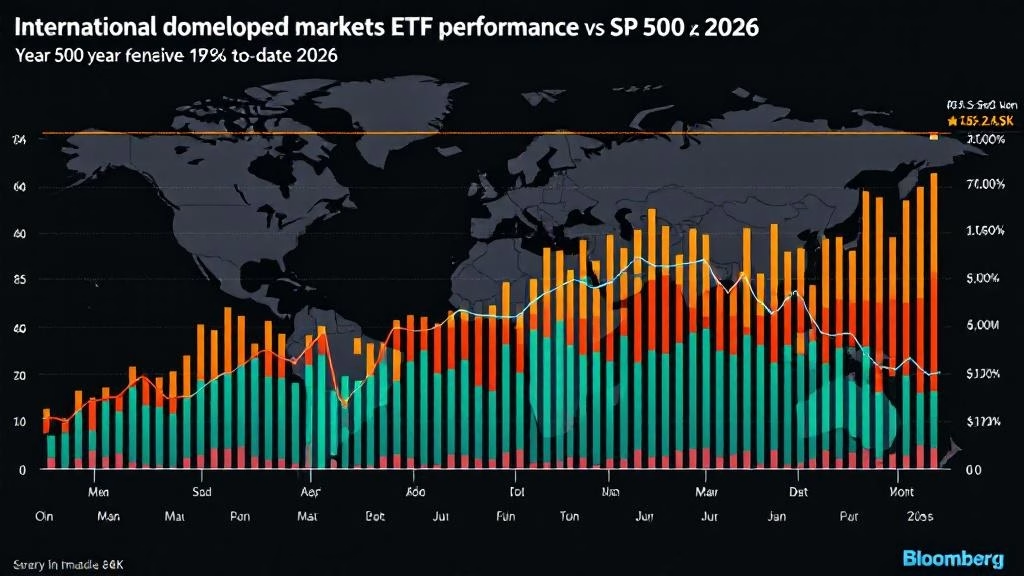
International developed markets have been outpacing the S&P 500 by meaningful margins through Q1 and into Q2 of this year. Per 24/7 Wall Street’s tracking, several broad international ETFs are up double-digit percentages year-to-date while VOO (Vanguard S&P 500) sits in the low single digits. The catalyst has been a combination of weaker US dollar, EU and Japan rate cuts ahead of the Fed, and renewed European industrial demand.
For Vanguard, the VDV/VDG launch is not a top-of-the-cycle product flip. It is a continuation of the firm’s strategy of letting advisors slice broad index exposure by factor without leaving the Vanguard ecosystem.
What VDV and VDG actually hold
Both ETFs track FTSE-derived indexes covering the same universe of developed-market companies excluding US-listed names. The difference is the factor screen.
VDV (Developed Markets ex-US Value) overweights companies with low price-to-book, low price-to-earnings, and high dividend yield characteristics. Top country exposures are typically Japan, UK, Germany, France, and Switzerland. Top sectors lean toward financials, energy, and industrials.
VDG (Developed Markets ex-US Growth) overweights companies with high earnings growth, high revenue growth, and momentum signals. The same country mix applies but with sector tilts toward technology (where international equity gives you SAP, ASML, Tokyo Electron) and consumer discretionary.
Both ETFs launched at expense ratios consistent with Vanguard’s broader index lineup — under 10 basis points, putting them at the cheapest tier of factor international ETFs available to US advisors.
Why this matters for portfolio construction
For advisors building international equity sleeves, the historic problem has been blunt instruments. The dominant international developed-market ETFs (VEA, EFA, IEFA) are broad cap-weighted exposures. To layer in a value or growth tilt, advisors had to mix in iShares MSCI EAFE Value (EFV) or growth (EFG), which carry higher expense ratios and use different index methodologies than the Vanguard parent.
VDV and VDG let an advisor build a Vanguard-only international sleeve with explicit factor tilts. A simple example: 60% VEA (cap-weighted core) plus 20% VDV plus 20% VDG produces a barbell value/growth structure inside Vanguard’s expense ratio band.
This is the kind of operational simplification that drives advisor adoption. We covered the broader Vanguard fixed-income models push earlier, where Vanguard’s BondBuilder lineup gave advisors a similar within-Vanguard option for fixed income. VDV/VDG continue that pattern on the international equity side.
The international rotation backdrop
The 2026 international story is not a small move. Per The Motley Fool’s analysis of Vanguard ETF performance, several Vanguard international funds are up significantly more than the S&P 500 through April. The drivers are well-documented:
- Currency tailwind: the US dollar is weakening against the euro, yen, and pound in 2026, which adds 3-5 percentage points to international ETF returns when measured in USD.
- Valuation gap: international developed equities entered 2026 at roughly 14× forward earnings versus 22× for the S&P 500. The gap has been compressing as international earnings have grown.
- Macro divergence: the European Central Bank and Bank of Japan have cut rates faster than the Fed, supporting equity valuations in those markets.
The risk is that this rotation is mid-cycle rather than early-cycle. International equities have outperformed for 14 months. Historical precedent suggests these rotations typically run 18-30 months before reverting. An advisor adding VDV/VDG today may be capturing the tail of the rotation rather than the start. The factor-tilt structure helps because value and growth do not necessarily correlate during the reversion phase.
How VDV/VDG fit in model portfolios
Three concrete model portfolio applications.
Core-and-explore international: 70% VEA (core) plus 15% VDV plus 15% VDG. Captures the broad developed-market rotation while adding factor diversification.
Tax-aware international: VDV’s higher dividend yield is helpful in tax-deferred accounts. VDG’s growth tilt suits taxable accounts where the lower dividend distribution helps after-tax returns.
Pair-trade construction: Advisors who believe value will outperform growth over the next cycle can run an over-weight VDV / under-weight VDG sleeve. The factor exposure is now achievable inside Vanguard’s lineup without going to iShares or DFA.
The intersection with the active ETF migration we documented is worth noting. VDV and VDG are explicitly passive factor ETFs — they screen by index methodology, not active manager judgment. For advisors running a hybrid passive-core / active-satellite framework, VDV/VDG sit on the passive side and pair naturally with active international equity ETFs from JPMorgan, Capital Group, or T. Rowe Price.
What flows are doing

The early flow data on VDV/VDG is constructive. Both ETFs collected meaningful inflows in their first two weeks of trading, with VDV pulling slightly more than VDG. The pattern matches the broader 2026 preference for value over growth that has held across both US and international markets.
Cumulative international ETF inflows in 2026 are running at multi-year highs. Per the BlackRock iShares 2026 ETF market trends report, international developed markets saw $50B+ in net inflows during Q1 alone, with single-country and factor-specific products taking a growing share.
The competitive read for VDV/VDG: Vanguard is not arriving early to the international rotation. The firm is arriving with the right product structure for advisors who want disciplined index exposure with cost discipline. That is a sustainable position even if the rotation eventually reverses.
What advisors are watching through Q3 2026
Three signals that will shape the next two quarters of international ETF flow.
Federal Reserve policy: if the Fed accelerates rate cuts to match the ECB and BoJ, the dollar weakness that has fueled international outperformance compounds. If the Fed pauses while international central banks continue, the trade reverses.
Earnings divergence: international developed equities need earnings growth to sustain valuations. Q2 2026 earnings season will be the test. If European and Japanese earnings disappoint, the rotation stalls.
Single-country flows: a meaningful share of the international rotation is concentrated in Japan and Europe. If country-specific risk events emerge (German political instability, Japan central bank shift), broad diversified ETFs like VDV/VDG hold up better than single-country products.
Three questions to bring to the next investment committee
For advisors managing international equity allocations:
Has the firm’s current international sleeve construction been compared against a VEA-VDV-VDG factor-tilted alternative on cost, factor exposure, and historical performance characteristics?
For taxable accounts, does the value-growth split align with after-tax return expectations, or are clients holding a single broad international ETF that is producing more dividend-driven taxable income than necessary?
If the international rotation reverses in late 2026, is the firm’s rebalancing protocol set up to capture the gain (rebalance back to target allocation) or is it operating on annual rebalancing that will leave the position over-weight at the wrong moment?
The Vanguard VDV/VDG launch is not a market-timing call. It is a tooling addition that gives advisors more precision with the same Vanguard cost discipline. Those who use the precision well will compound that advantage. Those who do not will continue to run blunt international exposure at slightly higher all-in cost.
Sources: Vanguard pressroom announcements; 24/7 Wall Street on international ETFs crushing VOO in 2026; The Motley Fool on Vanguard ETFs vs S&P 500 in 2026; iShares 2026 ETF market trends report; NerdWallet’s best Vanguard ETFs for May 2026.
About Me

Tradingmarketsignals serves as the definitive digital ecosystem for the modern wealth management community. As a premier source of intelligence, it delivers high-level analysis, regulatory updates, and technological insights tailored specifically for independent financial advisors, RIA leaders, and investment professionals.