

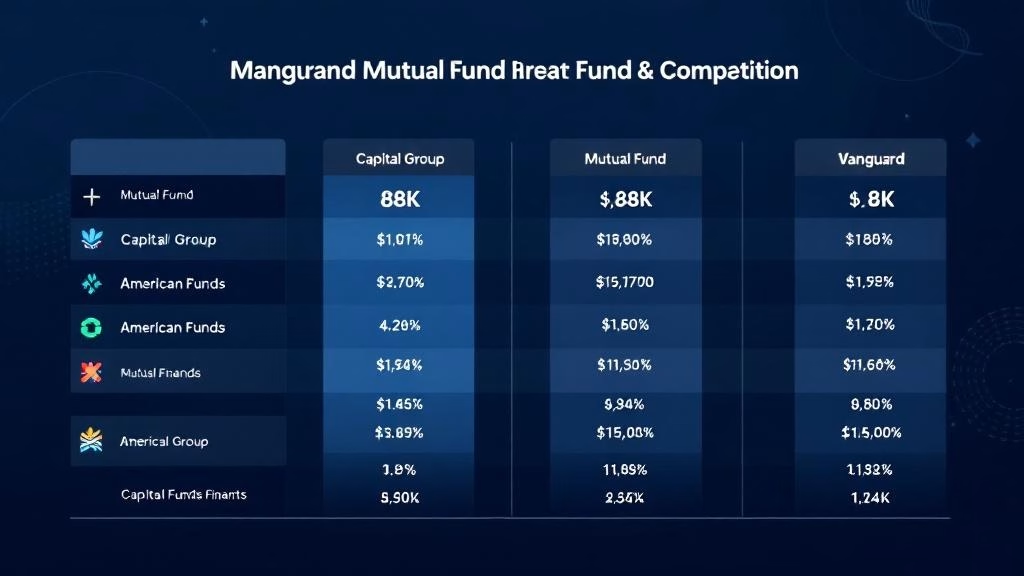

Broadridge published its 2026 U.S. Fund Brand 50 report on March 31, and the headline number is the one nobody in passive land wanted to read. BlackRock holds the top spot for a second consecutive year. Capital Group, the firm best known for American Funds, jumped to #2. Vanguard fell to third.
This is the first time Capital Group has ranked above Vanguard in the survey’s history. The indexing era was not supposed to produce that outcome.
Broadridge’s methodology is worth dwelling on for a second. The Fund Brand 50 is an advisor-driven survey. It asks roughly 800 U.S. financial advisors which fund firms they consider “industry leading” across six categories, including investment performance, sales support, and how well a brand listens to advisor feedback. The ranking measures mindshare, not assets under management. So when Capital Group leapfrogs Vanguard at the brand level, the ranking is telling us something specific: the advisor community is rewiring its preferences.
Three things stand out in the data, and they connect to a larger story about where active management is going next.
What changed in the survey
Broadridge attributes Capital Group’s #2 finish to consistent advisor outreach, model portfolio expansion, and a refreshed marketing strategy that has played well with RIAs and independent broker-dealers. The firm has also leaned into ETF distribution, with Capital Group ETFs crossing meaningful AUM thresholds through 2025 and into early 2026.
Vanguard’s drop, by contrast, is harder to characterize as a failure. The firm still manages roughly $12 trillion. Its passive lineup remains best-in-class on cost. What the survey captures is something subtler: advisors who use Vanguard products do not need to hear from Vanguard’s brand team to keep using them. Mindshare drifts to the firms that show up in the inbox, run the lunch-and-learn, and fund the conference booth. Vanguard, historically, has invested less in those motions than its competitors. That has consequences when the survey instrument is itself a measure of advisor-facing presence.
The other story inside the data is that iShares moved up to #4, and JPMorgan, Hartford Funds, and First Trust all gained ground. The Fund Brand 50 is not a one-firm story. It is a slow rotation of advisor preference toward firms that have learned to behave like sales organizations rather than asset gatherers.
Why this matters for the active comeback

Active management has spent a decade losing the asset-flow argument. Passive has won, repeatedly, on cost and tax efficiency. We covered the broader migration in our earlier piece on active mutual funds and the ETF shift, and the Q1 2026 data continues to show passive products gathering the bulk of new flows.
But the Broadridge ranking is measuring something different. It is measuring whether active managers can hold the advisor relationship even as their flagship vehicles bleed assets. The answer, on Capital Group’s evidence, is yes. American Funds remains the largest mutual fund family in the country by AUM, and the firm has used that scale to fund a distribution organization that simply outworks most of its competitors. When the survey asks an advisor which firm is “industry leading,” they are not always answering with their flow allocation.
The other piece of the comeback story is the ETF share class structure that started rolling out in April 2026. If Capital Group converts even a portion of its American Funds lineup into dual-class structures over the next twenty-four months, the firm carries its mutual fund track record into a tax-efficient wrapper without losing the brand equity that the Broadridge survey is now rewarding.
The Vanguard counterargument
Vanguard’s response to losing the #2 brand spot has been measured and largely silent. The firm has spent 2026 investing in product, not promotion. April saw the launch of BondBuilder model portfolios, the firm’s most aggressive fixed-income shelf push in years. February brought expense ratio cuts on 84 funds. April 27 added an Alexa integration that lets Vanguard investors use voice commands for portfolio queries and proxy voting through the firm’s Investor Choice program.
None of those moves are designed to win a brand survey. They are designed to retain assets at the lowest possible cost-per-dollar-managed, which is the equation Vanguard has run for fifty years. The argument Vanguard would make, if it were inclined to make it, is that advisor mindshare is a lagging indicator of product economics. The firm with the cheapest, most tax-efficient, most operationally clean lineup wins the next decade regardless of who wins the lunch meeting.
That argument has merit. It also has a five-year horizon, and Capital Group is winning in the meantime.
What advisors are actually choosing
The survey result invites a more practical question for the firm running model portfolios or building a fund menu. Should Capital Group’s #2 finish change anything?
A few observations from advisor interviews and platform data:
- Capital Group’s American Funds R6 share class is the cheapest active option many retirement plans can offer. Plan sponsors who care about the all-in fee but do not want a pure index lineup land here naturally.
- The firm’s new Capital Group ETFs are gaining shelf space because they fill the active-but-tax-efficient gap that has been hard to populate. Most large active managers either lack ETFs or have weak ETF brands. Capital Group is one of the few exceptions.
- Vanguard’s price advantage on passive is structural and not at risk. An advisor running a Bogle-style 60/40 indexed core has no reason to look at Capital Group for the same allocation.
The honest read of the Broadridge ranking is that the active and passive camps are competing on different vectors, and the brand survey rewards the firm that competes hardest on the advisor relationship, not the asset flow. Capital Group does that work.
The bigger sort

If you back up two steps from the survey result, the Fund Brand 50 looks like a coordinate in a longer chart. The asset management industry is sorting itself into three groups.
The first group is platform scale: BlackRock, Vanguard, State Street. These firms compete on lineup breadth, technology integration, and operational cost. They will continue to win passive flows by default.
The second group is active distribution: Capital Group, JPMorgan, Hartford, First Trust, T. Rowe Price, Fidelity. These firms compete on the advisor relationship, sub-advisory mandates, and increasingly on active ETF launches. They retain the active premium where the brand has held.
The third group is the long tail of mid-sized active managers who have neither the platform scale of group one nor the distribution machinery of group two. This is the consolidation pipeline. It is also where most of the Q1 2026 RIA M&A activity is occurring on the wealth management side, and where the asset management M&A pipeline will run hottest through 2027.
What to watch through the rest of 2026
Three signals will tell us whether Capital Group’s #2 finish is a one-year inflection or a durable shift.
The first is whether Capital Group files for ETF share class conversions on flagship American Funds strategies. If they do, the brand and the wrapper align, and the firm enters the next decade with its strongest hand. If they hold off, the active comeback narrative stalls.
The second is whether Vanguard responds. Mindshare can be bought back, but it costs. Watch for Vanguard’s marketing spend, advisor outreach hires, and whether the firm starts showing up at the conferences it usually skips.
The third is whether iShares, currently at #4, can take the Capital Group spot in the 2027 survey. BlackRock has the resources to do it. If active distribution is the next battleground, BlackRock will not concede the territory quietly.
Broadridge gave us one data point. The next twelve months will tell us whether it was a turning point or a tremor.
Sources: Broadridge 2026 Fund Brand 50 release; Vanguard press room; Morningstar on Vanguard’s next era; ETF Trends 2026 outlook.
About Me

Founder and Chief Research Analyst at Trading Market Signals. Abdelali El Khadmaoui specializes in AI Wealth Intelligence, Wealth Management, Registered Investment Advisors (RIAs), Family Offices, Retirement Planning and Private Credit. He publishes in-depth research and data-driven analysis for financial professionals.