


The Investment Company Institute reported on April 30, 2026 that total money market fund assets fell by $10.98 billion to $7.63 trillion for the week ended April 29 — still hovering within striking distance of the all-time record of $7.82 trillion set on March 4, 2026. For fund managers and the advisors who allocate through them, that $7.6 trillion figure is not merely a statistic. It is a cash wall — and its eventual rotation will reshape the mutual fund landscape for years.
The Record in Context: How We Got to $7.82 Trillion
Money market fund assets have grown by roughly $791 billion — 11.3% — over the past 52 weeks, according to ICI data. Institutional MMFs led that expansion, adding $550 billion (up 13.1%), while retail MMFs contributed $242 billion (up 8.5%).
The March 4 peak of $7.82 trillion arrived as tariff-driven equity volatility pushed institutional investors toward the perceived safety of government money market funds. The subsequent mild pullback to $7.63 trillion reflects modest re-engagement with risk assets — but the structural picture has not changed.
Money market funds now represent 25% of total U.S. mutual fund net assets, their highest share in over a decade. For the mutual fund industry, that concentration carries both opportunity and risk.
Who Holds the $7.6 Trillion — and Why It Stays
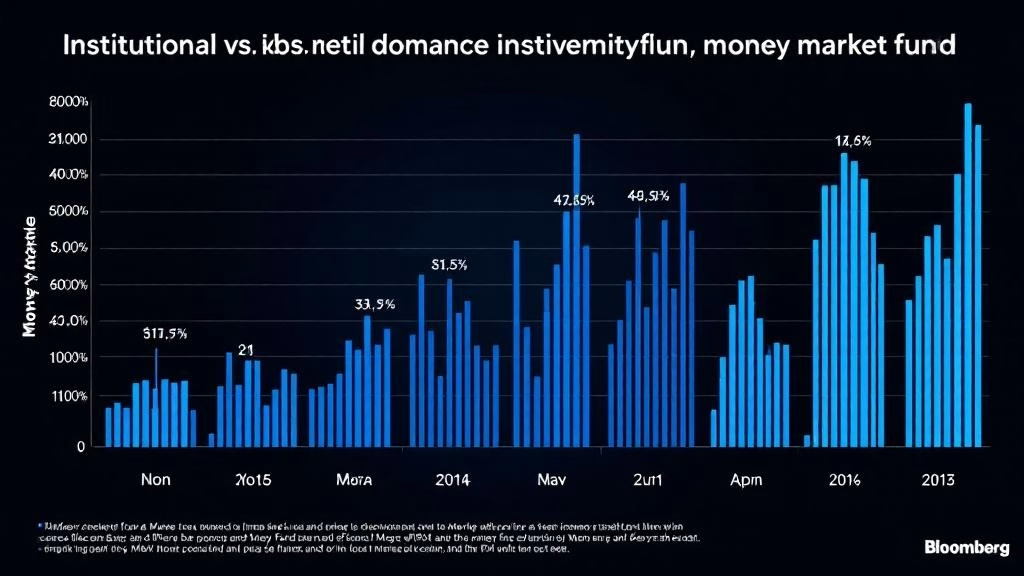
The breakdown matters. As of April 29:
- Government MMFs (institutional + retail): Down $8.02 billion, but still dominant at roughly $5.3 trillion of the total
- Prime MMFs: Down $5.23 billion; retail prime settled near $984.94 billion
- Tax-exempt MMFs: Up $2.26 billion to approximately $132.18 billion — the one category showing inflows last week
Institutional investors — corporate treasuries, plan sponsors, intermediaries — account for the majority of MMF assets. These allocators have a clear mandate: preserve capital, maintain liquidity, capture money market yields. As long as the Fed funds rate remains above 4%, the yield advantage of MMFs over idle bank deposits justifies the position. There is no imminent catalyst that would force a rapid exit.
On the retail side, the calculus is different. Individual investors who shifted into MMFs during 2022–2024 have grown accustomed to 4–5% returns with zero volatility. Behavioral inertia is a powerful force: moving back into equities or bond funds requires accepting duration risk that many retail investors are not ready to reaccept.
The Three Triggers That Could Move the Cash Wall
Crane Data, which tracks money market fund intelligence in real time, identifies three catalysts that historically precede meaningful MMF outflows:
1. Fed rate cuts that push MMF yields below the “pain threshold.” When yields on government MMFs fall below 3%, institutional investors begin re-evaluating duration risk in short-term bond funds. At 3.5–4%, money market funds remain competitive with 2-year Treasuries on a risk-adjusted basis. The current consensus, per CME FedWatch data, prices approximately two 25-basis-point cuts before year-end 2026. That is not enough to dislodge the institutional base.
2. Sustained equity market recovery that changes opportunity cost calculations. Retail investors respond to performance. A sustained S&P 500 rally above 5,800 — where equity return prospects visibly outpace MMF yields — has historically preceded retail redemptions from money market funds. The April tariff-driven selloff delayed that scenario, but markets have partially recovered.
3. Prime fund spread widening. When prime MMFs yield 50–75 basis points above government MMFs, investors accept the slightly higher credit risk and shift allocations. Today the spread is narrower, keeping assets consolidated in government funds.
None of these three triggers has fully activated as of early May 2026. The cash wall, for now, holds.
Fund Manager Implications: Who Dominates and What They’re Doing
Three managers control the majority of U.S. money market fund assets: Fidelity Investments, Vanguard, and BlackRock (with Federated Hermes and JPMorgan Asset Management rounding out the top five). Their strategies diverge in ways that matter for flow analysis.
Fidelity remains the largest retail MMF provider by a significant margin. Its Government Cash Reserves and Money Market funds anchored retail inflows through 2024 and into 2025. Fidelity’s MMF platform benefits from its direct distribution model — many retail holders have no reason to move, since Fidelity’s core account structure defaults idle cash into MMFs.
Vanguard operates its money market funds at near-cost. Its institutional prime and government MMFs attract fee-sensitive plan sponsors and RIA platforms that run omnibus structures. Vanguard’s February 2026 launch of BondBuilder model portfolios — discussed here — signals that the firm is already positioning for advisors who want to redeploy cash into structured fixed income allocations as rates drift lower.
BlackRock runs its MMF platform largely through institutional channels, often as embedded cash management solutions within wealth platforms. Its liquidity solutions group reported that institutional prime fund assets stabilized in Q1 2026 after two years of outflows driven by SEC money market reform concerns.
Federated Hermes, the Pittsburgh-based pure-play in money market management, has been the most vocal about the rotation risk. Its April 2026 shareholder letter flagged that “the question is no longer if assets rotate out of MMFs, but which category receives them — fixed income, equities, or alternative liquidity vehicles.”
Active vs. Passive: Where Does the Cash Go When It Moves?
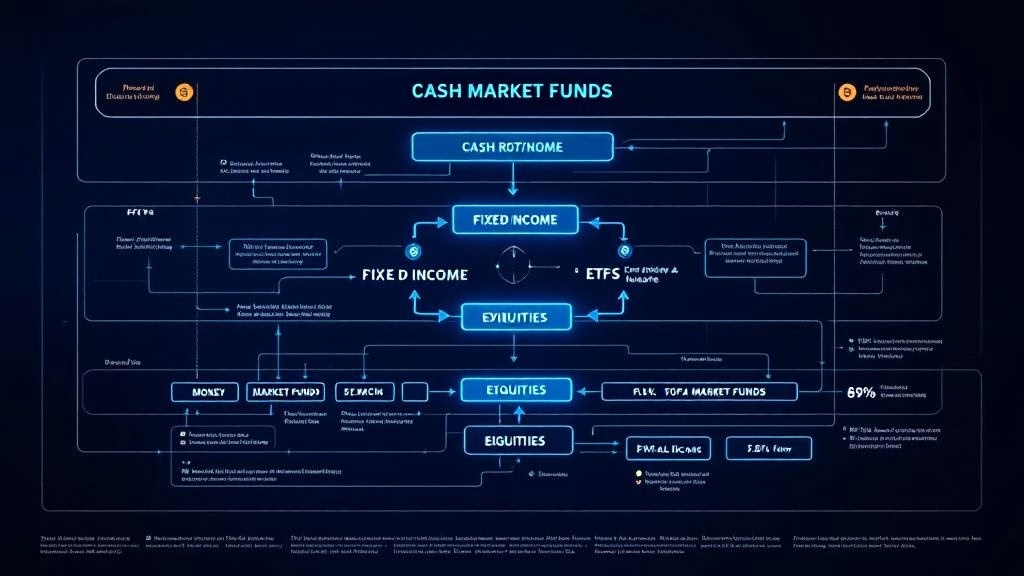
The $7.6 trillion question for the mutual fund industry is directional. Historical flow data from ICI suggests that previous MMF rotation episodes — notably 2015–2016 and 2019–2020 — did not produce uniform outcomes.
In 2016, intermediate-term bond funds absorbed the largest share of institutional MMF outflows. In 2019, the rotation was more diffuse: some into short-duration bond ETFs, some into equity income funds, and some into bank deposits.
The 2026 episode may differ in one key respect: the maturation of active ETFs as a vehicle. As JPMorgan’s position as the largest active ETF issuer illustrates, the product set available to advisors looking to deploy cash is now richer than in prior cycles. Active ultra-short bond ETFs — products like JPMorgan Ultra-Short Income ETF (JPST) or BlackRock’s NEAR — compete directly with prime MMFs on yield while offering intraday liquidity.
If the next wave of MMF outflows bypasses mutual funds entirely and flows into active ETFs, the mutual fund industry faces a structural reallocation challenge that has nothing to do with equity market performance.
The ICI’s 2026 Fact Book: A Benchmark for What’s Normal
ICI published its 2026 Fact Book in late April, covering full-year 2025 data on U.S. and worldwide money market funds. The report reconfirms that money market funds now serve as a genuine asset class within institutional portfolio construction — not merely a parking spot.
Among the key data points: the global money market fund industry exceeded $12 trillion for the first time in 2025. U.S. funds account for roughly 65% of that total. European LVNAV (Low Volatility Net Asset Value) funds — the EU’s post-reform equivalent — added €280 billion in the same period, suggesting that the MMF preference is not purely an American phenomenon.
For fund selectors and asset allocators, that global context matters: cash is sticky across jurisdictions, and the rotation thesis should not be assumed to unfold on any particular timeline.
What Advisors Are Watching in Q2 2026
Fee compression continues to narrow the gap between MMFs and short-duration bond funds. Advisors who use model portfolios — particularly those on Schwab, Fidelity, or Vanguard platforms — are being asked by clients why cash sitting in government MMFs isn’t being put to work.
The honest answer: because yield-to-risk still favors cash. But that calculus is shifting. Fund managers are beginning to build transition playbooks, and advisors who haven’t reviewed their cash management policy statements since 2022 are likely overdue.
The Capital Group’s brand strength among advisor-sold funds — recently documented in the Broadridge Fund Brand 50 — may prove relevant here. American Funds’ American High-Income Trust and fixed income offerings are positioned as natural landing zones for MMF rotation if risk appetite improves.
Questions to Bring to Your Investment Committee
- At what Fed funds rate level does our cash management policy require a formal review of MMF vs. short-duration bond fund allocations — and have we defined that trigger in writing?
- If 15% of our clients’ MMF holdings rotate into fixed income vehicles over the next 12 months, which specific funds or ETFs are our first-line candidates, and why?
- How are we communicating the opportunity cost of remaining in MMFs to clients who are questioning why their cash isn’t keeping pace with equity market recoveries?
Sources: Investment Company Institute — Money Market Fund Assets (weekly, April 29, 2026); Crane Data — MMF Intelligence; ICI 2026 Fact Book; Federated Hermes Q1 2026 Shareholder Letter; CME FedWatch; Broadridge Financial Solutions — Fund Brand 50 2026.
About Me

Tradingmarketsignals serves as the definitive digital ecosystem for the modern wealth management community. As a premier source of intelligence, it delivers high-level analysis, regulatory updates, and technological insights tailored specifically for independent financial advisors, RIA leaders, and investment professionals.