

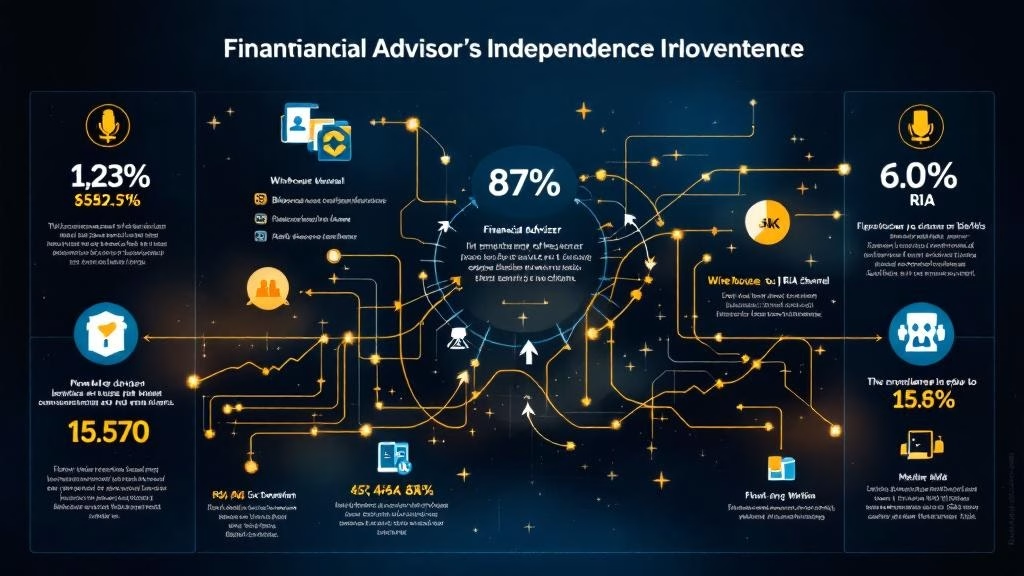

AdvizorPro’s 2025 Advisor Movement Trends Report counted 39,171 advisors who switched firms during the year — a near-decade high, up 10.5% from 2024. Cerulli Associates separately estimated that close to 9% of all U.S. advisors, representing approximately $3.1 trillion in client assets, changed affiliation in 2025.
The direction of that movement is what matters. And the direction was, once again, toward independence.
The retail RIA channel posted net gains of 2,573 advisors in 2025. Independent broker-dealers added 990 on net. Wirehouses lost 1,144. The insurance channel shed 1,888 — the largest single-channel loss of the year.
These numbers have been trending the same way for five years. What changed in 2025 is the pace, and the profile of who is moving.
The Wirehouse Math Is Getting Harder to Ignore
Only 22.5% of wirehouse advisors who left their firms stayed within the wirehouse model in 2025, according to Cerulli’s channel analysis. The other 77.5% either went directly into RIAs, dually registered firms, or IBDs.
That is a retention failure by any reasonable measure. When more than three-quarters of your departing advisors are choosing a fundamentally different business model — not a competitor wirehouse — it suggests something structural rather than something a better compensation grid can fix.
The most direct pipeline: 1,574 wirehouse advisors moved directly into RIAs in 2025. Another 2,022 shifted into dually registered structures, which Cerulli tracks as the primary staging ground before full RIA transition. Among advisors who started in that dually registered channel, 32.1% — representing 8,820 people — eventually transitioned into full RIA status.
Wirehouse firms are aware of this dynamic. The recruiting wars of the past decade — the oversized transition packages, the forgivable loan structures — have always been partly about retaining production, not just attracting it. But those packages come with strings. And the advisors who can afford to leave are precisely the high-producers who have been recruited most aggressively and who chafe most under compliance-heavy home office constraints.
Who Is Actually Leaving — and Why Now

The 2025 migration is not primarily composed of early-career advisors looking for better payouts. The breakaway demographic has shifted.
Advisors with $200 million or more in AUM now represent the majority of wirehouse-to-RIA transitions tracked by Diamond Consultants and Echelon Partners. They leave not because the wirehouse payout grid doesn’t work — it does — but because client ownership, investment platform flexibility, and succession planning optionality matter more to them at this stage of their practice than the economics of a transition package.
Client ownership is the one that tends to be underestimated. At a wirehouse, the client relationship technically belongs to the firm. Most advisors build their practice knowing this, and accept it as long as the platform delivers value. At $250 million in AUM and a 20-year client relationship, that arrangement starts to feel different.
Technology is the other factor. The gap between what wirehouse platforms offer and what RIA custodians — Schwab, Fidelity, Pershing — make available to independent advisors has narrowed substantially over the past five years. The old argument that you need a wirehouse to access institutional-grade portfolio management tools is largely gone. That argument has been replaced by a new one: that RIA tech stacks, built on third-party fintech integrations, are now more flexible than many wirehouse platforms.
This connects directly to the Schwab Advisor ProDirect program, which launched with 10 founding RIA firms in early 2026. The pitch is exactly this: custodial infrastructure plus a curated tech stack, at terms that no wirehouse can match on the economics.
The Consolidation Effect: You Can’t Escape M&A Even in Independence
Here’s something worth noting: the surge in advisor independence is happening simultaneously with a surge in RIA consolidation. These trends appear contradictory. They are not.
Advisors are leaving wirehouses to be independent. Many of them are then joining or affiliating with large RIA aggregators — Mercer Advisors, Mariner, Focus Financial, Hightower — that provide the back-office infrastructure and compliance support that a solo or small firm cannot easily replicate.
This is not the pure independence of a 1990s breakaway. It is a hybrid: entrepreneurial autonomy at the client-facing level, institutional infrastructure at the operational level. The Q1 2026 RIA M&A market hit 93 deals, driven partly by this dynamic — advisors choosing acquisition by an aggregator as their succession plan, rather than a wirehouse retirement package.
The LPL-Mariner Advisor Network deal at $31 billion earlier this spring is a clean example of what this consolidation looks like at scale. Independent advisors, under an IBD umbrella, being acquired by a larger independent platform. Technically not a wirehouse. But not exactly the solo RIA model either.
The Prosperity Capital Model: Unification as a Growth Strategy
One development from May 2026 worth watching is Prosperity Capital Advisors completing its unification of five previously separate advisory firms under a single brand and operational structure.
This is a different kind of independence story. Rather than individual advisors leaving wirehouses, Prosperity represents regional advisory firms that were already independent but chose to pool resources, technology, and brand equity rather than remain fragmented.
The decision makes sense as the RIA market matures. Being a $400 million AUM independent firm in 2026 is not as defensible a position as it was in 2018. Compliance costs are higher, technology demands are greater, and client expectations around digital access have shifted. Five $400 million firms under one brand and one infrastructure can service clients in ways that none of the five could separately.
What Wirehouse Retention Programs Will Look Like in 2026

Firms like Merrill Lynch, Morgan Stanley, UBS, and Wells Fargo Advisors are not passive observers. They have been modifying their retention and transition programs in response.
The trend is away from pure cash transition packages — which advisors were increasingly treating as signing bonuses — and toward equity-linked retention arrangements. If an advisor has a meaningful equity stake in the wirehouse’s wealth management unit or an affiliated RIA subsidiary, leaving becomes financially costlier in a different way. This is the model that Bank of America has been piloting with select Merrill Lynch advisors since late 2024.
The other play is investment platform expansion. Several wirehouses are adding alternative investment access, direct indexing capabilities, and tax overlay services that were previously only available through independent custodians. If the platform gap closes, the departure calculus changes for some advisors.
Whether these moves are enough to slow the independence trend is genuinely unclear. The structural forces are real: client ownership, succession flexibility, and the economics of owning an RIA practice that can be sold versus walking away from a wirehouse book. Those advantages don’t disappear because the wirehouse adds a direct indexing tool.
What Advisors and Practice Principals Should Be Asking
If you are running a wirehouse team or considering a transition in 2026, the three questions your decision framework needs to answer:
- What is the true economic difference — net of transition package clawbacks, build-out costs, and platform fees — between your current wirehouse payout and the post-transition economics of your target RIA model at your AUM level?
- Do you have a clear client portability plan — and have you had your client agreements reviewed by outside counsel to understand what you can actually take with you?
- If your practice were valued today as an independent RIA versus as a wirehouse practice at retirement, what is the multiple differential — and does that delta justify the disruption and cost of transition?
These are not questions with universal answers. But they are questions that 39,171 advisors apparently decided were worth asking in 2025 — and acted on.
Sources: AdvizorPro Advisor Movement Trends Report 2025; Cerulli Associates; Diamond Consultants; Echelon Partners; WealthManagement.com; AdvisorHub.
About Me

Tradingmarketsignals serves as the definitive digital ecosystem for the modern wealth management community. As a premier source of intelligence, it delivers high-level analysis, regulatory updates, and technological insights tailored specifically for independent financial advisors, RIA leaders, and investment professionals.