



Wealthspire Advisors announced this week that it has entered into an agreement to acquire Fi3 Advisors, an Indianapolis-based boutique firm managing approximately $1.2 billion in client assets. Separately, Atlanta-based Merit Financial Advisors confirmed the acquisition of Pradel Financial Group — a Seattle practice managing nearly $420 million across roughly 110 client households — marking Merit’s 58th deal since launching its acquisition program. Together, these two transactions capture something the headline RIA consolidation numbers miss: the boutique tier, firms between $400 million and $2 billion in AUM, has become the most active stratum in wealth management M&A.
The Wealthspire-Fi3 Deal: Indianapolis as a Strategic Market
Wealthspire Advisors, a New York-headquartered RIA with more than $20 billion in assets under management, has been deliberately expanding its Midwest footprint. The Fi3 Advisors acquisition represents a doubling down on Indianapolis, where Wealthspire already operates.
Fi3 Advisors was founded as an independent fee-only firm serving high-net-worth families and business owners in central Indiana. With $1.2 billion in AUM and a team-based advisory model, Fi3 fits the profile of what Wealthspire CEO Mike LaMena describes as a “culturally aligned, complexity-forward” practice. In a statement announcing the deal, LaMena noted that Fi3’s approach “aligns closely with how we serve clients, combining personalized guidance with the scale and resources needed to support more complex needs over time.”
The transaction is expected to close in Q2 2026, subject to customary regulatory approval. Financial terms were not disclosed, though mid-market RIA deals in the $1–$2 billion AUM range have recently transacted at multiples of 8–12x EBITDA, according to DeVoe & Company’s Q1 2026 RIA Deal Report.
Wealthspire is a subsidiary of NFP — itself acquired by Aon in 2023 — which gives it access to institutional-grade capital for acquisitions without the direct private equity ownership that defines many competing acquirers. That structure matters to sellers who want institutional backing without a PE firm’s exit-driven timeline.
Merit Financial’s 58th Deal: The Serial Acquirer Playbook

Merit Financial Advisors operates at a different velocity. Founded in Alpharetta, Georgia, Merit has grown to more than $26 billion in AUM across 55+ offices nationally — almost entirely through acquisition. The Pradel Financial Group deal, its 58th, adds Seattle to a national footprint that already spans the Southeast, Mid-Atlantic, and Mountain West.
Pradel Financial Group served approximately 110 client households, a relatively concentrated book weighted toward affluent pre-retirees and small business owners. For Merit, the Seattle acquisition checks two boxes: Pacific Northwest geographic diversification and a practice profile that integrates cleanly with Merit’s existing service model.
Merit’s acquisition pace — averaging more than one deal per month over the past three years — reflects a strategy articulated by founder and CEO Richard Saperstein: identify well-run independent practices under $500 million where the founding advisor is within 5–10 years of retirement, and offer a combination of cash, equity stakes in Merit, and operational support that a solo or small-team practice cannot replicate internally.
The Boutique Sweet Spot: Why $400M–$2B AUM Is the Most Active Tier
The mega-deals dominate headlines — LPL’s $31 billion Mariner Advisor Network acquisition, covered here, reshapes distribution economics at scale. But the deal volume in Q1 2026 that drove the record 93-transaction quarter — documented by Echelon Partners and DeVoe & Company — came disproportionately from the sub-$2 billion segment.
Why? Three structural reasons:
Succession pressure is most acute at this size. Practices with $400 million to $2 billion in AUM typically have 1–3 founding partners aged 55–68. These founders built real businesses — too large to wind down, too small to fund an internal succession at fair market value. Selling to a strategic acquirer like Wealthspire or a serial consolidator like Merit is often the only path that simultaneously rewards the founder and protects clients.
Buyers see margin recovery potential. Boutique firms in this range frequently carry above-market overhead — lease expenses, compliance costs, and technology licensing — relative to their revenue base. A larger acquirer can consolidate these costs immediately post-close, expanding EBITDA margins from a typical 15–20% at acquisition to 28–35% within two years. That accretion funds the acquisition multiple.
Private equity’s reach into the mid-market. As previously analyzed, private equity now backs more than 90% of significant RIA transactions. PE-funded platforms need deal volume to deploy capital. Large mega-deals are rare; boutique acquisitions are repeatable and scalable.
Buyer Profiles: What Wealthspire and Merit Offer That’s Different
Not all acquirers present the same value proposition to a selling founder, and the Fi3/Pradel deals illustrate how buyer differentiation works in practice.
Wealthspire’s pitch centers on brand preservation and cultural continuity. Acquired firms often retain their team structure and client relationships while gaining access to Wealthspire’s compliance infrastructure, investment platform, and institutional support. For Fi3’s clients — high-net-worth Indianapolis families who chose a boutique specifically because they didn’t want to work with a wirehouse — the Wealthspire structure preserves the boutique feel while adding resources.
Merit Financial’s pitch is velocity and equity participation. Founders who join Merit receive a combination of upfront cash and equity in the parent entity, creating a second liquidity event if Merit itself transacts with a larger buyer or goes public. Merit’s model assumes founders will remain engaged for 3–5 years post-acquisition as regional leaders, rather than immediately retiring. That assumption works for advisors who want liquidity without an immediate exit.
The contrast matters for the broader market: sophisticated sellers in the $400 million–$2 billion range are choosing between cultural fit (Wealthspire) and financial upside (Merit). Both deal types are closing — which tells you demand from sellers remains strong across motivations.
Valuation Math: What Boutique RIAs Command in 2026
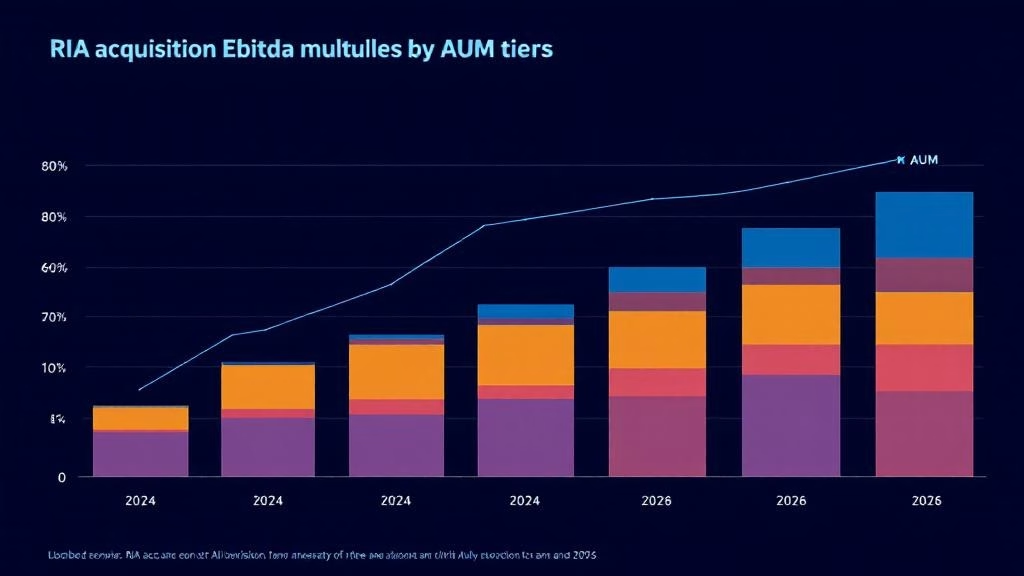
DeVoe & Company’s Q1 2026 RIA Deal Report pegged median transaction multiples for firms under $1 billion AUM at approximately 7.5–9x EBITDA, with outliers reaching 11–12x for practices with strong organic growth rates, diversified client bases, and documented next-generation advisor talent.
For a $1.2 billion AUM firm like Fi3 Advisors — assuming a revenue yield of roughly 60 basis points and an EBITDA margin of 22% — implied EBITDA is approximately $1.6 million. At a 9x multiple, the transaction value would approximate $14 million. At 12x, closer to $19 million. Without confirmed deal economics, these are illustrative, but they ground the discussion in the realistic range that boutique founders should expect to discuss with their M&A advisors.
For sellers: the difference between a 9x and 12x multiple at $1.2 billion AUM is $5 million. That delta is increasingly determined by three factors — the strength of the firm’s recurring revenue base, the depth of the advisory team beyond the founding partner, and the documented growth trajectory over the prior 36 months.
What to Watch: The Second Half of 2026
Merit Financial’s pace of roughly one acquisition per month, if sustained, puts it on track to exceed 65 total deals by year-end 2026 — a number that will require continued PE capital support and integration capacity. Constellation Wealth Capital, which took a minority stake in Merit in late 2025, gave Merit both fresh capital and a strategic partner with deep RIA M&A experience.
Wealthspire’s Indianapolis expansion may signal the next phase of its geographic strategy. The Midwest remains underpenetrated by national RIA consolidators relative to the Northeast and West Coast, and states like Indiana, Ohio, and Missouri contain a concentration of independent practices founded in the 1990s and 2000s whose principals are now approaching succession age.
Observers at Houlihan Lokey’s Financial Services Group have noted that deal flow in Q2 2026 shows no signs of moderating. “The pipeline is as strong as we’ve seen,” said Donald Schipf, a director in the group, in published comments last month. “Private equity firms that took stakes in RIAs during 2020–2022 are now approaching the end of their hold periods and looking at recapitalization or sale — which adds seller supply to an already active market.”
Questions to Bring to Your Advisory Practice Committee
- If your practice is in the $400M–$2B AUM range, have you received a formal independent valuation within the past 18 months — and do you understand which factors are currently moving multiples up or down for practices like yours?
- When evaluating acquirers, what weight does your succession plan give to post-close operational autonomy vs. financial upside, and have you articulated that preference to your M&A advisor?
- For advisory practices still planning internal succession: at what AUM level does the math of funding an internal buyout become competitive with the proceeds from an external sale — and have you modeled both scenarios with current 2026 multiples?
Sources: InvestmentNews — Wealthspire/Fi3 Advisors acquisition (May 2026); Merit Financial Advisors — Pradel Financial Group acquisition announcement; DeVoe & Company Q1 2026 RIA Deal Report; Echelon Partners M&A Intelligence; Houlihan Lokey Financial Services Group commentary (April 2026); Constellation Wealth Capital.
About Me

Tradingmarketsignals serves as the definitive digital ecosystem for the modern wealth management community. As a premier source of intelligence, it delivers high-level analysis, regulatory updates, and technological insights tailored specifically for independent financial advisors, RIA leaders, and investment professionals.