



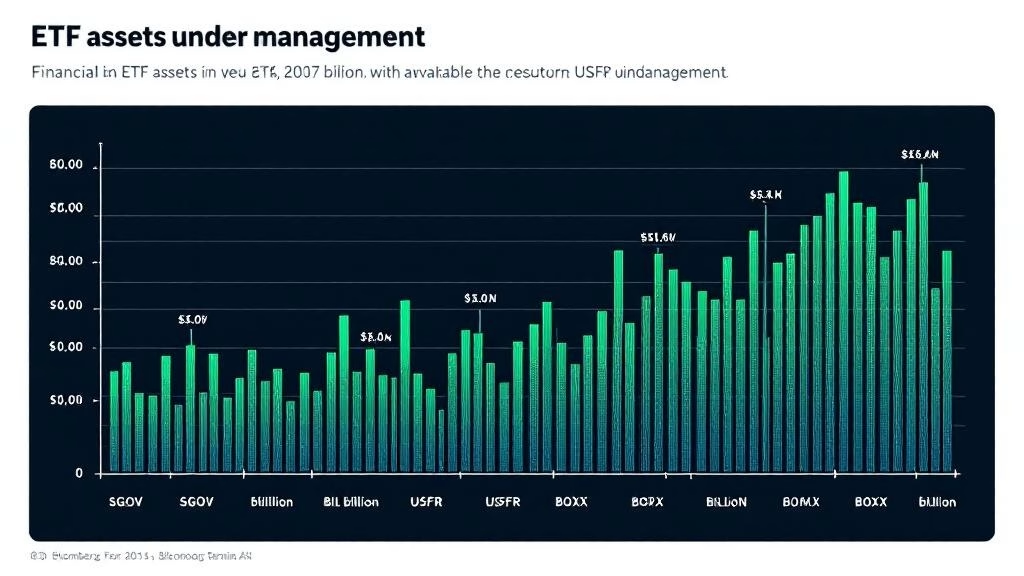
BlackRock’s iShares 0-3 Month Treasury Bond ETF (SGOV) crossed $85.2 billion in assets in early May 2026 after pulling in $22 billion year to date, a haul second only to the Vanguard S&P 500 ETF (VOO) across the entire U.S. ETF market. The surge confirms what asset managers, broker-dealers, and money market desks have tracked since January: client cash is leaving traditional money market funds and moving into a small group of ultra-short Treasury ETFs that trade like a stock, settle like a bond, and yield within a few basis points of an institutional sweep.
The shift is bigger than a single fund. Cash-like ETFs collected more than $100 billion in 2025, and Q1 2026 alone delivered roughly $40 billion of fresh inflows across SGOV, the SPDR Bloomberg 1-3 Month T-Bill ETF (BIL), the WisdomTree Floating Rate Treasury Fund (USFR), and Alpha Architect’s 1-3 Month Box ETF (BOXX). Together these four products now hold over $157 billion, which would have sounded fictional in 2022 when SGOV was still under $10 billion.
For advisors, plan sponsors, and family office allocators, the pace of the move forces a question that nobody had to answer cleanly when sweep yields were 4 basis points: where exactly should client cash sit in 2026?
Key Takeaways
- SGOV holds $85.2B AUM after $22B in 2026 YTD inflows; second only to VOO across all U.S. ETFs.
- BIL holds $46.4B and added $7B in 2026; USFR sits at $17.0B; BOXX has roughly doubled to about $8.8B with $4.1B since January.
- More than 50% of fixed income ETF flows in March 2026 went into ultra-short and short-term exposures, per iShares Q1 review.
- Yields cluster between 3.50% and 3.61%, with USFR’s floating rate slightly ahead and SGOV’s expense ratio of 0.09% the cheapest.
- BOXX uses a box-spread structure that delivers Treasury-equivalent yield as long-term capital gains, a tax wrinkle that has driven $4B of recent flows.
What Is a Cash-Like ETF, Exactly?
A cash-like ETF holds short-duration Treasury exposure and trades like a single equity ticker. The four funds at the center of the 2026 flow story all sit at the front end of the Treasury curve, with most weighted-average maturities under 90 days.
The structural advantages over traditional money market funds are familiar but suddenly matter at scale. ETFs settle T+1, can be bought and sold intraday at the prevailing NAV, do not require sweep account paperwork, and clear inside any brokerage that supports listed equities. Money market funds, by contrast, settle same-day but only against accepted cut-off times, and many advisor platforms route MMF assignments through proprietary share classes with fee leakage that disappears on an exchange-traded ticker.
The economics now favor ETFs in a way they did not 18 months ago. SGOV reports a 30-day SEC yield of 3.53%, BIL is at 3.50%, USFR is at 3.61%, and SHY (which extends to 1-3 year duration) is at 3.58%. The Federal Reserve’s overnight reverse repo rate sat around 4.25% to start May 2026, so government MMFs still print marginally higher coupons, but the gap is roughly 50 basis points and shrinks each time the Fed signals patience.
SGOV’s $85B Run: How BlackRock Captured the Cash Trade
BlackRock’s iShares platform booked a record $132 billion in net inflows in Q1 2026, and SGOV alone contributed $14 billion of that figure. The fund’s 0.09% expense ratio is the cheapest in the category, undercutting BIL at 0.14% and SHV at 0.15%. Cost matters at the ultra-short end because yield differentials between underlying portfolios are narrow, so 5 basis points of fee compression is the difference between competitive and uncompetitive.
SGOV holds 0-3 month T-bills exclusively. Its 3-year standard deviation sits at 0.18%, the lowest of any meaningful ETF outside of cash. Total return for the trailing twelve months through early 2026 came in around 4.2%, almost entirely from coupon and roll.
That tight risk profile has made SGOV the default placeholder for advisors who used to park cash in 1-3 year duration funds during rate-cut anticipation. With the Fed having moved its first 2026 cut to mid-year per the May FOMC dot plot, allocators stayed at the front end longer than expected, and SGOV was the cleanest expression.
BIL Holds Steady, USFR Wins on Floating-Rate Mechanics
State Street’s BIL is the older fund in the category and still holds $46.4B. Its growth has been steady rather than explosive in 2026, with about $7B of net new flows. The product is essentially the legacy cash-like benchmark, and many model portfolios that allocated to BIL in 2022 simply have not switched, which explains the persistence of the AUM despite SGOV’s lower fee.
WisdomTree’s USFR has carved out its own niche. The fund holds floating-rate Treasury notes (FRNs) issued by the U.S. Treasury, which reset weekly to the 13-week T-bill rate. That floating mechanic delivered the highest reported yield in the category at 3.61%, and during rate-cut speculation, USFR’s coupon adjusts down within days while fixed-rate T-bill ETFs need their portfolios to roll. The reverse is also true: USFR captured the early 2026 yield curve repricing faster than SGOV, which is why some institutional desks rotated dollars from SGOV to USFR in February and March.
BOXX Doubled in Size: The Tax-Efficient Wrinkle

Alpha Architect’s 1-3 Month Box ETF (BOXX) is the outlier. The fund delivers Treasury-equivalent yield through box-spread options on the S&P 500. Because the structure generates 1099-B reportable transactions rather than 1099-INT interest income, gains held more than one year qualify as long-term capital gains.
For a high-tax-bracket investor in California or New York, that delta is substantial. A 37% federal plus 13.3% California top bracket pays roughly 50.3% on Treasury interest. The same client in BOXX held over 12 months pays 20% federal long-term capital gains plus the state rate, dropping the effective tax to roughly 33%. Multiply that 17-point delta across a six- or seven-figure cash bucket and the math becomes serious.
BOXX has roughly doubled in size during the past nine months and now holds about $8.8 billion, with $4.1 billion of inflows since January 2026. The fund’s prospectus risks (IRS reclassification, box-spread liquidity, no Treasury direct exposure) have not slowed the flows, and family office allocators have been the dominant adopters.
Why Is Cash Leaving Money Market Funds in 2026?
Money market fund total assets crossed $7.6 trillion in late April 2026, per the Investment Company Institute (ICI). Outflows have not been the story — the cash wall is still growing. The story is rotation inside the cash bucket.
Three structural drivers explain the ETF gain:
- Sweep economics. Many brokerage sweep programs pay between 0.01% and 0.40% on retail cash. A $250,000 client cash balance earning 0.40% in a sweep leaves roughly $7,800 of annual yield on the table versus SGOV at 3.53%.
- Operational fit. Custodial reporting now treats cash-like ETFs as portfolio holdings rather than sweep balances. That cleans up performance reporting, billing, and trading workflows for advisors who used to run separate cash workflows through MMF share-class assignments.
- Tax-loss-harvesting parking. During Q1 2026 volatility, advisors using direct indexing platforms parked tax-loss-harvested cash in SGOV or BIL for the 31-day window before reinvestment. That use case was negligible in 2023 and is now a material flow contributor.
The Fed’s pending potential bill purchases post-quantitative tightening, combined with sustained Treasury bill issuance to fund deficits, has anchored the front of the curve and made the cash-like ETF trade structurally easier to underwrite.
How Does This Compare to the Money Market Cash Wall?
The site has covered the $7 trillion cash wall in money market funds and the structural rotation triggers ICI tracks each week. The cash-like ETF story is the other half of that picture: when MMF holders decide they want to keep cash-like exposure but with intraday liquidity, lower fee leakage, or tax efficiency, they end up in SGOV, BIL, USFR, or BOXX.
The companion shift is in how asset managers are positioning. BlackRock’s broader push behind active and bond ETFs in Q1 2026 came with iShares pulling in $132 billion of net new flows. That growth pattern fits with the broader migration from mutual funds to ETFs the site documented in late April — where active ETF launches now outpace mutual fund launches by roughly 10 to 1.
Vanguard’s competitive response has been fee-driven. Its February 2026 round of expense ratio cuts on 53 funds included its short-duration bond products. The pressure point for active managers in cash-equivalent space is whether they can justify any fee premium over a 9-basis-point Treasury ETF that has effectively zero credit risk and no duration exposure.
What Cash-Like ETFs Yield, Cost, and Trade Like Right Now
| Fund | Sponsor | AUM | Expense Ratio | 30-Day SEC Yield | Avg Duration |
|---|---|---|---|---|---|
| SGOV | iShares | $85.2B | 0.09% | 3.53% | 0.08 yr |
| BIL | State Street | $46.4B | 0.14% | 3.50% | 0.08 yr |
| USFR | WisdomTree | $17.0B | 0.15% | 3.61% | Floating |
| BOXX | Alpha Architect | ~$8.8B | 0.19% | ~3.45% (tax-eq.) | <90 days |
All four trade with bid-ask spreads under 2 basis points in normal market hours, settle T+1, and pay distributions monthly (except BOXX, which reinvests through the box-spread structure).
Where Does This Leave Active Cash Managers?
Active short-duration bond funds have struggled to keep flows. Federated Hermes, Fidelity, and JPMorgan all run institutional MMF and ultra-short bond strategies with multi-decade track records and operational scale that ETF issuers cannot easily replicate. Their relative-value pitch to advisors in 2026 increasingly leans on two arguments:
- Yield enhancement at the margin. Active short-duration strategies (FCNVX, JPST, ICSH) hold a sliver of agency MBS, ABS, or short corporates that lift yield 20 to 40 basis points above pure Treasury exposure. For institutional cash with no immediate liquidity need, that pickup pays for the active fee.
- Regulatory positioning. Some allocators with policy constraints (insurance general accounts, certain non-profits) cannot hold non-government securities in their cash bucket. For those, government MMFs and Treasury ETFs remain the only option, and the discussion is purely about wrapper.
The actively managed JPMorgan Ultra-Short Income ETF (JPST) is the largest hybrid of the two worlds at over $30 billion, and Fidelity launched its own active short-duration ETF in 2025 specifically to defend its institutional client base. Whether those active wrappers can grow inside a category where SGOV adds $14 billion per quarter at a 9-basis-point fee is the open question.
What Should Advisors Do Right Now?
The practical question for the next 90 days is whether to migrate sweep cash, MMF positions, or short-duration bond allocations into cash-like ETFs, and which ETF to pick. A short framework:
- For taxable HNW clients in high state-tax brackets, BOXX merits a serious look as a cash bucket if the client is comfortable with the prospectus risks. Run the after-tax math at the client’s marginal rate before recommending.
- For retirement and tax-deferred accounts, SGOV’s cost advantage usually wins. The 5-basis-point gap to BIL compounds meaningfully on six- and seven-figure cash positions.
- For institutional or insurance-restricted mandates, government MMFs and short-duration Treasury ETFs are both eligible. The decision is mostly operational rather than economic.
- For clients anticipating Fed cuts, USFR’s floating-rate mechanic captures rate moves faster than fixed-rate T-bill ETFs, which matters at inflection points but not in steady-state.
What to Watch in Q2 and Q3 2026
Three signals will tell allocators whether the cash-like ETF trade has more room or is reaching its natural ceiling:
- Fed bill purchase guidance. If the Fed begins buying T-bills to manage reserve scarcity post-quantitative tightening, the front-end curve flattens and the yield gap between MMFs and Treasury ETFs compresses, which removes some of the trade’s edge.
- MMF reform tail risk. SEC rule changes that further constrain prime MMF liquidity or impose mandatory liquidity fees could push another wave of corporate cash into Treasury ETFs.
- Active manager response. Watch whether Fidelity, JPMorgan, and Vanguard launch additional fee-cut rounds on their short-duration active ETFs (JPST, FCNVX, etc.) to defend against SGOV’s gravitational pull.
Questions Advisors Should Bring to Their Next Investment Committee
- Have we run after-tax yield math on our top 20 taxable cash balances, comparing current sweep / MMF positioning against SGOV, BIL, and BOXX?
- What is our written policy on cash-like ETFs as a sweep replacement, and does it differentiate by account type (taxable, retirement, institutional)?
- If the Fed signals balance sheet normalization or bill purchases, do we have a defined trigger to rebalance from cash-like ETFs into 1-3 year duration?
The cash-like ETF story is not a momentum trade. It reflects a durable structural shift in how investors and allocators wrap short-duration Treasury exposure. The $157 billion already in the four major products will be a floor, not a ceiling, if the Fed keeps the front end attractive through 2027.
Sources: BlackRock iShares Q1 2026 ETF Market Trends report; ICI Estimated Long-Term Mutual Fund Flows; Morningstar US Fund Flows 2026; ETF.com 6 ETF Predictions for 2026; ETF.com BOXX coverage; Alpha Architect BOXX prospectus.
About Me

Founder and Chief Research Analyst at Trading Market Signals. Abdelali El Khadmaoui specializes in AI Wealth Intelligence, Wealth Management, Registered Investment Advisors (RIAs), Family Offices, Retirement Planning and Private Credit. He publishes in-depth research and data-driven analysis for financial professionals.