


Introduction to Forex Trading Guide
Forex trading guide, or foreign exchange trading, involves the exchange of one currency for another with the aim of making a profit. It is the largest financial market in the world, with daily trading volumes exceeding $7 trillion. Traders operate in currency pairs—like EUR/USD or GBP/JPY—speculating on the relative strength of one currency against another.
Unlike stock markets, the forex market operates 24 hours a day, five days a week, offering traders flexibility and round-the-clock access. With its high liquidity, low entry barriers, and the ability to trade from anywhere using online platforms, forex has become a popular market for both beginners and seasoned investors.
Forex Trading Guide
Understanding How the Forex Market Works
The forex market is decentralized, meaning there is no central exchange. Instead, trading occurs over-the-counter (OTC) through a global network of banks, brokers, and financial institutions. Currency pairs are quoted with a base and quote currency. For example, in EUR/USD, the euro is the base currency and the U.S. dollar is the quote currency. If EUR/USD is trading at 1.1000, it means one euro can be exchanged for 1.10 dollars.
Forex traders profit by buying low and selling high (going long), or selling high and buying low (going short). Prices fluctuate based on a variety of factors, including economic news, central bank decisions, geopolitical events, and market sentiment.

Choosing a Forex Broker
One of the first steps in your forex trading journey is selecting a reliable broker. The best forex brokers are regulated by recognized financial authorities such as the FCA (UK), ASIC (Australia), or CFTC (USA). Regulation ensures that the broker follows strict financial standards and that your funds are kept safe.
A good broker will offer a user-friendly platform, competitive spreads, low commissions, a wide range of currency pairs, and strong customer support. Popular platforms include MetaTrader 4 (MT4), MetaTrader 5 (MT5), and proprietary web-based systems. Before committing real money, it’s wise to open a demo account to test the platform and practice trading without risk.
Learning Key Forex Concepts
To effectively use this forex trading guide, you need to understand some basic terminology. Leverage allows you to control a large position with a relatively small amount of money. For example, with 50:1 leverage, a $100 deposit lets you control a $5,000 trade. While leverage increases profit potential, it also magnifies losses, so it should be used with caution.
Pips are the smallest price movements in a currency pair. Most major pairs are quoted to four decimal places, and one pip equals 0.0001. Lots refer to the size of your trade. A standard lot is 100,000 units of the base currency, while mini and micro lots are 10,000 and 1,000 units respectively.
Understanding these fundamentals will help you read quotes, calculate profits and losses, and manage your risk appropriately.
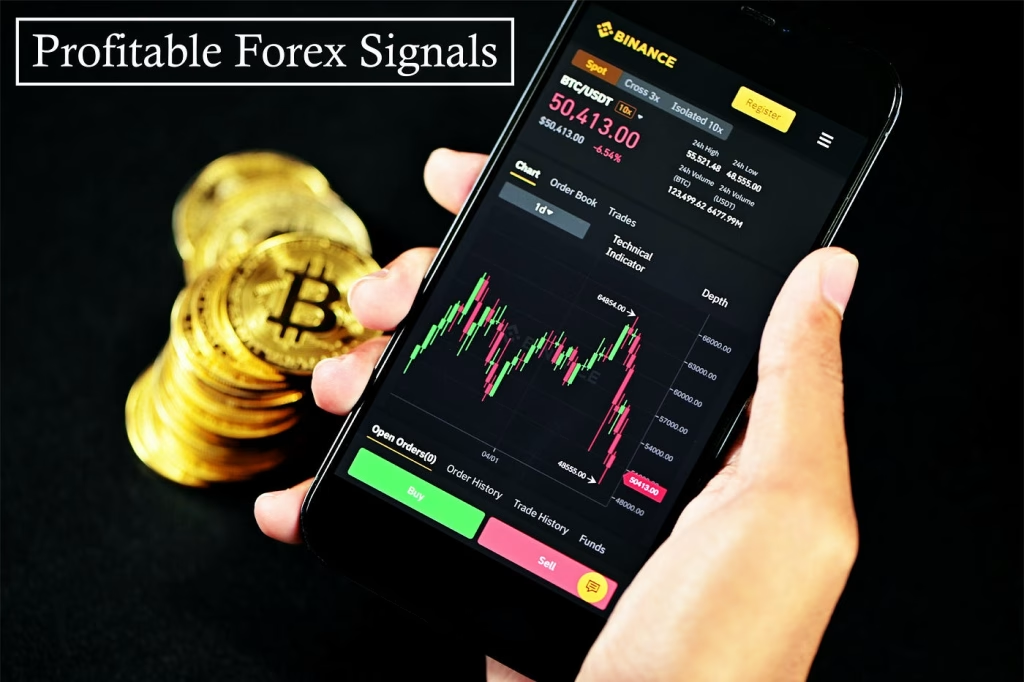
Developing a Trading Strategy
Every successful forex trader relies on a well-defined strategy. Your strategy outlines when to enter and exit trades, how much to risk, and what market conditions to look for. Strategies typically fall into one of two categories: technical analysis and fundamental analysis.
Technical traders study price charts, patterns, and indicators like moving averages, RSI, and MACD to forecast future movements. Fundamental traders, on the other hand, focus on economic indicators, interest rates, inflation data, and political events to determine a currency’s value.
A simple trend-following strategy, for example, might involve buying a currency pair when it moves above a key moving average. Regardless of which method you choose, consistency and discipline are critical to long-term success.

Risk Management: Protecting Your Capital
No forex trading guide is complete without a section on risk management. The goal of trading is not just to make profits, but to protect your capital so you can continue trading over time. Always use stop-loss orders to limit your downside on each trade. Many experts recommend risking no more than 1–2% of your account on a single trade.
Diversifying your trades, avoiding over-leverage, and keeping emotions in check are all essential elements of a sound risk management plan. Remember, even professional traders experience losses. What sets successful traders apart is how they manage and minimize those losses.

Practicing and Improving Your Skills
Forex trading is a skill that takes time to develop. Before going live, use a demo account to test your strategies and gain familiarity with market movements. Keep a trading journal to track your trades, including what went right or wrong, so you can learn from your experience.
Education should be ongoing. Follow forex news sites, join trading forums, and study successful traders. Many brokers also offer webinars, tutorials, and eBooks to help you refine your skills and expand your market knowledge.

Final Thoughts: Mastering Forex with the Right Guide
Forex trading can be a rewarding endeavor, but it requires preparation, patience, and a solid understanding of the market. This forex trading guide has walked you through the core components—from market basics to strategy development and risk management.
Whether you’re looking to trade as a hobby or pursue it professionally, start with a demo account, study the market, and develop a disciplined approach. With consistent effort and the right mindset, you can build a strong foundation and trade the forex market with confidence.
For more updates, visit https://tradingmarketsignals.com/

Tradingmarketsignals serves as the definitive digital ecosystem for the modern wealth management community. As a premier source of intelligence, it delivers high-level analysis, regulatory updates, and technological insights tailored specifically for independent financial advisors, RIA leaders, and investment professionals.