

The Dow Jones 50000 milestone is no longer a distant fantasy — it is an imminent reality. As of Tuesday’s close on February 17, 2026, the Dow Jones Industrial Average (DJIA) settled at 49,533.19, placing it less than 500 points — roughly 1% — away from a number that would have seemed absurd just five years ago. With broader indices like the S&P 500 holding firm at 6,843 and the Nasdaq Composite trading at 22,578, Wall Street is riding a wave of momentum that could push the Dow past this psychologically massive level within days.
But what is actually driving this rally? And more importantly, can it sustain itself beyond the headline-grabbing number? Let’s break down the forces behind the Dow’s march toward 50,000, the risks that could stall it, and what this milestone means for your portfolio.

How the Dow Jones Reached the Doorstep of 50,000
The Dow’s journey to this level has been anything but smooth. After the turbulent post-pandemic years, a brutal 2022 bear market, and the regional banking scare of 2023, the index has staged a remarkable multi-year recovery fueled by several converging tailwinds.
Corporate Earnings Remain Resilient
Fourth-quarter 2025 earnings season has been broadly positive. According to Reuters, roughly 78% of S&P 500 companies that have reported so far beat analyst expectations — a figure that has kept investor confidence elevated. Among Dow components specifically, heavyweights like Microsoft, Apple, and UnitedHealth Group delivered strong results, providing a solid floor under the index.
The upcoming NVIDIA earnings report on February 25 is expected to be another catalyst. While NVIDIA itself is not a Dow component, its results have an outsized influence on tech sentiment across all major indices, including the 30-stock Dow.
The Federal Reserve’s Balancing Act
Monetary policy has shifted decisively in favor of equities. After holding rates steady through much of 2025, the Federal Reserve signaled a more accommodative stance heading into 2026. The 10-year Treasury yield currently sits at 4.069%, a level that suggests bond markets are pricing in at least one additional rate cut this year. Lower rates reduce the discount rate applied to future corporate earnings, making stocks more attractive on a relative basis.
Fed Chair Jerome Powell’s recent testimony before Congress reinforced the message that inflation is trending toward the 2% target without requiring further tightening. This dovish tilt has been a key engine behind the Dow’s ascent.
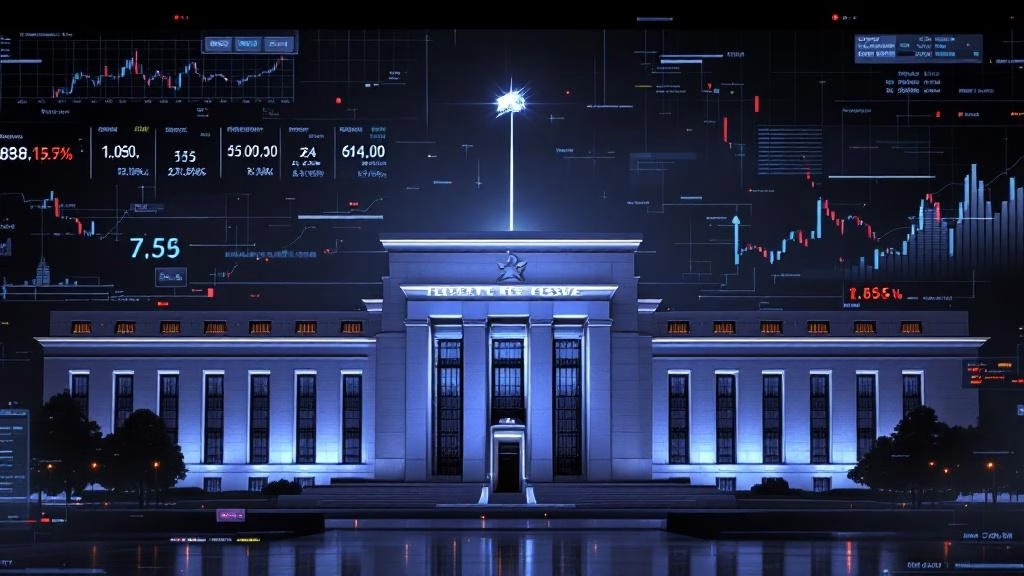
Dow Jones 50000 Analysis: What the Components Tell Us
Unlike the S&P 500, which is weighted by market capitalization, the Dow Jones is a price-weighted index. This means higher-priced stocks have a disproportionate impact on the index’s movements. Understanding this structure is critical to analyzing whether the Dow can sustain a push beyond 50,000.
Top Contributors to the Rally
Several high-priced Dow components have been leading the charge:
- UnitedHealth Group (UNH) — Trading above $550, UNH carries the largest weight in the Dow. Its consistent revenue growth from Medicare Advantage enrollment and Optum Health services has made it the single biggest contributor to the index’s gains.
- Goldman Sachs (GS) — With shares above $480, Goldman has benefited from a resurgence in investment banking activity and trading revenue. The IPO market’s gradual recovery in late 2025 and early 2026 has been a particular tailwind.
- Microsoft (MSFT) — Azure cloud revenue continues to accelerate, driven by enterprise AI adoption. Microsoft’s stock price above $450 gives it enormous pull on the price-weighted index.
- Caterpillar (CAT) — Infrastructure spending globally, particularly in the U.S. and emerging markets, has kept demand for heavy machinery elevated. CAT shares above $400 reflect this ongoing cycle.
Together, these four stocks account for a disproportionate share of the Dow’s recent gains, and their continued strength will be essential for a sustained break above 50,000.
Laggards and Potential Drags
Not every component is pulling its weight. Intel (INTC), despite restructuring efforts, remains one of the weakest Dow stocks. Nike (NKE) has struggled with inventory issues and softer consumer demand in China. Boeing (BA), while recovering from its 2024 crisis, still trades well below its all-time highs and carries execution risk related to production ramp-ups.
If these laggards stage even a modest recovery, they could provide additional fuel for the Dow’s push past 50,000. Conversely, any fresh negative surprises from these names could create a short-term headwind.
Global Tailwinds Supporting U.S. Indices
The Dow’s rally is not happening in isolation. Global equity markets have been broadly constructive, creating a supportive backdrop:
- European markets surging — The DAX has reached 24,998, flirting with 25,000. The FTSE 100 climbed 0.79% to 10,556. European equities are benefiting from a weaker euro, which boosts export-heavy companies, and expectations of further ECB rate cuts.
- Japan’s Nikkei rallying — The Nikkei 225 jumped 1.02% to 57,143 as the Bank of Japan maintains an accommodative stance even amid gradual policy normalization. The recent Nikkei volatility appears to have resolved in favor of the bulls.
- Commodity markets stable — Brent crude at $67.58 suggests manageable energy costs, which reduces input cost pressures for corporate America without signaling a demand collapse.
When global markets move in sync to the upside, it often reflects broad-based confidence in the economic outlook — a dynamic that favors further gains for the Dow.
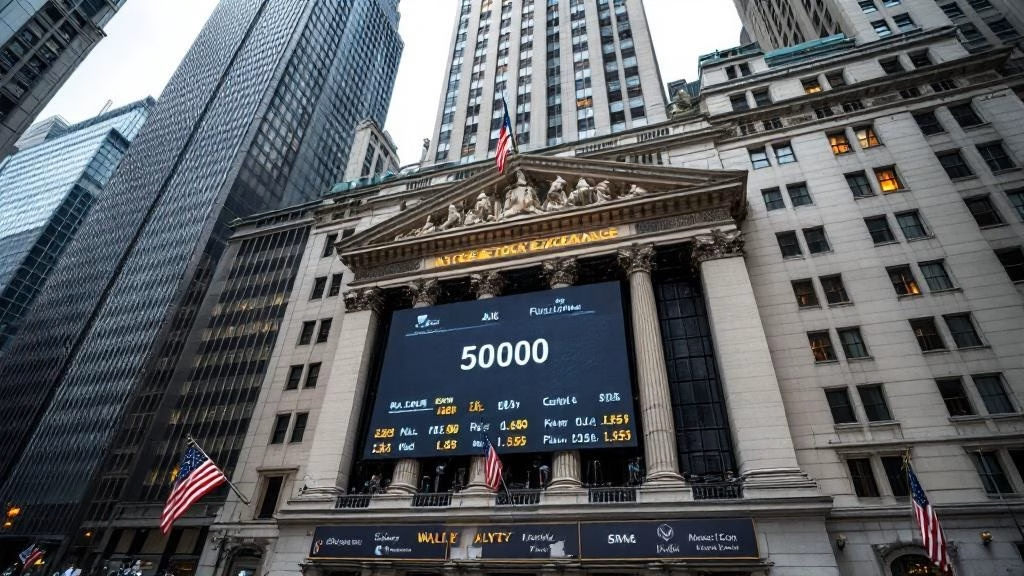
5 Reasons the Dow Could Break 50,000 This Month
Here are the specific catalysts that could drive the Dow through the 50,000 barrier before March:
- Earnings momentum — The remaining Q4 earnings reports, particularly from Walmart (WMT) and Home Depot (HD) this week, could provide positive surprises that lift the index. Retail earnings are a bellwether for consumer spending health.
- Technical breakout potential — The Dow has consolidated in a tight range between 49,000 and 49,600 for over a week. Technical analysts note that this type of compression often precedes a sharp directional move, and the path of least resistance appears to be upward.
- Rotation into value — As growth stocks face valuation scrutiny, money is rotating into the Dow’s more value-oriented components. This rotation trend that has also boosted small caps could extend to Dow industrials and financials.
- Buyback season — Corporate share buyback programs, which were paused during earnings blackout periods, are resuming. Many Dow components have authorized multi-billion-dollar repurchase programs that reduce share counts and support per-share earnings growth.
- Investor sentiment not yet euphoric — Contrary to what you might expect near a major milestone, the AAII Investor Sentiment Survey shows bullish sentiment at 42%, well below the extreme readings (above 55%) that typically mark market tops. This suggests there is still room for new buyers to enter.
Risks That Could Delay the Dow Jones 50000 Target
No rally is without risk, and several factors could prevent an immediate breakthrough:
- Geopolitical uncertainty — Trade tensions, particularly between the U.S. and China, remain a wildcard. Any escalation in tariffs or sanctions could rattle markets and trigger a risk-off selloff.
- Inflation resurgence — While inflation has been trending lower, any surprise uptick in CPI or PCE data could force the Fed to reconsider its dovish stance. The next inflation print on February 26 will be closely watched.
- Software sector weakness — Tuesday’s session saw declines in software stocks weigh on the broader market. As CNBC reported, this weakness prevented the S&P 500 from making meaningful gains. If tech weakness broadens, it could spill into Dow components like Microsoft and Salesforce.
- Profit-taking at round numbers — Round psychological levels like 50,000 often act as resistance. Traders may use the approach to this number as an opportunity to lock in gains, creating a temporary ceiling that requires multiple attempts to break through.
What Dow 50,000 Means for Investors
While 50,000 is ultimately just a number, milestones like this carry real psychological and practical significance:
For long-term investors: It is a reminder of the power of compounding. The Dow first hit 10,000 in 1999, 20,000 in 2017, 30,000 in 2020, and 40,000 in 2024. Each 10,000-point leap has occurred faster than the last, reflecting the exponential nature of equity growth over time.
For active traders: The approach to 50,000 creates a well-defined trading range. Support sits near 49,000 (the consolidation low), while a clean break above 50,000 would likely trigger algorithmic buying and momentum chasing that could push the index toward 51,000 rapidly.
For sector allocators: The Dow’s composition — heavy on industrials, financials, healthcare, and select tech — suggests that a Dow-led rally reflects broader economic health rather than narrow AI-fueled speculation. This is arguably a healthier form of market advance.
The Week Ahead: Key Events to Watch
Several upcoming data points and events could determine whether the Dow crosses 50,000 this week:
- Wednesday, Feb 18: FOMC meeting minutes release — investors will parse for any hawkish surprises
- Thursday, Feb 19: Walmart (WMT) earnings — the largest retailer’s results offer a window into consumer spending
- Thursday, Feb 19: Weekly jobless claims — labor market health remains a key input for Fed policy
- Friday, Feb 20: Existing home sales data — housing market strength supports consumer confidence
- Tuesday, Feb 25: NVIDIA earnings — the AI bellwether that moves all indices
Bottom Line
The Dow Jones Industrial Average stands less than 1% from the 50,000 milestone, backed by strong corporate earnings, a supportive Federal Reserve, resilient global markets, and still-reasonable investor sentiment. While risks like geopolitical tensions and potential inflation surprises remain, the weight of evidence suggests this milestone will be reached in the coming days or weeks rather than months.
For traders and investors alike, the key is not whether Dow 50,000 happens — it is what happens next. A clean break above this level, sustained by volume and breadth, would open the door to continued gains through the first half of 2026. A failed attempt, however, could trigger the kind of profit-taking pullback that creates better entry points for patient investors.
Either way, this is a market that rewards preparation over prediction. Stay informed, stay diversified, and let the data guide your decisions.

Tradingmarketsignals serves as the definitive digital ecosystem for the modern wealth management community. As a premier source of intelligence, it delivers high-level analysis, regulatory updates, and technological insights tailored specifically for independent financial advisors, RIA leaders, and investment professionals.