
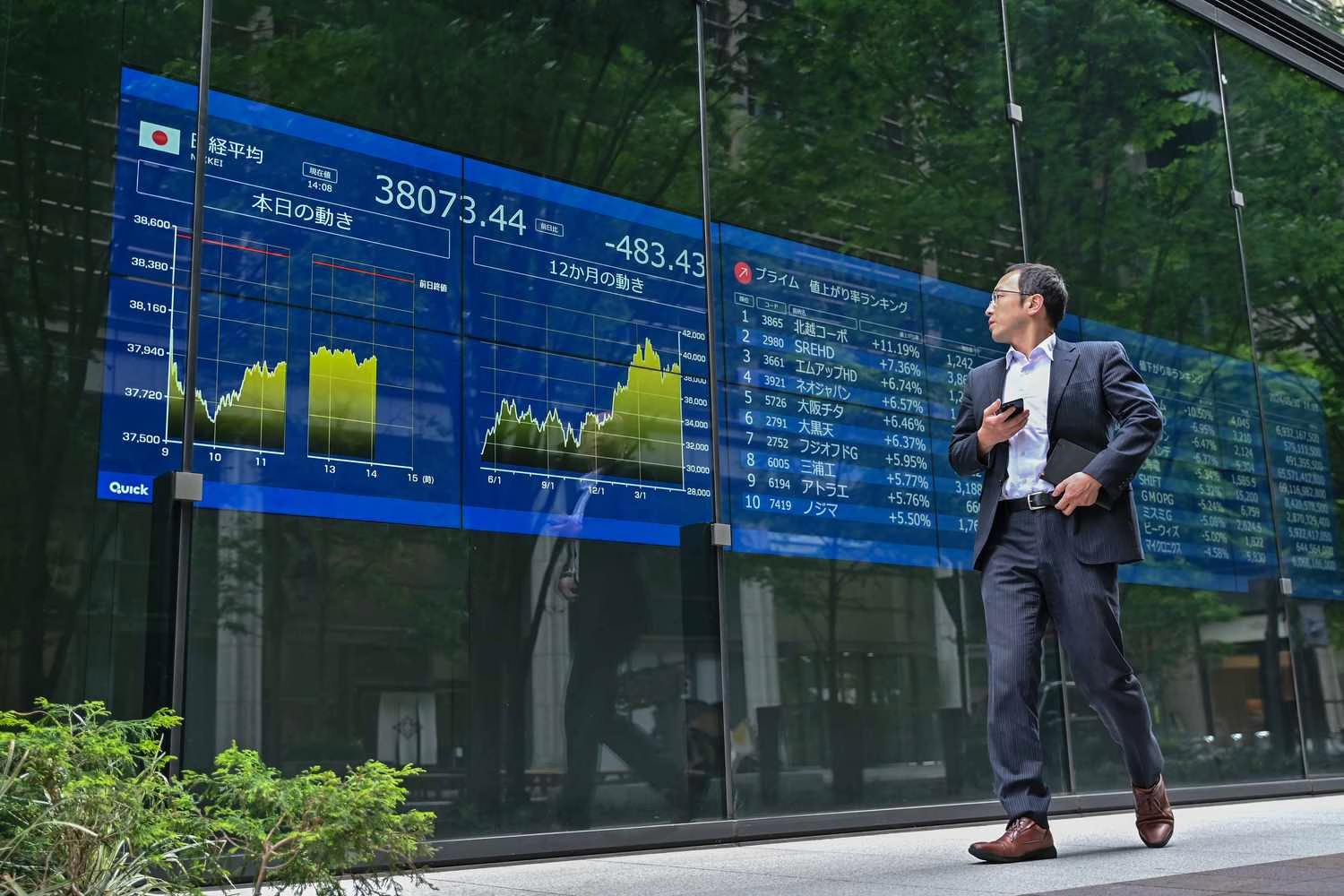

The Nikkei 225, often referred to simply as the Nikkei, is Japan’s most prominent stock market index. Just as the S&P 500 reflects the U.S. market and the FTSE 100 represents the UK, the Nikkei 225 is a vital indicator of the Japanese economy and the broader performance of companies listed on the Tokyo Stock Exchange (TSE).
For investors, analysts, and global market watchers, understanding the Nikkei 225 is essential for gaining insight into Asia’s second-largest economy. This article will explore what the Nikkei 225 is, how it’s calculated, its key components, performance history, and how to invest in it.
What Is the Nikkei 225?
The Nikkei 225 Stock Average is a price-weighted stock market index of the 225 most liquid and representative stocks traded on the Tokyo Stock Exchange. It was first introduced in 1950 and is maintained by Nihon Keizai Shimbun (The Nikkei newspaper).
Unlike many modern indices (which are market capitalization-weighted), the Nikkei 225 is similar to the Dow Jones Industrial Average (DJIA) in that it gives more weight to companies with higher share prices rather than those with larger overall market value.
Key Features of the Nikkei 225
- Number of Companies:
225
- Weighting Method:
Price-weighted
- Currency:
- Tracked Exchange:
Tokyo Stock Exchange (TSE)
- Sector Coverage:
Broad — includes technology, automotive, financials, manufacturing, and more…
What Companies Are in the Nikkei 225?
The Nikkei 225 includes companies across a wide range of industries. Some of Japan’s most iconic and globally recognized corporations are part of this index.
Notable companies in the Nikkei 225 include:
- Toyota Motor Corporation – Global leader in automotive manufacturing
- Sony Group Corporation – Electronics, gaming, and entertainment giant
- SoftBank Group – Conglomerate with investments in tech and telecom
- Honda Motor Co. – Major automobile and motorcycle manufacturer
- Nintendo Co. Ltd. – Iconic video game company
- Panasonic Holdings – Electronics and home appliances
- Hitachi Ltd. – Diversified tech and industrial firm
- KDDI Corporation – Telecommunications provider
- Fast Retailing Co. Ltd. – Parent company of Uniqlo
- Keyence Corporation – Automation and electronics
Together, these companies represent the backbone of Japan’s industrial and technological landscape.
How Is the Nikkei 225 Calculated?
The Nikkei 225 is a price-weighted index, meaning that companies with higher stock prices have more influence on the index, regardless of their overall market size.
Calculation Formula:
Nikkei 225 = Sum of Adjusted Stock Prices ÷ Divisor
The divisor is adjusted to maintain continuity when there are stock splits, dividends, or changes in index components. The use of a price-weighted method means that a company trading at a higher price will affect the index more than a company with a lower price, even if the latter has a higher market capitalization.
Sector Representation
The Nikkei 225 is well-diversified across major sectors in Japan’s economy:
- Industrials
- Technology
- Consumer goods
- Healthcare
- Financials
- Materials
- Telecommunications
While the index offers broad exposure, it has a notable tilt toward technology and manufacturing, reflecting Japan’s economic strengths.
Historical Performance of the Nikkei 225
The Nikkei 225 has a long and storied history, reflecting Japan’s economic highs and lows over the decades.
Key Milestones:
- 1980s Boom:
The Nikkei surged during Japan’s asset price bubble, reaching an all-time high of 38,957 points on December 29, 1989.
- 1990s Collapse:
The bubble burst in the early 1990s, leading to a prolonged period of stagnation known as the “Lost Decade.”
- 2000s Recovery Attempts:
The index remained volatile due to domestic deflation and global crises.
- 2010s Abenomics Rally:
Under Prime Minister Shinzo Abe’s economic reforms, the Nikkei saw renewed growth.
- 2020 COVID-19 Impact:
Like most global indices, the Nikkei dropped sharply in March 2020 but recovered quickly.
- 2023–2025:
The Nikkei 225 approached and, in early 2024, surpassed its 1989 peak for the first time in over 30 years.
Nikkei 225 vs. Other Major Indices
| Feature | Nikkei 225 | S&P 500 | FTSE 100 | Dow Jones (DJIA) |
| Country | Japan | United States | United Kingdom | United States |
| Companies | 225 | 500 | 100 | 30 |
| Weighting | Price-weighted | Market-cap weighted | Market-cap weighted | Price-weighted |
| Sector Focus | Tech, industrials | Broad, tech-heavy | Energy, finance | Blue-chip, mixed sectors |
| Currency | Japanese yen (JPY) | US dollar (USD) | British pound (GBP) | US dollar (USD) |
The Nikkei is unique in its calculation and its strong focus on manufacturing, tech, and export-oriented companies, which gives it different risk and reward characteristics compared to Western indices.
How to Invest in the Nikkei 225
Although you can’t invest directly in an index, several financial products offer exposure to the Nikkei 225:
1. Exchange-Traded Funds (ETFs)
Popular ETFs that track the Nikkei 225 include:
- iShares Nikkei 225 ETF
- MAXIS Nikkei 225 ETF
- Nomura Nikkei 225 ETF
These ETFs are often available on Japanese exchanges and sometimes through international platforms.
2. Mutual Funds
Some actively managed mutual funds invest primarily in Nikkei 225 companies or broader Japanese equities.
3. Derivatives
For more advanced investors, Nikkei 225 futures and options are traded on the Osaka Exchange (JPX), allowing for speculation, hedging, or leveraged exposure.
4. American Depositary Receipts (ADRs)
Many Nikkei 225 companies are available as ADRs on U.S. exchanges (e.g., Toyota, Sony, and SoftBank), making it easier for U.S. investors to gain exposure.
Pros and Cons of Investing in the Nikkei 225
✅ Pros:
- Exposure to Japan’s leading companies
- Strong representation of global exporters
- Historically undervalued compared to Western markets
- Diversification from U.S. and European equities
❌ Cons:
- Price-weighted index may not reflect true market dynamics
- Currency risk for non-JPY investors
- Economic stagnation and demographic challenges in Japan
- Lower dividend yields compared to some Western indices
Nikkei 225 and the Japanese Economy
Japan’s economy is characterized by innovation, technology, and strong global trade ties. The Nikkei 225 closely mirrors these strengths but also reflects long-term challenges like an aging population and low inflation.
In recent years, reforms in corporate governance, increased foreign investment, and digital transformation have contributed to a more optimistic outlook for Japanese equities.
Final Thoughts
The Nikkei 225 is more than just a stock market index—it is a historical, economic, and financial symbol of Japan’s post-war recovery, its industrial might, and its ongoing journey through global economic cycles.
For investors looking to diversify into Asian markets or gain exposure to global technology and manufacturing leaders, the Nikkei 225 is a compelling option. While it operates differently from Western indices due to its price-weighted structure, it offers valuable insight and potential growth in a changing global economy.
For more updates, visit https://tradingmarketsignals.com/

Tradingmarketsignals serves as the definitive digital ecosystem for the modern wealth management community. As a premier source of intelligence, it delivers high-level analysis, regulatory updates, and technological insights tailored specifically for independent financial advisors, RIA leaders, and investment professionals.